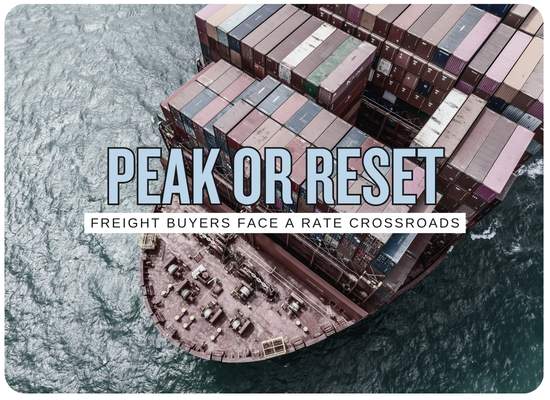
The $4,547 Container Question: Are Spot Rates Peaking or Just Resetting for Peak Season?
🔔 Subscribe to ShipUniverse Weekly →
One softer week does not settle the freight market
The $4,547 container number matters because it lands at an awkward point in the cycle. Rates are high enough to strain budgets, but the latest dip is small enough that it could be a pause rather than a reversal. Cargo owners need a strategy that works in both directions.
The procurement read
A 2% decline should change behavior, not trigger a full strategy reversal. The smarter response is to separate cargo by urgency, benchmark lanes separately, and watch whether capacity is actually opening.
The $4547 question
A small dip after a fast run-up is not the same as a market rollover. It can mean demand is easing. It can also mean carriers are testing the ceiling before the next general rate increase, peak-season surcharge, blank sailing round, or routing change. The danger for cargo owners is reacting too simply: locking too much freight if rates soften, or waiting too long if space tightens again.
The sharper read is that the container market may be shifting from a pure rate-rally phase into a strategy phase. Freight teams now need to compare the next sailing window, not just the next index print. If bookings are accepted, equipment is available, quote validity improves, and premium offers fade, the dip may have teeth. If space remains selective, surcharges stick, and blank sailings continue, the market may be resetting at a higher peak-season floor.
Procurement takeaway: A 2% dip does not justify abandoning protection for urgent cargo. It does justify challenging premiums, retesting quotes, splitting volume, and slowing non-urgent bookings where inventory allows.
8 signals that separate a peak from a reset
Booking acceptance starts improving
The most important signal is not the quoted rate. It is whether carriers and forwarders confirm bookings without escalation. A dip with improving acceptance suggests capacity is opening. A dip with continued booking friction suggests the market is still tight below the surface.
- Peak signal Standard bookings confirm faster and fewer containers require premium treatment.
- Reset signal Quotes look softer, but space still requires escalation or carrier approval.
- Buyer action Track requested bookings against confirmed bookings by lane and provider.
- Forwarder angle Show customers the difference between quoted rate and executable space.
Premium space loses pricing power
Premium service is often the market’s pressure gauge. If premium offers disappear or get discounted, carriers may be losing urgency. If premium remains the practical way to secure a sailing, the headline dip may be cosmetic.
- Peak signal Premium offers fall, standard service becomes usable, and forwarders stop pushing urgency.
- Reset signal Premium remains common even after the benchmark softens.
- Buyer action Reserve premium only for customer-critical, margin-protected, or production-critical cargo.
- Forwarder angle Build premium approval logic into quotes instead of using premium as the default.
Blank sailings stop stacking
Blank sailings can turn a softening rate into a temporary illusion. If carriers remove sailings while demand is still active, usable capacity tightens and rates can hold at a higher floor. A true peak usually needs cancellation pressure to ease.
- Peak signal Fewer cancellations, better sailing continuity, and more predictable rollover outcomes.
- Reset signal Blank sailings keep enough pressure on space to protect carrier pricing.
- Buyer action Watch the next five weeks of sailings, not just the next quote.
- Forwarder angle Price the risk of missing the first available sailing into customer options.
Surcharges start failing
General rate increases and peak-season surcharges are only useful if they stick. When carriers announce increases but forwarders can negotiate them down quickly, the market is losing upward force. If surcharges hold across lanes, the rate floor may be resetting even if the index dips.
- Peak signal New surcharges are delayed, discounted, narrowed, or removed after customer pushback.
- Reset signal Surcharges stick and rate validity remains short.
- Buyer action Challenge all-in cost, not just base ocean freight.
- Forwarder angle Break quotes into base rate, surcharge, premium, D&D risk, and validity window.
Inventory frontloading runs out of fuel
Peak-season pressure may have started early because cargo owners pulled shipments forward. If warehouses are stocked and future purchase orders slow, rates can soften. If tariff deadlines, retail programs, or production needs keep cargo moving, the market can reset around a higher level.
- Peak signal Import programs slow after early cargo arrives and buyers resist more premium freight.
- Reset signal Frontloading continues because tariff, fuel, or disruption risk remains unresolved.
- Buyer action Compare freight urgency against inventory coverage and sell-through risk.
- Forwarder angle Ask customers which volumes are firm purchase orders and which are defensive over-ordering.
Equipment availability improves at origin
Ocean space is only part of the freight decision. If containers, high cubes, reefers, chassis, or inland pickup windows remain tight, shippers may still pay more to protect cargo. Better equipment availability is one of the cleaner signs that the market is loosening.
- Peak signal Empty release becomes easier and suppliers stop missing stuffing windows.
- Reset signal Equipment remains tight even as rate indexes soften.
- Buyer action Confirm box availability before delaying a booking for a lower rate.
- Forwarder angle Quote equipment certainty separately from ocean price where needed.
Transit reliability starts recovering
Rates may ease while schedules remain poor. That can leave shippers with lower freight invoices but higher inventory, detention, customer, and warehouse costs. A real market improvement should show up in schedule reliability, fewer rollovers, and less destination congestion.
- Peak signal Fewer rollovers, cleaner ETAs, less dwell, and more reliable arrival windows.
- Reset signal Rates dip but congestion and unreliable arrival timing keep total landed cost high.
- Buyer action Measure total delay cost, not just ocean freight movement.
- Forwarder angle Give clients options by cost and reliability, not only by lowest quote.
Quote validity gets longer
Short validity windows are a sign that providers do not trust the rate to hold. If quote validity expands and revalidation language softens, procurement teams may have more room to negotiate. If quotes remain same-day or subject to final carrier confirmation, the market is still unstable.
- Peak signal Quotes stay valid longer and providers stop forcing immediate approval.
- Reset signal Rate sheets still expire quickly or carry heavy exceptions.
- Buyer action Speed up approvals for urgent cargo but delay flexible cargo when quote discipline improves.
- Forwarder angle Use clear validity language so customers understand the cost of hesitation.
Peak or reset decision table
| Market signal | Peaking interpretation | Resetting interpretation | Procurement move | Forwarder move |
|---|---|---|---|---|
| 2% index dip | Upward momentum is cooling after the early surge. | Small pause before carriers test another rate floor. | Retest quotes, but protect urgent cargo. | Offer two-case pricing instead of one fixed call. |
| Blank sailings | Fewer cancellations suggest more usable space. | Continued blanking supports a higher rate floor. | Check the next two sailing windows before delaying cargo. | Show customers rollover risk by lane. |
| Premium space | Discounted premium suggests urgency is fading. | Persistent premium means standard space is still weak. | Use premium only for high-value deadlines. | Separate standard, protected, and premium service tiers. |
| Equipment availability | More boxes at origin support softer rates. | Equipment tightness keeps practical capacity constrained. | Confirm equipment before chasing a lower quote. | Quote box availability and ocean space together. |
| Surcharge behavior | Failed GRIs and PSS discounts point to a top. | Sticky surcharges show carriers still have leverage. | Challenge all-in cost and audit invoices. | State surcharge assumptions clearly in every quote. |
| Customer demand | Frontloading fades and future booking volume slows. | Tariff, fuel, disruption, or retail pressure keeps cargo moving. | Split urgent, planned, and flexible cargo pools. | Ask clients for firm versus optional volume forecasts. |
Practical test: Treat the dip as real only when rate softness appears together with easier bookings, longer quote validity, fewer blank sailings, weaker premium pricing, and better equipment availability.
Strategy by shipper position
| Shipper position | Best action now | Rate risk | Service risk | Buying posture |
|---|---|---|---|---|
| Urgent peak-season cargo | Protect sailing space and equipment first, then negotiate extras. | Moderate | High | Book protected space |
| Flexible replenishment cargo | Retest quotes and delay if inventory coverage is comfortable. | Improving | Manageable | Use spot selectively |
| Low-margin goods | Avoid premium unless customer penalties exceed the added cost. | High margin risk | Depends on deadline | Wait or use alternate routing |
| Contracted base volume | Audit acceptance, surcharges, free time, and rollover behavior. | Contract dependent | Allocation dependent | Use contract leverage |
| Forwarder-managed cargo | Request scenarios instead of a single rate quote. | Watch | Provider dependent | Compare standard, protected, and premium options |
Procurement playbook for the next rate move
- ① Build a cargo urgency ladder with production-critical, customer-committed, seasonal, replenishment, low-margin, and flexible cargo separated before quotes are requested.
- ② Requote lanes weekly because a composite index can hide differences between Transpacific, Asia-Europe, Mediterranean, and secondary port pairs.
- ③ Keep contract volume honest by checking whether the carrier is actually accepting bookings at the contracted rate.
- ④ Challenge premium offers unless the cargo has a clear customer, margin, inventory, or production reason to justify the upgrade.
- ⑤ Watch blank sailings as capacity math because a softer rate with fewer sailings may still be a tight market.
- ⑥ Audit surcharge language before approving peak-season, fuel, congestion, canal, war-risk, equipment, or emergency charges.
- ⑦ Use index-linked clauses carefully when buyers and forwarders need a middle path between fixed contracts and volatile spot exposure.
- ⑧ Prepare a rate reset memo for finance showing the trigger that would shift more cargo to spot, contract, premium, or deferred movement.
The decision gate after a small weekly dip
A 2% decline should not create a one-size-fits-all decision. Use a gate that matches buying action to the cargo’s business risk.
- Protect: Cargo tied to customer penalties, production risk, launch windows, or high-margin sales.
- Negotiate: Cargo that needs to move but does not require premium service.
- Retest: Flexible cargo where quote validity is improving and equipment is available.
- Delay: Low-margin or replenishment cargo with enough inventory coverage.
- Audit: Every surcharge, premium charge, rollover fee, and rate-validity exception.
Rate dip strategy calculator
This planning screen helps cargo owners and forwarders decide whether a small rate dip should trigger immediate booking, negotiation, or delay. It is not a freight quote.
Peak or reset buying screen
Adjust the inputs to test whether waiting for lower rates is worth the delay and rollover risk.
Planning note: This simplified screen does not include inland drayage, detention, demurrage, warehouse overflow, customs holds, lost sales, cargo damage, inventory financing, or contract penalties. Use it as a first-pass procurement discussion tool.
Common mistakes after the first rate dip
| Mistake | Result | Better freight move | Priority |
|---|---|---|---|
| Assuming the top is in | Critical cargo waits and then faces tighter space or higher premium cost. | Wait only on cargo with real schedule flexibility. | High |
| Booking everything immediately | Flexible cargo misses a chance to benefit if rates keep softening. | Protect urgent freight and retest non-urgent lanes. | Medium high |
| Ignoring quote validity | Internal approval delay turns a good quote into an expired quote. | Create fast approval thresholds by volume and rate spread. | High |
| Comparing only the composite index | Lane-specific pressure gets hidden by the average. | Benchmark each trade, destination, equipment type, and service tier separately. | Medium high |
| Skipping surcharge audit | A lower base rate still produces a higher invoice. | Compare all-in cost including PSS, bunker, congestion, war risk, equipment, and D&D. | High |
| No written recovery plan | Forwarders and procurement teams make one-off decisions under pressure. | Document triggers for booking, waiting, premium use, alternate routing, and escalation. | Watch |
The procurement mindset shift
The $4,547 rate level should not be treated as a simple buy or wait signal. It should be treated as a market test. If the dip is backed by better booking acceptance, longer quote validity, weaker premiums, fewer blank sailings, and more equipment availability, freight buyers can push harder. If those signals stay tight, the market may only be pausing before settling into a higher peak-season floor.
Forwarders can add real value by helping customers avoid binary thinking. Instead of telling shippers the rate is up or down, they should show which cargo deserves protected space, which cargo can wait, and which surcharges or premiums deserve challenge. In a market this jumpy, freight intelligence is not the rate itself. It is knowing which decision the rate should trigger.
We welcome your feedback, suggestions, corrections, and ideas for enhancements.
Please click here to get in touch