
🔔 Subscribe to ShipUniverse Weekly →
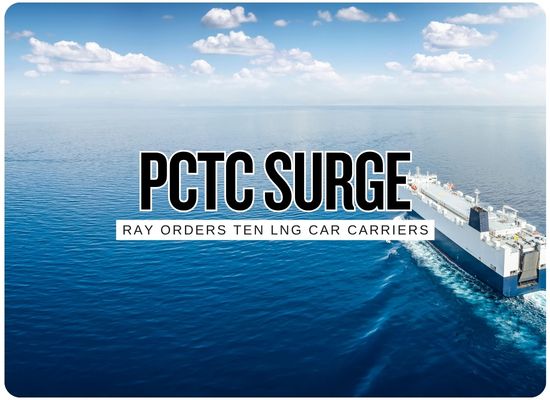
Ray Car Carriers’ move into China for a $1 billion-plus batch of LNG dual-fuel car carriers looks like more than another large order in a hot sector. It points to a market where vehicle-export demand, yard slot pressure, charter backing and fuel-ready ship designs are pulling established tonnage providers toward Chinese builders at scale. The ten firm 8,200 CEU PCTCs at Guangzhou Shipyard International are expected for delivery between 2029 and 2031, giving Ray a larger vessel class than its existing Hyundai-linked newbuilds and giving GSI another headline order in a segment China is quickly learning to dominate. The commercial signal is straightforward: the car-carrier market still needs capacity, owners want LNG dual-fuel flexibility, and Chinese yards are no longer just filling the gaps. They are winning the big fleet programs.
Car-Carrier Ordering Is Moving Deeper Into China
The Ray-linked order gives GSI a ten-ship LNG dual-fuel PCTC series and shows how fast Chinese yards are becoming central to the vehicle-carrier fleet cycle.
$1B-Plus Newbuilding Program
Ten firm 8,200 CEU LNG dual-fuel PCTCs create a major multi-year orderbook block for deliveries between 2029 and 2031.
China Yard Shift
Ray has long leaned toward South Korean shipyards, so the GSI move is a visible signal that Chinese builders are winning more premium PCTC work.
Capacity Backed by Export Demand
Chinese vehicle exports continue to stretch global car-carrier capacity, keeping modern PCTCs highly relevant even as new tonnage is ordered.
LNG Dual-Fuel Becomes Baseline
The latest high-value PCTC orders continue to favor LNG dual-fuel designs, with owners buying fuel flexibility and regulatory optionality.
2029-2031 Delivery Risk
The order helps the long-term fleet picture, but it does not solve near-term tonnage tightness, charter pressure or cargo overflow into containers.
The operating signal is that PCTC owners are no longer just chasing vessel count. They are chasing yard slots, fuel-ready specifications, charter-backed economics and exposure to the next wave of global vehicle exports.
Ray Car Carriers PCTC Order Board
The order ties together Chinese yard capacity, vehicle-export growth, LNG dual-fuel propulsion, long-term charter economics and the next wave of car-carrier fleet renewal.
The strongest read is that this order changes the supplier map as much as it changes Ray’s fleet plan. GSI gets another large LNG dual-fuel PCTC series, Ray gains later-decade capacity at a competitive cost base, and the market gets another sign that Chinese yards are becoming trusted builders for high-capacity vehicle carriers.
Firm LNG dual-fuel PCTCs under the newly disclosed GSI and China Shipbuilding Trading contract.
Nominal capacity of each vessel in the signed contract.
Minimum disclosed contract value, implying more than $100 million per ship.
Expected delivery window for the ten firm vessels.
Commercial Signal Table
| Signal | Latest Detail | Commercial Read | Stakeholders | Status |
|---|---|---|---|---|
| Firm order | GSI and China Shipbuilding Trading signed for ten 8,200 CEU LNG dual-fuel PCTCs. | A ten-ship block is large enough to affect Ray’s long-term capacity profile and GSI’s standing in vehicle-carrier construction. | Ray Car Carriers, GSI, CSSC, charterers, lenders | Very High |
| Buyer identification | CSSC did not name the buyer, while trade reports identify Ray Car Carriers as the owner behind the contract. | The filing confirms the contract. The Ray name comes from shipbroking and trade-press identification, so that distinction matters. | Owners, brokers, analysts, investors | Watch |
| China yard breakthrough | Ray is reported to be making its first major newbuilding move into China after years of South Korea-focused ordering. | Chinese yards are now competing for established international tonnage providers, not only domestic or state-linked buyers. | Chinese yards, Korean yards, brokers, equipment suppliers | High |
| Cost signal | The minimum value works out above $100 million per vessel. | The per-ship price looks competitive against recent high-spec PCTC pricing and may explain why large batches are moving to China. | Owners, lenders, yards, charterers | Medium |
| Fleet scale | Ray is reported to have about 66 car carriers on the water, plus seven LNG dual-fuel PCTCs already under construction at HD Hyundai. | The GSI order adds a major later-decade growth layer on top of an already active renewal program. | Ray, charterers, OEM customers, ship managers | High |
| Largest Ray car carriers | The new ships are reported to be larger than Ray’s current and contracted South Korean PCTCs. | Ray is moving toward bigger long-haul export capacity, likely aimed at deep-sea vehicle flows and mixed rolling cargo. | Automakers, RoRo operators, port terminals, cargo planners | Positive |
| Options potential | Trade reports point to four optional vessels, though the public CSSC filing covers only ten firm ships. | If declared, options would lift the program from a major order to a fleet-shaping series. | Ray, GSI, suppliers, charterers | Watch |
| Charter backing | Earlier market reports said the ships were expected to have long-term charter support. | Charter coverage is critical because late-decade delivery slots need predictable employment to justify billion-dollar capital exposure. | Charterers, owners, lenders, brokers | Medium |
| GSI’s PCTC position | GSI has rapidly built its car-carrier track record, including delivery of very large LNG dual-fuel PCTCs. | The yard is moving from challenger to mainstream builder in one of shipping’s most attractive specialized sectors. | GSI, CSSC, engine makers, cargo-system suppliers | Positive |
| Market timing | Vehicle exports and PCTC charter demand continue to support a newbuilding rebound. | The order lands in a market where new capacity is needed, but late deliveries mean near-term tightness is not solved quickly. | Automakers, shipping lines, exporters, car terminals | High |
PCTC Newbuild Order Economics Tool
Estimate fleet capacity, capital cost, charter-backed revenue and break-even pressure for a large LNG dual-fuel PCTC newbuilding program.
Total car-carrying capacity across the firm ships.
Estimated capital cost across firm vessels.
Estimated annual operating earnings before financing.
EBITDA compared with estimated annual financing cost.
The modeled program has enough utilization, charter coverage and modern-vessel premium to support the capital commitment.
Track options and charterersThis tool is for editorial and commercial sensitivity only. It does not replace shipbuilding contracts, audited financing terms, charter-party terms, vessel valuations, broker guidance, fuel-price curves, class review, delivery schedules or professional investment diligence.
We welcome your feedback, suggestions, corrections, and ideas for enhancements.
Please click here to get in touch