
🔔 Subscribe to ShipUniverse Weekly →
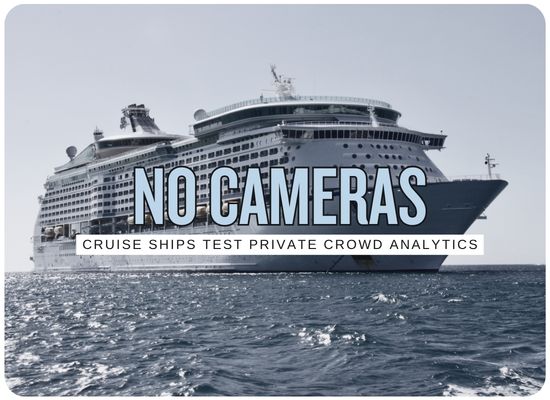
5,000 guests. No cameras. Real crowd intelligence.
AIDA’s Innovation Hub has put camera-free passenger-flow analytics into the cruise spotlight. The commercial value is clear: shorter queues, smarter staffing, safer crowd release, better venue planning and fewer privacy concerns.
The short version
The cruise buyer does not need a single “tracking” product. The better fit is a layered system: broad Wi-Fi flow signals, precise sensors at choke points, opt-in tags for children or crew, and software that turns movement into staffing, safety and revenue decisions.
8 technologies competing onboard
Broad shipwide patterns
Useful for zone heat maps, dwell time, repeat routes and venue pressure where modern access-point coverage already exists.
Opt-in guests, crew and assets
Works through wristbands, badges, phones or tags for children, crew, safety teams and equipment.
Precision zones
Higher-accuracy location for crew safety, restricted areas, evacuation support and high-value asset tracking.
Dense public spaces
Strong for queues, atriums, gangways, theatres and corridors without facial video.
Doorway counts
Depth sensing counts bodies crossing entries, exits and choke points, independent of phone carriage.
Privacy-heavy occupancy
Radar-based presence and people counting can work in low light and sensitive areas without images.
Guest intent
Searches, maps, event reminders and venue lookups reveal demand before guests arrive at the bottleneck.
The decision layer
Combines sensors into dashboards for staffing, queue alerts, venue planning, safety and revenue analysis.
Technology fit matrix
| Technology | Best Cruise Use | Accuracy | Privacy Position | Buyer Fit |
|---|---|---|---|---|
| Wi-Fi analytics | Shipwide heat maps, dwell, venue pressure | Zone level | Strong when identifiers are minimized | Modern AP coverage is already installed |
| BLE | Children, crew, assets, wayfinding | Zone to room level | Best with opt-in tags or badges | Known people or assets need location |
| UWB | Restricted zones, crew safety, evacuation | High precision | Good for controlled tag programs | Accuracy beats coverage |
| 3D LiDAR | Queues, gangways, theatres, atriums | High spatial accuracy | No facial imagery needed | Real-time crowd density matters |
| Time-of-Flight | Doors, venue entries, tender lobbies | Strong at fixed points | Geometry, not identity | Clean counts come first |
| mmWave radar | Occupancy, restrooms, crew spaces, energy control | Medium to strong | No images captured | Camera sensitivity is high |
| App telemetry | Wayfinding, event demand, accessibility routes | User dependent | Consent-led | The cruise app has strong usage |
| Fusion platform | Dashboards, staffing, safety, revenue planning | Depends on inputs | Depends on architecture | Operations need one decision screen |
Best first buys
Camera-Free Passenger Flow ROI Tool
Estimate whether queue reduction, staffing savings and venue revenue justify a camera-free analytics pilot.
Pilot result
The practical answer
Wi-Fi gives reach. LiDAR and Time-of-Flight give better queue counts. BLE and UWB fit opt-in safety and crew workflows. Radar fits sensitive occupancy zones. App data adds intent. The strongest cruise deployment combines only the layers needed for a measurable outcome.
We welcome your feedback, suggestions, corrections, and ideas for enhancements.
Please click here to get in touch