
🔔 Subscribe to ShipUniverse Weekly →
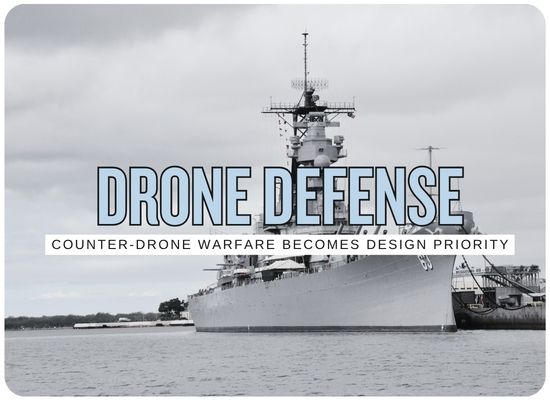
Only if it stops treating drones as single targets. The next frigate needs a layered counter-UAS stack that can find, classify, jam, shoot, burn or confuse drones without emptying its missile magazine.
The answer in 30 seconds
A swarm turns the problem from accuracy into capacity, sequencing and magazine depth.
Technically possible in small waves, economically painful in mass attacks.
Radar, RF, EO/IR, EW, guns, missiles, lasers and CMS working together.
Navantia’s evolved F-110 IAMD concept now includes a dedicated C-UAS capability.
The five-step shipboard kill chain
Detect early
AESA radar, passive RF and offboard sensors find small targets before they become close-in emergencies.
Identify fast
EO/IR and RF classification separate drones from birds, clutter, decoys and friendly aircraft.
Assign the cheapest effective layer
Jamming, guns, low-cost interceptors, lasers and missiles must be sequenced by threat and range.
Defeat in waves
The system must handle multiple simultaneous tracks, not just a single test target.
Recover the magazine
The ship needs reload logic, gun ammunition, laser cooling recovery, EW duty-cycle planning and missile reserve discipline.
10 systems behind next-generation shipboard counter-UAS
-
01
AESA radar
Small-target search and swarm track capacity
The radar must find low-RCS drones against sea clutter, land clutter, weather and friendly traffic.
Best useEarly warning and track handoff.Failure pointTrack saturation or false targets. -
02
Passive RF
Drone-link detection without lighting up the ship
RF sensors can detect control links, video links or emitters before visual confirmation.
Best useSilent cueing and classification.Failure pointAutonomous or emission-controlled drones. -
03
EO/IR
Visual ID, fire control and kill assessment
EO/IR directors confirm what the radar sees and support guns, lasers and operator decisions.
Best useConfirm, track and assess.Failure pointWeather, smoke, glare and clutter. -
04
Combat management
Sensor fusion and automated effector assignment
The CMS must merge tracks, rank threats and avoid wasting missiles on targets better handled by EW, guns or lasers.
Best useOne picture, fast decisions.Failure pointManual overload during swarm attacks. -
05
Electronic attack
Jammers and non-kinetic defeat
EW can break control, navigation or data links where drones depend on them, often at a better cost exchange than missiles.
Best useFirst defeat layer for link-dependent drones.Failure pointAutonomous drones and friendly-link conflicts. -
06
Soft kill
Decoys, deception and signature control
A swarm defense should not rely only on shooting. It also needs ways to confuse targeting and protect the ship’s signature.
Best useReduce hits and buy time.Failure pointPoor integration with CMS and EW. -
07
Guns
Programmable airburst and close-in volume fire
Guns give the frigate a lower-cost kinetic layer, especially when ammunition and fire-control software match small drones.
Best useClose and medium-close drone kills.Failure pointToo late, too few mounts or weak fire control. -
08
Missiles
Short-range interceptors and magazine discipline
Missiles still matter for drones that are fast, high-confidence hostile or outside gun and laser windows.
Best useHigh-risk targets and outer layers.Failure pointCost exchange and VLS depletion. -
09
Lasers
Deep magazine for suitable targets
Lasers are attractive because the shot cost can be low, but power, cooling, weather and dwell time decide real value.
Best useCheap repeated shots on small drones.Failure pointThermal limits, haze, rain and sea spray. -
10
HPM
High-power microwave for dense drone groups
HPM could become the swarm breaker if it can defeat electronics across multiple drones without heavy ship-integration penalties.
Best useGroup effects against electronics.Failure pointPower, safety and collateral electronic effects.
Swarm-defense scorecard
| Layer | Primary job | Best against | Weakness |
|---|---|---|---|
| AESA radar | Early detection and tracking | Inbound drones and mixed air picture | Small targets, clutter and saturation |
| Passive RF | Silent cueing and classification | Link-dependent commercial or tactical drones | Autonomous drones with low emissions |
| EO/IR | Identification and fire control | Close visual confirmation and kill assessment | Weather and visibility |
| EW/jamming | Non-kinetic defeat | Control-link, GNSS or datalink-dependent drones | Autonomy and spectrum conflicts |
| Guns | Low-cost kinetic layer | Drones inside effective gun range | Reaction time and fire-control quality |
| Missiles | High-confidence hard kill | Fast or high-risk targets | Cost and magazine depth |
| Lasers | Low-cost repeated engagement | Small drones in suitable weather | Power, cooling and dwell time |
| High-power microwave | Area electronic defeat | Dense groups of small drones | Integration, safety and effects control |
Procurement heat map
What Navantia’s F-110 Flight II signals
The important detail is not simply that a dedicated C-UAS capability appears on an evolved frigate concept. It is that C-UAS is becoming part of the frigate design brief, not a bolt-on afterthought.
| Design signal | Meaning for future frigates | Supplier opening |
|---|---|---|
| Dedicated C-UAS capability | Drone defense is now a named frigate requirement. | C-UAS sensors, jammers, effectors and CMS software. |
| IAMD framing | Drones sit inside the wider air-and-missile defense picture. | Track fusion, threat ranking and layered engagement logic. |
| SPY-7 and SCOMBA integration | Counter-drone performance depends on combat-system integration. | Aegis/SCOMBA interfaces, test centers and fire-control software. |
| Digital twin and smart-ship baseline | Future upgrades can be modeled, tested and supported digitally. | Simulation, digital testing, lifecycle analytics and software updates. |
Frigate Swarm Survival Meter
Use this quick screen to judge whether a frigate has a credible layered counter-UAS posture.
This is a practical screening aid, not tactical advice. Real ship-defense planning depends on classified threat data, ship class, rules of engagement, electronic-warfare limits, missile loadout, weather, sensors, crew training and fleet support.
Bottom line
A frigate survives 100 cheap drones only if it has more than a missile-defense system. It needs a counter-UAS architecture. Navantia’s F-110 Flight II signal matters because C-UAS is moving into the frigate design conversation itself. The high-value spend is clear: sensors, RF detection, EO/IR, electronic attack, guns, low-cost interceptors, directed energy, combat-management software, testing and crew training.
We welcome your feedback, suggestions, corrections, and ideas for enhancements.
Please click here to get in touch