COSCO’s $3 Billion Boxship Order Turns Fleet Renewal Into a Capacity Race
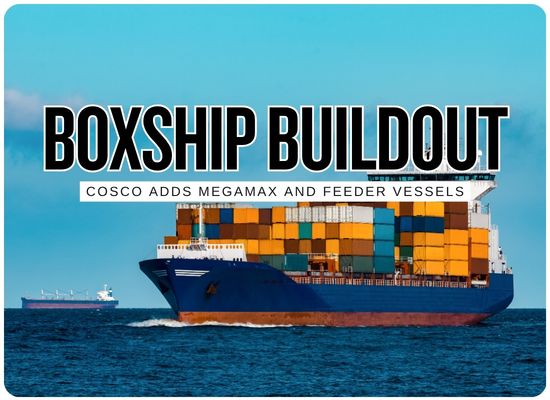
COSCO Shipping Holdings has committed nearly $3 billion to another round of containership newbuildings, ordering 18 vessels from Chinese shipyards under the CSSC group. The package includes 12 LNG dual-fuel 22,000 TEU class ships at Shanghai Waigaoqiao Shipbuilding and six 3,200 TEU wide-beam feeder ships at Huangpu Wenchong. The contracts are valued at about RMB20.27 billion, or roughly $2.99 billion, with deliveries scheduled between 2028 and 2030. The latest order lifts COSCO’s 2026 containership contracting to 48 vessels, about 676,800 TEU, and approximately $8 billion of total investment.
Ship Universe Fleet Strategy Watch
Operator Impact Snapshot
COSCO is adding mainline scale and feeder reach in the same order cycle.
$3B fleet signal
The latest package adds 18 ships and nearly $3 billion of contracted value, making it one of the strongest liner investment signals of the week.
Megamax scale returns
The 12 LNG dual-fuel 22,000 TEU class ships point directly at large east-west trades where slot cost, fuel flexibility and schedule density matter.
Feeder ships fill the network
The six 3,200 TEU wide-beam vessels show that COSCO is not only buying headline capacity. It is also reinforcing regional cargo collection.
LNG becomes central
COSCO’s 2026 ordering is now heavily weighted toward LNG dual-fuel tonnage after earlier emphasis on methanol and conventional propulsion.
Orderbook pressure builds
The global containership orderbook is already above 40% of the existing fleet, raising the risk of too much capacity landing after disruption fades.
U.S. route exposure remains
Chinese-owned, operated and built ships face a separate U.S. policy headwind if deployed into American trades under Section 301 vessel-fee rules.
COSCO Fleet Board
Megamax Ships, Feeder Reach and a Larger Green-Fuel Pipeline
The latest order is both a scale play and a network-design play.
RMB20.27 billion for 18 containerships across two Chinese yard groups.
Three contracting rounds now total about RMB54.27 billion, or roughly $8 billion.
The range reflects 21,700 TEU contract intake versus 22,000 TEU class description for the larger ships.
About 3.66 million TEU in COSCO Shipping Holdings’ self-managed container fleet.
| Order Piece | Latest Detail | Strategic Reading | Commercial Risk | Signal Meter |
|---|---|---|---|---|
| 22,000 TEU Class ShipsMainline scale | Twelve LNG dual-fuel units at Shanghai Waigaoqiao, priced at $224 million each. | COSCO is reinforcing the large east-west network, especially Far East to Northwest Europe style trades. | Very large ships need strong utilization, port readiness, schedule discipline and enough demand per loop. | High |
| 3,200 TEU Wide-Beam ShipsRegional and feeder network | Six ships at Huangpu Wenchong, about $50 million each, for delivery between 2028 and 2029. | The smaller ships help feed hub ports, support regional trades and cascade cargo into the larger network. | Returns depend on feeder margins, regional cargo growth, port rotation density and charter-market alternatives. | Medium High |
| 2026 Order StackingJanuary, April and August rounds | COSCO’s 2026 total now reaches 48 ships and around 676,800 TEU. | The company is using one year to reset a large portion of its future fleet profile. | The delivery wave creates more exposure to demand timing and freight-rate normalization. | High |
| LNG Dual-Fuel ShiftFuel strategy pivot | Thirty-six of the 48 ships ordered in 2026 are LNG dual-fuel vessels. | LNG has become a major part of COSCO’s green-fleet program alongside methanol and conversions. | Future value depends on LNG pricing, methane rules, FuelEU, IMO policy, bunkering access and lifecycle emissions accounting. | High |
| Owned OrderbookPipeline scale | The latest contracts lift the owned newbuilding orderbook toward 100 ships and about 1.46 million TEU. | That is a major embedded fleet option for COSCO as charters expire and older ships are replaced. | Gross orderbook does not equal net growth if older ships are retired or chartered-in tonnage is reduced. | High |
| Global OrderbookIndustry supply risk | The world orderbook is near 13.97 million TEU and more than 40% of the existing fleet. | COSCO is ordering into a market where many competitors are also building heavily. | If Red Sea diversions, congestion and demand growth fade, new supply could pressure rates after delivery. | Severe |
| China Yard ConcentrationDomestic industrial strategy | Both vessel groups are contracted at Chinese yards under the CSSC umbrella. | The deal strengthens China’s liner, shipbuilding and state-industrial ecosystem in one transaction. | U.S. vessel-fee rules add a geopolitical cost layer if Chinese-owned, operated or built tonnage calls U.S. ports. | High |
| Delivery Window2028 to 2030 | The feeder ships arrive in 2028 to 2029, while the megamax ships deliver through 2030. | COSCO is positioning for the next cycle, not merely this year’s freight market. | The market in 2028 to 2030 may look very different if chokepoints reopen and fleet growth outruns cargo growth. | Watch |
Containership Newbuild Capacity and Overcapacity Tool
Model the latest COSCO order against fleet size, replacement assumptions, demand growth and market overcapacity risk.
Latest Added Capacity
279,600 TEU
Capacity from the latest megamax and feeder ship order.
Latest Order Value
$2.99B
Estimated contract value based on selected ship counts and unit prices.
Owned Orderbook After Latest Order
1.46M TEU
Existing owned orderbook plus the latest newbuilding package.
Net Growth After Offsets
153,780 TEU
New capacity remaining after replacement or charter-offset assumption.
Fleet Strategy Signal
The model shows a large fleet-renewal program with real expansion pressure, but replacement and charter offsets can soften the net capacity impact.
We welcome your feedback, suggestions, corrections, and ideas for enhancements.
Please click here to get in touch