
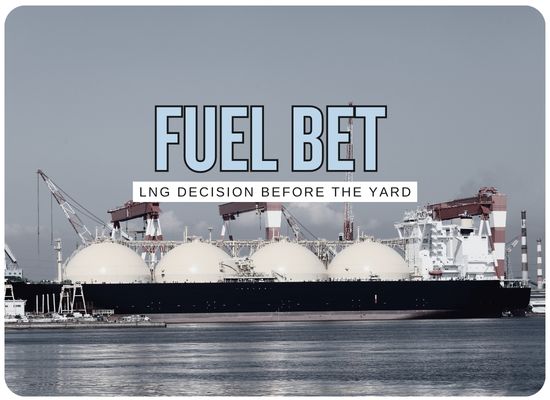
Should Your Next Ship Still Be LNG Dual-Fuel? 10 Numbers to Run Before Signing a Newbuild Contract

2027 Newbuild Decision

Should Your Next Ship Still Be LNG Dual-Fuel? 10 Numbers to Run Before Signing a Newbuild Contract

Höegh Autoliners ordering six more LNG dual-fuel Aurora-class car carriers is a reminder that the LNG pathway is still winning real newbuild money and that is why we keep coming back to it. The decision doesn't need to be about a culture war between “bridge fuel” and “stranded asset.” It can be made as a spreadsheet with ten numbers: fuel spread, methane slip, tank-space penalty, FGSS capex, bunkering coverage, bio-LNG access, FuelEU exposure, residual value, retrofit flexibility and vessel lifetime.

Contract timing 2027 orderbook test
Core bet LNG today, bio-LNG later
Main risk Methane slip plus fuel spread
Best buyer Route-backed owner
LNG wins when

Fuel, ports and customers line up

The strongest case is a long-lived vessel on trades with reliable LNG bunkering, charterer support and a believable low-GHG methane pathway.

LNG is marginal when

The ship needs optionality

If the owner is unsure about trade, fuel availability, customer demand or methane-slip treatment, LNG-ready or future-fuel-ready design may be safer than full commitment.

LNG weakens when

The tank and slip math fail

High FGSS capex, cargo-space loss, weak bunkering coverage, poor engine slip profile and no bio-LNG plan can turn the dual-fuel premium into stranded complexity.

Run the FGSS Sizing Test

Before the LNG newbuild spec gets locked, estimate engine gas demand, pump capacity, vaporizer duty and reserve margin.

Open our LNG FGSS Tool →

The 2027 LNG decision is not the same as the 2021 decision

LNG dual-fuel newbuilds are no longer exotic. The equipment market, class knowledge, bunkering infrastructure and owner experience are far deeper than they were five years ago. That helps LNG buyers. But the commercial test is also tougher. FuelEU, EU ETS, methane-slip accounting, bio-LNG availability, residual-value uncertainty and competing methanol/ammonia-ready options mean the owner has to prove that LNG capability will earn money through the vessel’s actual life.

The biggest mistake is asking whether LNG is “good” or “bad.” LNG can be a strong newbuild choice in one trade and a weak choice in another. A PCTC with long-term customer demand, major-hub bunkering and a credible low-GHG methane pathway is a different asset from a tramp vessel with uncertain routes and no guarantee that LNG will be used often enough to recover the fuel-system premium.

Executive takeaway: LNG dual-fuel should clear three gates before a 2027 signature: the fuel economics must beat conventional fuel after methane and cargo penalties, the trade must support reliable LNG and future bio-LNG supply, and the vessel must preserve enough residual value or retrofit flexibility for a 20 to 25-year life.

10 numbers to run before signing

01

LNG price spread versus fuel oil

The first number is the expected spread between LNG and the fuel the ship would otherwise burn. Owners should model normal, high and low LNG-price scenarios by route, not use one global assumption.

Annual spread value = fuel volume × LNG use share × price spread
Fuel spread Bunker strategy TCO model
02

Methane slip exposure

The engine choice matters. High-pressure two-stroke, low-pressure two-stroke and four-stroke dual-fuel engines can produce very different methane-slip profiles. A small slip percentage can become a large FuelEU and lifetime-emissions number.

Slip cost = LNG energy × slip factor × CO₂e value or penalty proxy
Methane slip Engine selection FuelEU
03

Tank-space and cargo penalty

LNG needs more tank volume than fuel oil, and the tank type, location and safety envelope can affect cargo, range, stability and revenue. The penalty is not just steel. It is lost earning capacity.

Tank penalty = lost cargo revenue + reduced range value + layout constraint
LNG tank Cargo loss Range tradeoff
04

FGSS and cryogenic system capex

The dual-fuel premium is not only the engine. It includes tanks, fuel gas supply, bunker station, cryogenic piping, vaporizers, controls, safety systems, ventilation, detection, crew training and service support.

Dual-fuel premium = FGSS + tanks + piping + engine premium + integration
FGSS Vaporizers Cryogenic piping
05

Bunkering coverage on actual routes

LNG bunkering has expanded, but coverage still matters by vessel segment and voyage pattern. The owner should model where the ship will actually bunker, not where LNG exists in theory.

Coverage score = route ports with reliable LNG ÷ ports where the ship needs energy
Bunkering network Route fit Fuel reliability
06

Bio-LNG and e-methane availability

The long-term LNG argument increasingly depends on low-GHG methane. Bio-LNG and e-methane may be drop-in fuels for LNG-capable ships, but price, supply, certification and chain-of-custody rules can decide whether the pathway is real for a specific fleet.

Low-GHG methane value = available volume × verified GHG benefit × customer or compliance value
Bio-LNG e-methane Book-and-claim
07

FuelEU and EU ETS exposure

LNG may provide a compliance advantage early in the vessel life, but the numbers change as FuelEU intensity targets tighten and as methane slip is counted in CO₂e. Owners need annual exposure, not a single first-year compliance answer.

Regulatory exposure = EU energy × GHG intensity gap × penalty or EUA value
FuelEU EU ETS Compliance curve
08

Residual value at year 10, 15 and 20

Residual value is where the LNG debate becomes real. A dual-fuel ship may earn a premium if the low-GHG methane pathway matures. It may be discounted if buyers fear methane rules, fuel scarcity, stranded tanks or better newbuild alternatives.

Residual uplift = resale premium − stranded system discount
Asset value Secondhand market Exit plan
09

Retrofit flexibility for the next fuel decision

A 2027 newbuild should not lock the owner into one answer forever. The vessel design should be tested for future fuel-system changes, tank adaptation, carbon capture space, shore power, energy-saving devices and possible low-GHG methane upgrades.

Flexibility value = avoided future retrofit cost + preserved optionality
Future fuels Retrofit-ready Optionality
10

Useful vessel lifetime after regulation tightens

The LNG system must still make sense after 2035, not just after delivery. A ship delivering in 2029 or 2030 may trade into the 2050s. The owner should test whether LNG, bio-LNG, e-methane or later retrofit pathways keep the vessel commercially useful.

Lifetime case = years of useful premium × annual benefit − lifetime risk cost
Vessel life 2035+ Fleet renewal

Decision map by vessel profile

Newbuild profile LNG dual-fuel case Main caution Likely posture
Repeat-route PCTC, ferry, RoRo or feeder Strong if LNG bunkering, customer demand and low-GHG methane pathway are visible on the trade. Tank placement and methane-slip profile still decide lifetime value. Strong candidate
Large container vessel on major hub routes Can work if bunkering coverage is strong and cargo-space impact is designed into the commercial model. Opportunity cost of tank volume and future fuel uncertainty. Run full TCO
Tramp bulker or tanker with uncertain routes Weaker unless charterers, ports or cargo owners support LNG use. LNG may not be used enough to recover system premium. Hybrid or LNG-ready
High-EU exposure vessel Early compliance value may be meaningful, especially with lower-slip engines and future bio-LNG access. FuelEU intensity tightens, and methane slip matters more over time. Engine choice critical
Vessel with weak customer green premium Harder to justify unless fuel spread and residual value carry the economics. Owner may pay for capability that charterers do not reward. Be careful
Long-life strategic asset with optionality budget LNG may work as part of a staged pathway with bio-LNG, e-methane and retrofit readiness. The design must preserve future fuel and efficiency options. Pathway candidate

LNG dual-fuel is easier to justify when...

  • The vessel trades on routes with reliable LNG bunkering.
  • The engine has a low methane-slip profile or verified slip pathway.
  • The owner has a bio-LNG or e-methane strategy after the fossil-LNG window narrows.
  • The cargo customer values lower lifecycle emissions or green transport capacity.
  • The tank design does not damage cargo economics.

LNG dual-fuel weakens when...

  • The vessel will operate mostly on fuel oil because LNG supply is uncertain.
  • The tank takes too much earning space or range flexibility.
  • The engine slip profile creates future FuelEU pain.
  • Bio-LNG availability is theoretical, expensive or poorly documented.
  • Residual buyers may discount the ship before the owner exits.

Commercial spend behind the LNG decision

The LNG newbuild premium is an equipment and integration market, not just an engine line item

The commercial traffic around this decision is high-value because the owner is buying a complete gas-fuel architecture. That includes fuel gas supply systems, LNG tanks, bunker stations, cryogenic piping, vaporizers, controls, detection, ventilation, training, lifecycle service and future methane-slip upgrades.

Fuel system FGSS, pumps, vaporizers
Storage LNG tanks and insulation
Integration Piping, controls, GVU
Lifecycle Service and slip upgrades

Supplier opportunity map

Provider niche Owner pain High-value offer Buyer trigger
FGSS suppliers Owners need reliable pressure, temperature and gas delivery across real operating profiles. Fuel gas supply system, pumps, vaporizers, bunker station, controls and service support. Dual-fuel newbuild specification or future retrofit-ready design.
LNG tank and containment providers Tank volume can consume cargo value and constrain the general arrangement. Optimized Type C, membrane, Type B or other containment layout and safety integration. Owner needs range without killing cargo capacity.
Cryogenic piping and valve suppliers LNG systems require safe, insulated and monitored fuel-transfer paths. Double-walled piping, valves, bunker lines, ESD, detection and insulation packages. Yard wants proven package integration and class confidence.
Engine OEMs Methane-slip profile and fuel efficiency shape lifetime economics. Low-slip dual-fuel engines, verified emissions data, upgrade packages and lifecycle agreements. FuelEU exposure and asset-value protection.
Bio-LNG and e-methane suppliers Fossil LNG alone may not carry the ship through its full life. Low-GHG methane offtake, certificates, mass-balance or book-and-claim structures. Owner needs a pathway beyond 2035.
Engineering and class advisors The owner needs to compare LNG against methanol, ammonia-ready, LNG-ready and conventional designs. Concept selection, TCO modeling, safety case, fuel-readiness design and residual-value review. Board approval before signing a 2027 newbuild contract.

2027 LNG newbuild approval workflow

Use this workflow before a board signs the specification, not after the yard contract is already locked.

1 Model the fuel spread Run LNG, VLSFO/MGO, bio-LNG and high-price stress cases by route.
2 Price the ship impact Add FGSS capex, tank-space loss, yard complexity and service cost.
3 Measure methane Compare engine slip profiles and verified emissions options.
4 Check the fuel pathway Confirm LNG bunkering, bio-LNG access, certificates and supplier depth.
5 Protect exit value Test year 10, 15 and 20 resale value under multiple regulation scenarios.

LNG dual-fuel newbuild calculator

This planning screen tests whether the LNG dual-fuel premium is likely to be supported by fuel savings, regulatory value, customer premium and residual value after methane slip, tank-space loss and system capex are included.

2027 LNG newbuild decision screen

$0
Estimated lifetime LNG dual-fuel value
Calculating

Adjust the inputs to test whether LNG dual-fuel still earns its premium.

$0/year
Annual net benefit before capex and exit value

Planning note: This simplified tool does not include financing cost, tax, exact fuel-energy conversion, specific engine SFOC, exact FuelEU formula, verified methane-slip factors, EU ETS allowance prices, charterparty pass-through, vessel-specific cargo revenue, exact LNG bunker port costs, insurance, class fees, training requirements or final residual-value appraisal.

The owner mindset shift

LNG dual-fuel is still a serious option for 2027 newbuilds, but it is no longer a simple “lower carbon today” purchase. It is a long-life asset bet. The strongest orders will be those where the owner has a route, a customer, a low-slip engine, reliable LNG bunkering, a bio-LNG or e-methane pathway, and a realistic exit-value story.

The weakest orders will be those where LNG is bought as a label. If the ship rarely burns LNG, loses too much cargo space, carries a high methane-slip profile, lacks low-GHG methane access and cannot preserve flexibility for the 2040s, the dual-fuel premium may not earn back its cost. The 2027 question is not whether LNG is right for shipping. It is whether LNG is right for this vessel, this route, this engine, this fuel contract and this owner’s full investment horizon.

Feedback Welcome

We welcome your feedback, suggestions, corrections, and ideas for enhancements.

Please click here to get in touch
By the ShipUniverse Editorial Team — About Us | Contact