Maersk Sends Two Mega-Containerships Through Suez as Red Sea Comeback Gains Scale
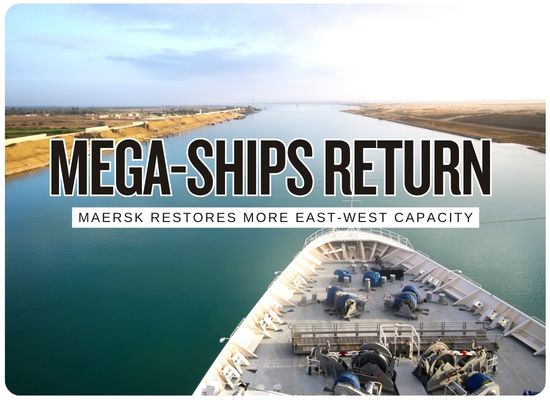
Two of Maersk's largest containerships passed through the Suez Canal in the same northbound convoy on August 22, providing the clearest sign yet that the carrier is moving larger East-West capacity back toward the Red Sea corridor. Mathilde Maersk, a 399-meter Triple E vessel with nominal capacity of about 19,000 TEU, led the convoy on its way toward Colombo and the Far East, followed by Bangkok Maersk, a 350-meter methanol-capable containership making its first Suez transit while sailing from Italy toward Singapore. The Suez Canal Authority recorded 57 vessels totaling 2.8 million net tons through the canal that day. Maersk has progressively restored selected services during 2026, including AE15, MECL, WAF6 and most recently AE19, but the carrier continues to describe the process as a gradual return rather than a complete restoration of its East-West network.
Operator Impact Snapshot
Large East-West capacity is moving back through Suez
Mathilde Maersk and Bangkok Maersk placed roughly 36,000 TEU of nominal ship capacity into the same northbound canal convoy, moving the return beyond smaller test sailings.
Suez can recover up to two weeks of voyage time
Maersk has calculated improvements of roughly seven days on some westbound services and as much as 14 days eastbound compared with Cape of Good Hope routing.
Several Maersk services have now shifted back
AE15, MECL and WAF6 were already using trans-Suez routing by mid-August, while AE19 became another Gemini service to make a structural switch from the Cape route.
This is still not a full network return
Maersk continues to assess services individually and retains contingency plans to revert vessels around the Cape if Red Sea security conditions deteriorate.
From Test Transit to Mega-Ship Deployment
The carrier's return to Suez has progressed service by service, with reversals whenever the regional security threshold changed.
| Date | Development | Service / Vessel | Network Effect | Stage |
|---|---|---|---|---|
| Dec. 18–19, 2025 | First Maersk Red Sea transit in nearly two years. | Maersk Sebarok / MECL | Initial test sailing through Bab el-Mandeb and the Red Sea. | TEST |
| Jan. 11–12 | Second successful Red Sea transit. | Maersk Denver / MECL | Expanded the stepwise return beyond a single voyage. | TEST |
| Jan. 15 | MECL structural return to trans-Suez announced. | Middle East / India to U.S. East Coast | First Maersk service formally restored to its original Suez routing. | RETURN |
| Mar. 1 | Regional conflict forces another routing reversal. | ME11 + MECL | Future trans-Suez sailings temporarily sent back around the Cape. | PAUSED |
| Jul. 6 | Gemini's AE15 service structurally shifts back through Suez. | Majestic Maersk first sailing | Major Asia-Europe Gemini capacity returns to the corridor. | RETURN |
| Jul. 9–13 | MECL restored again and WAF6 moved through the Red Sea. | MECL + WAF6 | More Maersk-operated services shift away from Cape routing. | |
| Aug. 10 | AE19 becomes another Gemini trans-Suez service. | Berlin Maersk first westbound vessel | Adds Asia, Mediterranean, Saudi Arabia and Europe capacity. | |
| Aug. 22 | Two Maersk mega-containerships transit in the same convoy. | Mathilde Maersk + Bangkok Maersk | Roughly 36,000 TEU of nominal capacity passes Suez in two ships. |
Suez vs Cape Mega-Containership Calculator
Estimate the time, bunker and vessel-capacity value of returning an Asia-Europe containership from Cape routing to the Suez Canal.
Suez Route Economics
Value created by shorter routing compared with the additional canal and Red Sea-specific costs entered above.
We welcome your feedback, suggestions, corrections, and ideas for enhancements.
Please click here to get in touch