Could Explosion Rated Rotor Sails Unlock Tanker Wind Assist?
🔔 Subscribe to ShipUniverse Weekly →
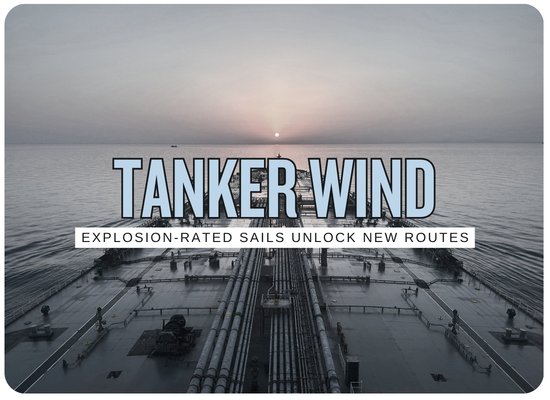
The tanker market is becoming the next serious test for wind assist
Rotor sails are no longer only a clean-deck experiment for bulkers and general cargo ships. Explosion-rated designs are pushing wind-assist technology toward tankers and chemical carriers, where hazardous zones, cargo safety, and operational restrictions make every deck-mounted system harder to approve.
The tanker deck is not an ordinary wind-assist platform
Tankers and chemical carriers look attractive for rotor sails because many have long sea passages, open deck length, high fuel burn, and growing pressure to reduce emissions intensity. But the same deck that gives rotor sails space also contains the industry’s hardest safety questions: cargo vapor, hazardous zones, manifold access, tank cleaning, inert-gas procedures, closed loading, emergency shutdowns, firefighting access, vapor return, crane reach, crew movement, and port-terminal restrictions.
That is why explosion-rated rotor sails matter. The technology is not only about putting a rotating cylinder on deck. It is about whether the complete system can be designed, installed, powered, controlled, maintained, isolated, and inspected without becoming an ignition source or a cargo-operation obstacle. For tankers, the wind-assist case is as much about risk engineering as it is about fuel saving.
Operator takeaway: Explosion-rated rotor sails could expand the tanker market for wind assist, but the owner still needs a vessel-specific safety case, class pathway, cargo-operation study, and verified savings plan before treating the project as investment-ready.
Recent tanker-focused wind-assist projects suggest the sector is moving from “can this work on tankers?” toward “which tanker designs, cargoes, routes, and hazardous-zone arrangements make the best first cases?” That shift is important for suppliers, because product tankers, chemical carriers, VLCCs, and gas carriers do not all have the same deck risk, savings profile, or commercial recovery path.
8 signals that explosion-rated rotor sails are becoming serious for tankers
Class approval is moving from concept to hazardous-zone detail
The most important shift is certification depth. General wind-assist approval helps prove structural and ship-integration principles. Explosion-rated approval goes further by addressing equipment intended for hazardous environments. That is the level of scrutiny tanker operators need before rotor sails can move beyond isolated pilots.
- Owner value A clearer class path can reduce approval uncertainty and shorten engineering cycles.
- Remaining risk Type approval does not automatically approve every vessel installation.
- Supplier opportunity EX-rated design, documentation, isolation philosophy, maintenance access, and operational restrictions become selling points.
- Decision test Can the vendor explain the difference between product certification and ship-specific integration approval?
Product and chemical tankers are a logical bridge segment
Product tankers and chemical carriers can be attractive because they often have repeat routes, strong charterer decarbonization pressure, and less extreme scale than VLCCs. They also have highly sensitive cargo-operation requirements, making them a demanding but commercially useful proving ground.
- Owner value Savings can be tested across repeat voyage patterns and charter relationships.
- Remaining risk Manifold zones, tank cleaning, cargo segregation, coating compatibility, and terminal rules can complicate installation.
- Supplier opportunity Systems that minimize deck interference and simplify maintenance access may win faster than systems with only higher claimed savings.
- Decision test Does the rotor-sail arrangement preserve cargo work, emergency access, and terminal compatibility?
VLCC projects raise the ceiling for wind assist
VLCC installations matter because they test wind assist at the largest end of the tanker market. The scale is attractive: long voyages, high fuel consumption, and strong decarbonization pressure. The challenge is equally large: deck arrangement, bridge visibility, terminal compatibility, structural foundations, emergency access, and conservative owner risk appetite.
- Owner value Large fuel burn can improve the absolute dollar value of percentage savings.
- Remaining risk The installation must survive owner, class, charterer, terminal, and oil-major vetting expectations.
- Supplier opportunity Proven tanker references can become a major commercial advantage.
- Decision test Can the project demonstrate savings without compromising vetting, terminal acceptance, or operational flexibility?
Hazardous-zone boundaries may decide the business case
The difference between installing inside, above, adjacent to, or outside a hazardous area can change the whole project. It affects equipment specification, maintenance access, cabling, power supply, controls, isolation, inspection, and cost. Owners should treat hazardous-zone mapping as an early commercial filter, not a late engineering detail.
- Owner value Early zone mapping prevents redesign and class delays.
- Remaining risk A rotor that looks well-placed for wind may be poorly placed for cargo safety or access.
- Supplier opportunity Lower profiles, access-door placement, certified components, and clear maintenance philosophy can separate credible systems from weak ones.
- Decision test Has the owner mapped every rotor, access point, cable route, enclosure, and control element against hazardous zones?
Cargo operations are the real acceptance test
Fuel saving does not matter if the rotor sail slows cargo work, blocks access, interferes with cranes or hoses, complicates tank cleaning, causes terminal objections, or creates emergency-response problems. Tanker owners should evaluate rotor sails against real port calls, not just sea passage models.
- Owner value A cargo-operation study reduces the risk of expensive retrofits that crews dislike or terminals reject.
- Remaining risk Each terminal, cargo type, and loading arrangement can create different restrictions.
- Supplier opportunity Installation layouts that preserve working deck space can win even with similar fuel-savings claims.
- Decision test Can the vessel load, discharge, clean tanks, inspect, fight fire, and evacuate without rotor-related restriction?
Verified fuel savings must survive tanker operating reality
Rotor-sail performance depends on wind angle, wind speed, vessel speed, route, loading condition, control logic, and how often the system can be used. Tankers may have favorable long legs, but chemical and product trades can also include port-heavy schedules and changing drafts. The owner needs a baseline and a verification plan before spending capex.
- Owner value A verified baseline protects the investment case and supports charterer discussions.
- Remaining risk Generic savings claims can overstate value on short legs, low-wind routes, or heavily restricted operating profiles.
- Supplier opportunity Route-specific modeling and transparent measurement methods can help close cautious buyers.
- Decision test Can the owner prove savings after installation against weather, draft, trim, speed, and voyage pattern?
Charterer demand could turn safety approval into commercial pull
Tankers are often driven by charterer requirements, oil-major vetting, emissions reporting, and commercial reputation. If charterers begin rewarding verified wind-assist savings, explosion-rated systems could move from owner curiosity to procurement advantage. But owners need clarity on who captures the fuel and carbon value under the charter structure.
- Owner value Wind assist can support charter attractiveness if savings are measured and operational risk is controlled.
- Remaining risk The owner may pay capex while the charterer captures fuel savings unless the contract is aligned.
- Supplier opportunity Documentation that supports charterer reporting and CII or emissions discussions can increase buyer confidence.
- Decision test Does the charterparty let the owner recover value from fuel savings, emissions performance, or better vessel acceptance?
Newbuild designs may move faster than retrofits
Retrofits are possible, but tanker newbuilds can solve many problems earlier: structure, stability, cable routing, access, firefighting layout, visibility, air draft, power integration, and hazardous-zone placement. If shipyards and class societies begin offering wind-ready tanker designs, adoption could accelerate without every owner starting from a blank engineering page.
- Owner value Newbuild integration can reduce retrofit disruption and improve class confidence.
- Remaining risk Newbuild slots, capex, technology selection, and charterer willingness still decide timing.
- Supplier opportunity Yard partnerships and standard design packages can reduce friction for fleet buyers.
- Decision test Is the vessel wind-ready only in marketing language, or are foundations, space, power, class pathway, and safety zones actually engineered?
Tanker and chemical carrier fit map
| Vessel segment | Wind-assist appeal | Installation challenge | Safety focus | Adoption signal |
|---|---|---|---|---|
| Chemical tankers | Repeat trades, charterer pressure, manageable vessel size, efficiency gains. | Complex cargo segregation, tank cleaning, manifold access, hazardous zones. | Explosion protection, cargo compatibility, crew access, terminal acceptance. | Strong early testbed |
| Product tankers | Good deck space, repeat routes, emissions pressure, MR and LR design activity. | Manifold operations, vapor zones, inspection access, commercial schedule. | Hazardous-area mapping and cargo-operation continuity. | High potential |
| Crude tankers | Long sea legs and high absolute fuel burn can make savings meaningful. | Large structures, terminal compatibility, vetting, emergency systems, visibility. | Oil-major acceptance, EX compliance, firefighting and emergency access. | Selective but growing |
| VLCCs | Large fuel burn creates a bigger dollar value for each percentage point saved. | Scale, structural load, port clearance, conservative commercial acceptance. | Vetting, class, terminal compatibility, operational restrictions. | High-profile proving ground |
| LPG and gas carriers | Long voyages and emissions pressure can support wind-assist screening. | Gas-code safety, deck arrangement, cargo containment, hazardous zones. | Explosion prevention, cargo system separation, emergency response. | Case by case |
| LCO₂ carriers | Emerging low-carbon shipping segment may welcome visible efficiency technology. | New designs, evolving trade patterns, cargo system integration. | Class pathway, cargo-system separation, performance verification. | Strategic niche |
Practical test: Tanker owners should not ask only whether the rotor sail is explosion-rated. They should ask whether the complete installation remains safe and practical across loading, discharging, tank cleaning, inspection, maintenance, emergency response, and terminal vetting.
Owner screening checklist before approving a tanker rotor-sail project
- 01. Hazardous-zone map Match rotor position, access points, cable routes, motors, sensors, controls, and isolation points against the vessel’s classified areas.
- 02. Cargo-operation review Test the rotor layout against manifolds, hoses, cranes, tank cleaning, vapor management, crew walkways, and terminal procedures.
- 03. Class and flag pathway Confirm whether the project needs approval in principle, type approval, ship-specific approval, plan review, survey attendance, and operating restrictions.
- 04. Stability and visibility study Recheck lightweight, vertical center of gravity, wind loads, bridge visibility, emergency sightlines, and navigation constraints.
- 05. Structural foundation review Confirm deck reinforcement, fatigue, vibration, dynamic loads, corrosion protection, and inspection access.
- 06. Power and control integration Review electrical supply, emergency shutdown, hazardous-area protection, automation, alarms, operating modes, and blackout behavior.
- 07. Maintenance philosophy Decide whether inspection, access, greasing, repair, isolation, cleaning, and spares are realistic during tanker operations.
- 08. Performance baseline Build a fuel and route baseline before installation so savings can be verified after the rotor sails enter service.
- 09. Charter recovery logic Confirm who benefits from lower fuel burn, lower emissions, CII improvement, EU cost reduction, or better charter appeal.
- 10. Terminal acceptance file Preserve evidence that key terminals, charterers, vetting groups, and port restrictions have been considered.
Approval gate for explosion-rated rotor sails
A tanker wind-assist project should pass a stricter gate than a conventional dry cargo installation.
- Safety gate: The rotor sail and all supporting systems are compatible with hazardous-zone requirements.
- Cargo gate: The installation does not reduce cargo-handling safety, emergency access, or terminal acceptance.
- Class gate: Certification, plan approval, operating restrictions, and survey steps are clear before contract award.
- Operations gate: Crew procedures, maintenance access, shutdown modes, and port-call behavior are practical.
- Commercial gate: The owner can explain fuel savings, off-hire, capex, carbon value, charter recovery, and resale impact.
Explosion-rated rotor-sail fit calculator
This tool helps owners screen whether a tanker or chemical carrier is a strong candidate for explosion-rated rotor sails. It is a planning screen, not a class approval or vendor guarantee.
Tanker rotor-sail readiness screen
Adjust the inputs to test whether rotor sails look commercially and operationally realistic for the vessel.
Planning note: This simplified tool does not include class fees, carbon costs, maintenance, spare parts, financing, crew training, charterparty sharing, terminal restrictions, insurance effects, or resale value. Use it as an early screening model before detailed engineering.
Common mistakes that could slow tanker adoption
| Mistake | Result | Better owner move | Priority |
|---|---|---|---|
| Treating EX rating as full project approval | The owner underestimates ship-specific class and integration work. | Separate product certification from vessel installation approval. | High |
| Ignoring cargo-operation conflicts | The rotor saves fuel at sea but creates port-call friction. | Run a cargo-operation and terminal-acceptance study early. | High |
| Using generic wind savings | The investment case fails on the actual route or loading pattern. | Use route-specific modeling and post-installation verification. | High |
| Weak hazardous-zone documentation | Approval, inspection, or maintenance access becomes delayed. | Map zones, equipment, cabling, isolation, access, and emergency modes. | High |
| Missing charter recovery | The owner pays for the system while someone else captures fuel savings. | Align charter clauses, reporting, fuel accounting, and carbon-value sharing. | Medium high |
| No crew maintenance plan | The system becomes a burden during tanker operations. | Define inspection, access, isolation, spares, and vendor support before installation. | Watch |
The tanker wind-assist mindset shift
Explosion-rated rotor sails could help wind assist move deeper into tankers and chemical carriers, but the technology will not spread only because it saves fuel. It will spread where owners can prove that the system is safe, classable, operationally practical, charter-relevant, and measurable.
The most likely winners are not the owners chasing the largest headline savings claim. They are the owners who pick the right vessel, map the hazardous zones early, protect cargo operations, secure class confidence, and build a credible fuel-savings file before the rotor sails ever spin.
We welcome your feedback, suggestions, corrections, and ideas for enhancements.
Please click here to get in touch