Japan Opens $95M Zero-Emission Ship Fund With Up to 50% Support for Newbuild Equipment
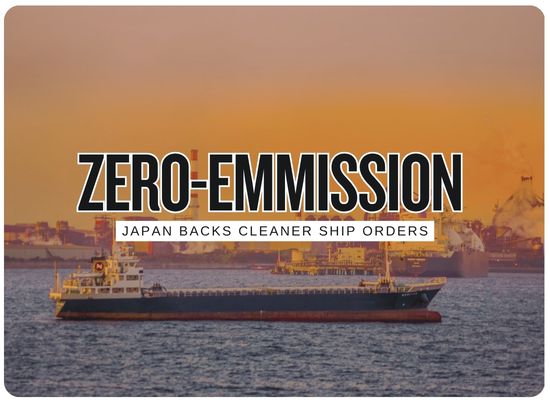
Japan opened applications Monday for a new subsidy program designed to move hydrogen, ammonia, methanol and battery-powered vessels from development into actual ship orders. The five-year funding commitment totals ¥15.1 billion, roughly $95 million, although only ¥1.2 billion is budgeted in the first fiscal year, making the larger figure a multi-year commitment rather than a one-year grant pool. Applications run from August 24 through December 3, 2026, with eligible spending covering equipment including engines, fuel tanks, fuel-supply systems, propulsion batteries and certain shore-power installations. Hydrogen, ammonia and non-hybrid battery vessels can receive support of up to 50% of eligible costs, while methanol and hybrid vessels qualify for up to one-third. The program applies more broadly to domestic shipping, but ocean-going vessels are restricted to hydrogen and ammonia projects. Japan is launching the order-side incentive while simultaneously subsidizing the factories and shipyard infrastructure needed to build next-generation vessels, creating a coordinated push on both ship demand and domestic manufacturing capacity.
Operator Impact Snapshot
Up to half of eligible equipment costs can be supported
Engines, fuel tanks and fuel-supply equipment for hydrogen and ammonia vessels qualify for subsidies of up to 50%. These are also the only fuel categories eligible for ocean-going vessel projects.
Domestic battery vessels receive the highest support tier
Fully battery-electric vessels can qualify for up to 50% support on eligible propulsion equipment, including batteries and qualifying shore-power infrastructure.
A separate one-third support tier targets early adoption
Methanol-fueled vessels and battery-hybrid ships are eligible for subsidies of up to one-third of qualifying equipment costs, but the program limits these categories to domestic applications.
The order window runs through December 3
Applications are being accepted through Japan's jGrants system. Companies without the required gBizID Prime account are warned that account issuance can take two to three weeks.
Zero-Emission Ship Subsidy by Technology
Eligibility changes materially by propulsion technology and by whether the vessel operates domestically or internationally.
| Technology | Maximum Subsidy | Eligible Equipment | Domestic Vessel | Ocean-Going Vessel | Procurement Signal |
|---|---|---|---|---|---|
| Hydrogen Fuel | Up to 50% | Engines, fuel tanks, fuel-supply equipment and other qualifying propulsion systems | ELIGIBLE | ELIGIBLE | Highest support tier and one of only two alternatives eligible for international ships. |
| Ammonia Fuel | Up to 50% | Engines, ammonia tanks, fuel-supply systems and related qualifying equipment | ELIGIBLE | ELIGIBLE | Directly aligned with Japan's effort to commercialize ammonia-fueled ships before the end of the decade. |
| Battery Electric | Up to 50% | Propulsion batteries and qualifying associated shore-power equipment | ELIGIBLE | NOT INCLUDED | Particularly applicable to domestic short-sea, ferry and coastal operating profiles. |
| Methanol Fuel | Up to 33.3% | Engines, tanks, fuel-supply equipment and related qualifying systems | ELIGIBLE | NOT INCLUDED | Lower support tier than hydrogen and ammonia under the current program structure. |
| Battery Hybrid | Up to 33.3% | Propulsion batteries and associated qualifying hybrid-electric equipment | ELIGIBLE | NOT INCLUDED | Offers a transition route for coastal ships that cannot operate fully on batteries. |
| Green Steel | Additional support | Qualifying green steel incorporated into hull structure of supported vessel projects | ADD-ON | ADD-ON | Separate calculation adds support for lower-carbon material procurement. |
Japan Zero-Emission Ship Subsidy Calculator
Estimate the government contribution toward eligible propulsion and energy-system costs, then calculate the remaining owner investment and optional green-steel support.
Project Funding Split
Modeled government support compared with the owner's remaining capital requirement for one vessel.
We welcome your feedback, suggestions, corrections, and ideas for enhancements.
Please click here to get in touch