Zumwalt Hypersonics Expose the Real Modernization Bill
🔔 Subscribe to ShipUniverse Weekly →
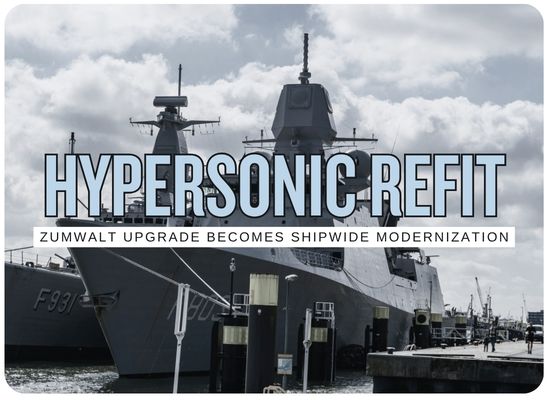
When I look at the Zumwalt hypersonic upgrade, the most interesting part is not the missile itself, but everything the ship has to absorb around it. Putting hypersonic missiles on Zumwalt-class destroyers is not a missile swap. It is a ship modernization project that reaches into structure, launch hardware, combat systems, command links, testing, cooling, magazines, crew training, production lines, and long-term sustainment.
The weapon is only the visible upgrade
The Conventional Prompt Strike modernization is easy to describe in a headline: remove unused gun systems, install large-diameter launch tubes, and give Zumwalt-class destroyers a long-range hypersonic strike role. But GAO’s delay findings show the reality is more complicated. A weapon upgrade on a unique ship class quickly becomes a whole-platform modernization.
Zumwalt is not a standard destroyer. It has a distinctive electric-drive architecture, tumblehome hull, stealth shaping, unique combat system elements, specialized radar and network systems, automation, and a small three-ship class with limited commonality. Those features make the class a powerful testbed for new capability, but they also make modernization harder to schedule, harder to sustain, and harder to scale.
Program signal board
Modernization is 24 months behind
GAO reported that the Navy’s effort to modernize the three DDG 1000 ships for CPS is two years behind, with unplanned work affecting the lead ship.
Large-diameter launch changes the ship
The Zumwalt conversion replaces the unused gun-space problem with a new launch-tube, payload-adapter, ejection, magazine, test, and safety problem.
Shipboard flight testing shifted to 2027
The missile, payload adapter, eject system, combat-system interface, and ship integration all need proof before the upgrade becomes fleet-ready.
The missile supply chain is part of the ship story
GAO also pointed to CPS quality and production issues, keeping current output below the goal of 12 missile rounds per year.
The modernization chain
A hypersonic launcher does not become usable combat power until a long chain of ship systems works together. A weak link can delay testing, reduce loadout confidence, or turn a premium weapon into a limited demonstration asset.
10 ship systems that turn the upgrade into a modernization project
These are the hidden buying lanes and integration headaches behind the Zumwalt hypersonic conversion.
- ❶ Structure Gun-space conversion is heavy shipyard engineering Removing the Advanced Gun System and adding large-diameter launch tubes is not just a clean cut-and-paste job. The shipyard must address foundations, deck openings, structural reinforcement, shock paths, access routes, hatches, blast considerations, cableways, and long-term maintainability. Unplanned work in these spaces can quickly turn a weapons upgrade into a schedule problem.
- ❷ Launch tubes The tube is part of a full launch ecosystem The visible tubes are only one layer. The system also needs payload adapters, canister interfaces, ejection hardware, pressure and safety controls, environmental monitoring, launch authorization, hatch actuation, status sensing, and test instrumentation. The larger the missile, the more the launch system behaves like a ship-specific engineering project rather than a standard VLS insert.
- ❸ Magazine safety Storage rules change with large hypersonic rounds A Zumwalt carrying CPS needs clear rules for missile storage, handling, thermal limits, safety zones, fire suppression, monitoring, shock, vibration, maintenance access, and emergency response. The magazine is no longer only a space where weapons are stored. It becomes a monitored environment tied to crew safety, ship survivability, and operational readiness.
- ❹ Combat system The ship must plan and authorize a different kind of strike Hypersonic strike is not a normal surface-to-surface missile workflow. The combat system needs mission planning, target package handling, launch status, weapon inventory, command authorization, route constraints, deconfliction, and post-launch reporting. Zumwalt’s unique combat and network systems make this integration especially important because every interface can become a schedule risk.
- ❺ Communications Long-range strike depends on data outside the ship A hypersonic weapon is only as useful as the network that supports it. The ship needs targeting information, updated command guidance, joint-force coordination, satellite communications, secure data links, emission-control planning, strike authorization, and battle-damage reporting. That pulls the modernization into C4ISR, not just shipboard weapons.
- ❻ Power and cooling Electronics, cabinets, controls, and test gear need ship services Zumwalt has a powerful electric architecture, but modernization still creates new service loads. Launch-control cabinets, environmental monitoring, communications equipment, processors, sensors, safety systems, and test equipment need power, cooling, grounding, and electromagnetic discipline. A weapon upgrade can expose power-distribution and cooling bottlenecks even on a high-electric-power ship.
- ❼ Testing The test campaign is a system of its own The missile, payload adapter, eject system, launch tubes, ship software, crew procedures, range safety, telemetry, communications, and data analysis all have to be tested. Shipboard flight testing moving to 2027 shows how a weapon upgrade can be delayed even after major installation work looks far along. The test system becomes a major budget and schedule driver.
- ❽ Crew training A small crew needs new strike, safety, and maintenance habits Zumwalt’s crew must learn how to operate, monitor, troubleshoot, secure, and fight with a weapon the Navy has never fielded from a surface ship before. Training must cover launch procedures, emergency actions, magazine monitoring, system status, communications, targeting workflow, degraded modes, maintenance coordination, and tactical employment.
- ❾ Sustainment Three unique ships make support harder GAO highlighted that the DDG 1000 class has unique radar, combat, and network systems that are costly and difficult to sustain and maintain. Adding CPS creates another specialized sustainment layer: launcher spares, software support, handling tools, missile support equipment, contractor field service, ship-specific documentation, depot repair, and recurring certification.
- ❿ Production line The ship cannot outrun the missile supply chain A destroyer can carry large hypersonic missiles only if the program can produce reliable rounds, support testing, stock spares, replace expended weapons, and coordinate Army and Navy demand. GAO’s warning about CPS quality and production issues shows that ship modernization and missile industrial capacity are connected. A launcher without sufficient missiles is not full capability.
Modernization cost map
The Zumwalt CPS effort shows how spending spreads far beyond the missile itself.
| System layer | Modernization work | Best supplier lane | Main delay risk |
|---|---|---|---|
| Ship structure | AGS removal, foundations, tube openings, reinforcement, access, shock paths | Shipyards, naval architects, structural engineers, steel fabrication teams | Unplanned condition work and legacy space constraints |
| Launch system | Large-diameter tubes, payload adapters, eject system, hatches, monitoring | Launcher OEMs, weapons integrators, shipboard safety-system suppliers | Fit, safety case, environmental control, and testing |
| Combat system | Strike planning, status displays, fire-control interfaces, inventory tracking | Combat-system primes, software integrators, tactical display teams | Unique DDG 1000 interfaces and software certification |
| C4ISR | Targeting data, secure communications, joint strike networks, battle reporting | Satellite communications, data-link, mission planning, cyber teams | Network approvals and joint-force integration |
| Ship services | Power, cooling, grounding, EMI control, cabinet support, environmental monitoring | Marine power, HVAC, controls, electrical integrators | Hidden load growth and equipment-space conflicts |
| Test campaign | Adapter testing, eject testing, shipboard checks, telemetry, flight testing | Range operators, test engineers, telemetry suppliers, OEM teams | Late test failures and funding-driven schedule movement |
| Crew pipeline | Operator training, emergency procedures, maintainer qualification, doctrine | Training contractors, simulators, OEM schoolhouses, fleet trainers | Training cannot mature before hardware and software stabilize |
| Sustainment | Spares, support equipment, documentation, software updates, depot repair | OEM sustainment, logistics firms, depot maintenance teams | Small class size and unique systems raise per-hull burden |
| Missile production | Glide body, all-up round, quality control, production ramp, stockpile planning | Hypersonic missile primes, propulsion, thermal protection, guidance, canister suppliers | Production rates below goal and quality issues |
Modernization pressure gauge
The highest pressure points are the ones that connect physical ship work with first-of-kind weapon testing.
Three spending lanes behind the upgrade
The shipyard conversion lane
This lane includes AGS removal, structural modification, missile tubes, foundations, cabling, safety systems, access changes, and physical readiness for test.
- Best fit for shipyards, structural engineers, weapons integrators, launcher suppliers, and shipboard safety-system providers.
- Most exposed to unplanned work and schedule slip.
- Value depends on turning a unique hull into a repeatable three-ship conversion path.
The combat network lane
This lane includes targeting data, communications, strike planning, cyber approval, command authorization, joint-force coordination, and battle reporting.
- Best fit for C4ISR, mission planning, data-link, satellite communications, and cyber suppliers.
- Most important for turning a weapon into operational strike capability.
- Value depends on secure, fast, trusted data flow beyond the ship.
The lifecycle support lane
This lane includes training, technical manuals, spares, support equipment, depot repair, software updates, missile handling, and contractor field support.
- Best fit for OEM sustainment, training, logistics, depot, and fleet-support firms.
- Especially important because Zumwalt is a small and unique ship class.
- Value depends on keeping the capability available after the first test shot.
Red flags inside hypersonic ship-integration plans
The Zumwalt program shows how easy it is to underestimate the difference between installing tubes and fielding a reliable strike capability.
| Red flag | Problem underneath | Diligence question |
|---|---|---|
| Launcher counted as capability | The tubes may be installed before the missile, adapter, eject system, software, and crew procedures are proven | Which test events remain before the ship can operationally fire? |
| Unique ship interfaces downplayed | Zumwalt combat, radar, and network systems are not standard destroyer systems | Which integration tasks are ship-class specific? |
| Production line separated from ship plan | The ship may be ready before enough reliable missile rounds exist | Can the missile industrial base support testing, deployment, and reload demand? |
| Training starts too late | Crews cannot develop doctrine, emergency routines, and maintenance habits after deployment pressure begins | Is training funded before the first operational milestone? |
| Testing treated as a final checkbox | Flight testing can reveal launcher, adapter, eject, software, range, or telemetry issues | Does the schedule include margin for test-discovered fixes? |
| Sustainment deferred | Small-class uniqueness can turn spares and support into chronic readiness drag | Are field support, spares, manuals, and depot pathways funded with installation? |
| Joint investment not coordinated | Army and Navy demands use shared missile-production pathways | Is there a coordinated investment strategy across ship, missile, and production programs? |
Buyer scorecard for shipboard hypersonics
- ❶ Conversion realism Physical fit is only the first risk A shipboard hypersonic program should price the full conversion: removals, structure, tubes, hatches, safety, power, cooling, launch controls, and access.
- ❷ Test maturity Shipboard flight testing drives credibility The capability is not mature until the ship, launcher, adapter, eject system, missile, software, and range procedures have been tested as an integrated chain.
- ❸ Network depth Long-range strike needs long-range data The ship must receive, protect, process, authorize, and report strike data across joint networks, not simply carry missiles.
- ❹ Crew readiness New weapons create new shipboard behaviors Watch teams, weapons departments, engineers, and commanders need training that reflects launch safety, targeting, communications, degraded modes, and emergency response.
- ❺ Sustainment Small-class support cannot be assumed Three unique destroyers create high per-hull support demands. Any new weapon layer should include spares, documentation, depot repair, technical support, and recurring certification.
- ❻ Missile supply Launcher capacity is not stockpile capacity A ship that can carry up to 12 missiles still depends on production quality, round availability, reload strategy, test demand, and Army-Navy coordination.
Hypersonic Ship Modernization Risk Meter
Use this quick tool to score whether a shipboard hypersonic upgrade looks like a manageable weapons refit or a full modernization project.
This tool is a practical screening aid, not procurement advice. Real shipboard hypersonic decisions should include classified performance, safety approval, ship drawings, test results, missile production data, crew model, combat-system interfaces, targeting networks, and lifecycle cost.
Bottom line for Zumwalt modernization
Hypersonic missiles may give the Zumwalt class a much clearer strategic role, but the GAO schedule slip shows the cost of turning a unique destroyer into the Navy’s first surface hypersonic platform. The weapon creates demand across the ship: launch tubes, structure, combat systems, communications, testing, power, cooling, magazines, crew training, and sustainment.
The strongest lesson is that hypersonic modernization should be budgeted as an integrated ship-and-missile enterprise. The tubes matter, but they are not the capability. The capability is a tested, networked, crewed, supplied, and sustainable strike system that can work at sea when the fleet needs it.
We welcome your feedback, suggestions, corrections, and ideas for enhancements.
Please click here to get in touch