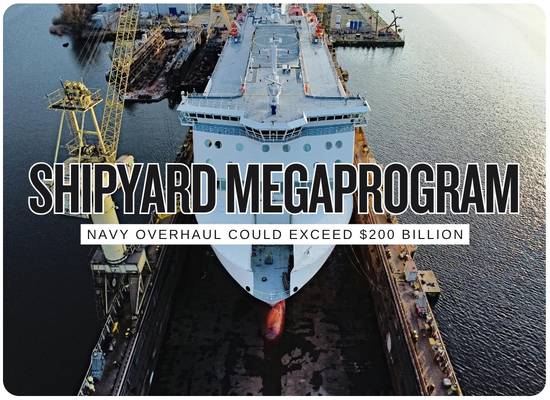
The U.S. Navy’s plan to rebuild its four public nuclear-ship maintenance yards has expanded from an estimated $21 billion over 20 years in 2018 to more than $200 billion across more than five additional decades, according to a September 25 Government Accountability Office review. GAO found that the final projects currently contemplated under the Shipyard Infrastructure Optimization Program, or SIOP, are not scheduled for completion until after 2080. The program covers Norfolk, Portsmouth, Pearl Harbor and Puget Sound, which maintain the Navy’s nuclear-powered submarines and aircraft carriers. GAO’s $200-billion-plus figure is based on Navy funding guidance, planned projects and shipyard cost analyses rather than a single final congressionally approved lifetime program baseline, and the watchdog warned that long-term costs, requirements and schedules will continue changing as projects mature.
U.S. Navy Shipyards · GAO-26-107830
A 20-Year Modernization Plan Has Become a Program Spanning Generations
The cost growth is partly the result of better estimating, but GAO also found
substantially more work: seismic reinforcement, utilities, additional repairs,
transportation changes, new facilities and unexpected conditions inside shipyards
where infrastructure can be more than a century old.
Original SIOP · 2018$21BAt least 20 years
Initial Navy estimate for modernizing dry docks, facilities and equipment
across the four public naval shipyards.
→
GAO Analysis · 2026>$200BLast projects after 2080
GAO's analysis of Navy plans, funding guidance and completed cost analyses
indicates more than five decades of additional execution.
Cost Expansion>9.5×
Simple comparison of the original $21B estimate with GAO's greater-than-$200B finding.
Planning Time>8 Years
GAO says development of shipyard plans and project sequencing took years longer than anticipated.
Lowest Yard Analysis$41.6B
Portsmouth alone was the lowest of three completed whole-yard analyses cited by GAO.
Current Construction Set$33.45B
140 completed, underway or in-design construction projects identified as of April 2026.
The New SIOP Runway
Block 1 · FY2026–2042Dry Docks First
Near-term projects with the most mature scope, including dry docks,
piers and the first new waterfront production facility at each yard.
Block 2 · ~FY2038–2079Production Facilities
Remaining waterfront production facilities and the enabling infrastructure
needed to support them.
Block 3 · ~FY2074–EndFinal Complexes
Logistics complexes, specialized shops, administrative facilities and
remaining capability requirements.
GAO's schedule goes beyond 2080.
The dates are rough planning ranges, not fixed completion guarantees.
Navy officials told GAO that some maintenance and equipment facilities could
already be pushed into the 2070s or later because of expected funding limits.
Four Yards · One Nuclear Maintenance System
The Original $21B Program Budget Is Now Roughly the Price of Three Dry-Dock Projects
The most striking cost comparison inside GAO's report is not the $200-billion
lifetime figure. It is the near-term dry-dock program already consuming a sum
slightly greater than the Navy's original estimate for the entire modernization effort.
Three Major Dry-Dock Projects$21.7B
Portsmouth, Pearl Harbor and Puget Sound combined, based on Navy budget
documents submitted in April 2026.
Portsmouth$2.46B
Two new dry-dock spaces for Virginia-class Blocks I-IV.
Navy completion target: May 2029.
Pearl Harbor$4.47B
New Virginia-class dry dock plus dredging, utilities, pumping
infrastructure and related demolition. Completion target: March 2029.
Puget Sound$14.76B
New dry dock and extensive yard reconfiguration supporting Virginia-class
submarines, Ford-class carriers and seismic resilience. Planned completion: 2038.
Norfolk Naval ShipyardVirginia
Projects25
Current Set$4.27B
GAO identified safety problems in deteriorating buildings that required
extensive repair work even where structures may later be demolished under SIOP.
Other projects include facilities and utility improvements supporting carrier maintenance.
Pearl Harbor Naval ShipyardHawaii
Projects22
Current Set$5.80B
Virginia-class submarine homeporting requirements are driving the new dry dock.
The Navy's earlier whole-yard plan for Pearl Harbor had already climbed to about
$16 billion by 2022.
Portsmouth Naval ShipyardMaine
Projects43
Current Set$3.82B
The completed whole-yard cost analysis cited by GAO reaches roughly
$41.6 billion when projects are escalated across their potential execution horizon,
even though Portsmouth was the lowest of the three completed analyses.
Puget Sound Naval ShipyardWashington
Projects50
Current Set$19.56B
Puget Sound dominates the currently identified construction value because
the $14.76-billion dry-dock program requires relocation or demolition of piers,
facilities and other infrastructure in addition to the dock itself.
These four cost figures are not each yard's full SIOP lifetime cost.
GAO's $33.45-billion total covers 140 construction projects that were completed,
underway or in design as of April 2026. It excludes much of the future program
and does not include all capital equipment. Separately, SIOP had procured
385 pieces of equipment worth about $1.49 billion as of March 2026.
Ship Universe SIOP Horizon Tool
How Much Annual Funding Does a 50-Year Shipyard Rebuild Imply?
Compare the arithmetic funding pace implied by the GAO horizon with a shorter
completion target. This is not a Navy budget forecast. It is a simple scale test
for understanding a program measured in hundreds of billions of dollars and decades.
$B
year
year
year
$B/year
$B
Years in Current Horizon55
selected end year minus selected execution start
Average Pace to Current Horizon$3.64B
simple annual average, not an appropriations forecast
Average Pace for Alternative Year$8.33B
arithmetic pace required under the shorter scenario
Finish at Entered Annual Funding2076
cost divided by annual funding, added to start year
Cost Multiple vs 20189.5×
selected cost divided by original program estimate
Extra Annual Pace for Faster Finish$4.70B
alternative pace minus current-horizon pace
Program Horizon Visualization
2026
2050
2081
Original 2018 Scale
~$1.05B/year
The initial $21-billion, 20-year concept implies a simple average of roughly
$1.05 billion per year. That is only a scale comparison and not the Navy's
historical annual appropriation profile.
GAO's Central Oversight Concern
Plans Must Survive Decades
A facility designed around today's fleet may not necessarily match maintenance
requirements in the 2050s, 2060s or 2070s. GAO therefore wants recurring reviews
of requirements, affordability, readiness and program performance rather than
treating today's plan as fixed for half a century.
Scenario tool only:
GAO's finding is that SIOP will exceed $200 billion and the last currently planned
projects extend beyond 2080. The program does not spend money evenly every year.
Actual appropriations, inflation, project escalation, sequencing, construction capacity,
maintenance requirements and congressional decisions will materially change annual funding.
Feedback Welcome
We welcome your feedback, suggestions, corrections, and ideas for enhancements.