Japan’s Shipowners Need 12M GT of New Ships a Year. Domestic Yards Built Only 9M GT in 2024
🔔 Subscribe to ShipUniverse Weekly →
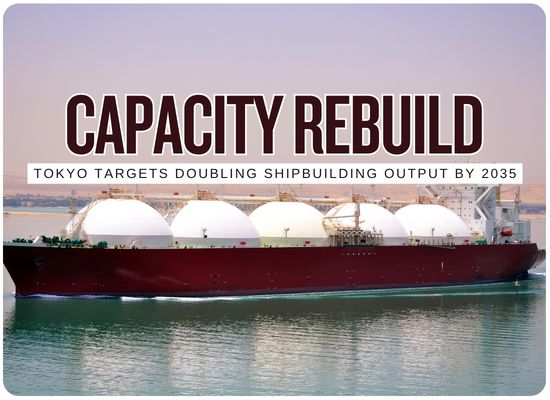
Japan’s Ministry of Land, Infrastructure, Transport and Tourism has put unusually clear numbers around a widening maritime-industrial dependency. Japanese shipowners have been ordering roughly 12 million gross tons of new ships per year on a delivery-year basis, while Japanese yards have generally built only around 10 million GT annually since 2020, falling to roughly 9 million GT in 2024. As domestic capacity has tightened, Chinese yards have taken a much larger share of Japanese orders: China captured 32% in 2024, versus Japan’s 63% and South Korea’s 5%, and has generally accounted for about 30% to 40% since 2022. MLIT explicitly warns that continued erosion could leave Japan dependent on foreign countries for tankers and bulkers essential to its maritime transport system. The government’s response is a plan to double domestic shipbuilding output to 18 million GT by 2035, rebuild LNG-carrier capability that has been dormant since 2019, and reduce dependence on foreign repair capacity.
Japan's Maritime Industrial Loop Is Beginning to Feed on Itself
Japanese owners still need large volumes of new tonnage, but domestic yards are no longer supplying all of that demand. More orders are moving overseas, while specialist capabilities such as LNG-carrier construction and oceangoing ship repair are becoming harder to sustain at home.
Japanese-controlled fleets continue generating roughly 12M GT of annual newbuild demand.
Yard scale, higher relative ship prices and severe labor shortages constrain Japanese output.
Chinese yards have recently captured roughly 30% to 40% of Japanese owners' newbuilding orders.
Japan now identifies LNG-carrier construction and oceangoing repair capacity as strategic capabilities that need rebuilding.
Japan's Maritime Capability Gap Is Wider Than Newbuild Capacity
The report identifies multiple dependencies across the vessel lifecycle. Japan is short of newbuilding capacity, has lost recent LNG-carrier construction continuity, and cannot absorb all repair demand from Japanese-controlled oceangoing ships at domestic docks.
| Capability | Current Position | Evidence in Maritime Report 2026 | Dependency Created | Government Security Concern | 2035 Response |
|---|---|---|---|---|---|
| General Newbuilding | CAPACITY GAP ~9M GT in 2024 | Japanese owners typically generate roughly 12M GT of annual newbuilding demand, while domestic yards have generally produced around 10M GT or less since 2020. | Japanese owners must place part of their fleet-renewal demand with foreign shipbuilders. | MLIT warns that continued erosion could force reliance on other countries for tankers and bulk carriers essential to stable sea transport. | Double domestic construction to 18M GT annually. |
| China Ordering Exposure | SHARPLY HIGHER 32% in 2024 | Chinese yards took roughly 30% to 40% of Japanese-owner ordering from 2022 onward, versus approximately 10% to 20% in the latter 2010s. | A larger share of Japanese-controlled fleet replacement is being supplied by China's industrial base. | Tokyo's roadmap explicitly links domestic shipbuilding capability to national and economic security. | Expand Japanese capacity while strengthening cooperation with allied countries. |
| LNG Carrier Construction | CAPABILITY LAPSE Last Completion: 2019 | MLIT says Japan's last domestically completed LNG carrier was in 2019 and notes that membrane containment has become the dominant architecture despite limited recent Japanese experience. | A country highly dependent on seaborne LNG imports lacks a current domestic series-production capability for LNG carriers. | MLIT explicitly calls acquisition and retention of LNG-carrier construction technology important for economic-security autonomy. | Establish stable capacity for 3 to 5 LNG carriers per year after 2035. |
| Oceangoing Ship Repair | FOREIGN DEPENDENCE Domestic Capacity Insufficient | Much of Japan's repair resource is occupied by coastal, naval, Coast Guard and other government ships. | Domestic docks cannot absorb all repair demand from Japanese owners' oceangoing ships, leaving high dependence on facilities in specific foreign countries. | Loss of access to overseas repair capacity could impair operation of Japanese-controlled fleets. | Improve domestic repair productivity and secure repair docks in allied countries along major Japanese routes. |
| Global Market | DEMAND RISING 80–100M+ GT | MLIT cites forecasts showing annual global shipbuilding demand moving toward roughly 80M to more than 100M GT during the 2030s. | Japan must expand while competing for labor, equipment and orders in a growing global shipbuilding cycle. | China's industrial scale gives it greater ability to capture the coming replacement and alternative-fuel construction wave. | Regain international competitiveness in next-generation and zero-emission vessels. |
| Workforce & Yard Scale | STRUCTURAL BOTTLENECK Severe Labor Shortage | MLIT identifies smaller facility scale, relatively higher ship prices and serious labor shortages as key reasons Japanese output has stagnated. | Simply adding orders does not automatically create physical production capacity. | Skills loss can make rebuilding complex-vessel capability slower even after capital investment is approved. | Automation, AI shipbuilding robots, yard investment, training and foreign-worker programs. |
Japan Shipbuilding Independence Analyzer
Test how much domestic shipbuilding capacity Japan needs to close the current owner-demand gap, reduce overseas ordering exposure and reach the government's 2035 target.
We welcome your feedback, suggestions, corrections, and ideas for enhancements.
Please click here to get in touch