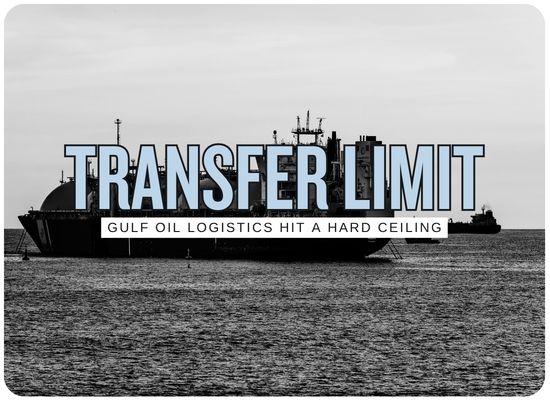
The Gulf's emergency oil-export system has reached the point where
adding tankers does not necessarily add capacity. Another 20 VLCCs
would bring roughly 40 million barrels of nominal cargo space into a
transfer network already constrained by STS slots, equipment, support
crews and vessel cycle time.
Gulf of OmanVLCC STSSaudi export reroutingSeptember 25, 2026
STS capacity pressureAt practical limit
AvailableTightQueueingCapacity limit
At saturation, the 21st arriving tanker is not automatically another
2 million barrels of export capacity. It may simply become another
vessel waiting for a transfer slot.
Gulf producers have built a floating logistics system outside the
Strait of Hormuz. Shuttle tankers load crude inside the Gulf, transit
the strait and transfer cargo to other VLCCs in the Gulf of Oman.
The receiving ships then continue toward refineries, while shuttle
vessels return through Hormuz and repeat the cycle.
The system is now carrying volumes it was never originally designed
to handle. Saudi exports through Hormuz are tracking around
3.6 million barrels per day in September, up from about 900,000 barrels
per day in August. Iraq and the UAE are also using the same offshore
transfer network.
Vessel availability is no longer the only constraint. Transfer support
around Fujairah and Sohar is reported at or near maximum capacity.
Tugboats, fenders, hoses, mooring support and personnel have become part
of the throughput equation. The result is a tanker queue in which the
next ship can add cost much faster than it adds exported barrels.
Current operating system
The transfer network is already running at record intensity
September liquid STS activity
7.2M bpd
Kpler September-to-date Gulf of Oman activity. Some barrels may be
transferred more than once.
VLCC crude STS activity
~6M bpd
Vortexa estimate for crude loaded west of Hormuz since late August.
New STS pairs starting
~3/day
Roughly three VLCC pairs beginning transfer operations daily.
Current STS operation
~10 days
Up from approximately five to seven days previously.
Different datasets measure different parts of the system.
Kpler's 7.2 million bpd figure measures liquids STS activity and may
count barrels undergoing multiple transfers. Vortexa's roughly
6 million bpd figure refers specifically to crude loaded on VLCCs
from ports west of Hormuz.
The 20-VLCC shock
Twenty more ships are much bigger than they sound
Additional VLCCs20
They represent a second fleet inside the queue
A VLCC typically carries about 2 million barrels. Twenty arrivals
therefore represent roughly 40 million barrels of nominal cargo
capacity before any transfer begins.
Nominal cargo capacity
40M bbl
20 ships × 2 million barrels.
Versus current shuttle fleet
+37%
Kpler estimates about 54 current shuttle VLCCs.
Current start-slot equivalent
6.7 days
If all three daily STS starts were devoted to the newcomers.
Queue mechanics
At full utilization, more ships do not make the queue disappear
The key variable is spare STS start capacity, not the number of
tankers waiting nearby.
STS starts
3/day
Existing demand
~3/day
Spare capacity
~0
The queue does not naturally clear when arrivals equal service capacity.
If the existing flow already consumes roughly three daily STS starts,
adding 20 vessels creates a backlog that must be removed through
additional transfer capacity, diversion, reduced upstream loadings or
direct voyages.
A useful queueing approximation
Ten-day operations create a surprisingly large vessel footprint
Starts per day
3 pairs
Current Vortexa-reported operating rate.
Operating cycle
~10 days
Current reported STS operation duration.
Implied simultaneous pairs
~30
Simple throughput × duration approximation.
Implied vessels involved
~60
Rough analytical occupancy, not a reported vessel count.
The release valves
The queue can move, but distance destroys tanker productivity
Round cycle17 d
Gulf of Oman
0.12 mbd per VLCCShortest shuttleCapacity constrained
The most productive location, but shore-side and marine support
are now operating close to practical limits.
Round cycle21 d
West Coast India
0.09 mbd per VLCC+4 days25% lower productivity
Kutch, Mumbai and Vadinar offer the nearest major alternative
lightering options outside the Gulf of Oman system.
Round cycle38.5 d
Offshore Malaysia
0.05 mbd per VLCC+21.5 days58% lower productivity
Linggi and Pelepas add transfer capacity but more than double the
shuttle cycle compared with Gulf of Oman operations.
Fleet multiplication
Moving the transfer point requires more ships for the same barrels
STS location productivity
Kpler round-trip and fleet-demand estimates
STS location
Round voyage
Capacity / vessel
VLCCs for 3 mbd
Relative productivity
Gulf of Oman
17 days
0.12 mbd
~25
Highest
West Coast India
21 days
0.09 mbd
~32
-25%
Offshore Malaysia
38.5 days
0.05 mbd
~58
-58%
Same transport work
Twenty Gulf of Oman shuttles become 27 in India or 48 in Malaysia
Based on Kpler's estimated monthly transport capacity per vessel.
Gulf of Oman
20
Theoretical 2.4 mbd transport capacity if STS support were available.
West Coast India equivalent
~27
About seven additional VLCCs for the same modeled transport capacity.
Malaysia equivalent
~48
More than twice the original vessel count for the same modeled capacity.
Vessel-day exposure
Waiting turns into nine-figure tanker capacity surprisingly fast
Illustrative time-charter-equivalent exposure using the record
$1.27 million/day Middle East-to-China VLCC rate reported this week.
These are not demurrage calculations.
5 days
$127M
7 days
$177.8M
10 days
$254M
14 days
$355.6M
These figures measure immobilized vessel economics, not invoices.
Individual charter contracts, demurrage clauses and voyage terms vary.
The calculation simply applies today's reported VLCC market rate to
20 ships for the stated number of days.
The actual bottleneck
More sea room does not automatically create another STS berth
Tugs
Marine support has to scale with vessel movements
Reuters reports queues for equipment such as tugboats as STS
activity intensifies.
Fenders
Two VLCCs require specialized separation equipment
STS operations depend on correctly selected and maintained
pneumatic fenders and associated rigging.
Hoses
Cargo-transfer equipment is finite
Hose strings require inspection, handling, maintenance and safe
installation between vessels.
People
Mooring and transfer operations require qualified personnel
Reuters specifically identifies labour constraints, while current
OCIMF guidance emphasizes human factors and service-provider competence.
Weather
Offshore transfers need safe environmental windows
Mooring loads, vessel movement and hose integrity impose operating
limits that cannot simply be ignored to raise throughput.
How the system could absorb more barrels
The next million barrels per day probably comes from reshuffling the network
GoO operational efficiency
+0.5 mbd
Kpler base-case assumption for additional local capacity.
Crude prioritization
+0.5 mbd
Potential capacity from moving more product STS activity elsewhere.
West Coast India
+0.5 mbd
Kpler base-case crude increment after weather restrictions ease.
Remaining barrels
Elsewhere
Malaysia, direct voyages or another operating solution.
The alternative to transferring
Some cargoes will simply skip the Gulf of Oman STS step
SaudiChina
Direct long-haul delivery
The Bahri-operated VLCC Gold Shine loaded roughly 2 million barrels
at Ras Tanura and was heading directly toward Quanzhou rather than
transferring the cargo off Oman.
STSIndia
Vadinar diversion
Reuters reported that South Korean refiner S-Oil was sending two
VLCCs to conduct transfers off Vadinar on India's west coast.
STSMalaysia
Linggi lightering
Tanker-market participants have reported increasing crude-transfer
activity around Malaysia's established transshipment hubs.
Research anchors
Data behind the stress test
Reuters, September 25, 2026
Gulf of Oman STS capacity limits, Saudi export flows,
three daily VLCC-pair starts, near-10-day STS operations,
transfer queues and record VLCC freight.
Kpler, September 21, 2026
Gulf of Oman STS volume, regional capacity limits, 17-day Gulf
shuttle cycle, West Coast India and Malaysia alternatives,
per-vessel transport capacity and VLCC requirements.
Reuters, September 21, 2026
Development of the Hormuz shuttle system, Gulf of Oman STS growth
and record freight economics.
OCIMF 2025 STS Transfer Guide
Current industry guidance covering STS planning, fenders, cargo hoses,
mooring equipment, human factors and safe execution.
Interactive congestion model
Gulf of Oman VLCC Queue Stress Tool
Add tankers to a saturated STS network, change transfer-start capacity
or divert vessels to India or Malaysia and see how the queue,
vessel-days and transport productivity change.
VLCC arrivals
20
0
0%
Gulf of Oman service rate
Diversion economics
GoO queue outcome
The additional queue does not naturally clear
Existing background demand is consuming all modeled STS start
capacity, leaving no spare service rate for the new arrivals.
No clearance
modeled queue-clear time
Cargo capacity represented
40M bbl
Nominal cargo capacity of the additional arriving VLCCs.
VLCCs remaining in GoO system
20
New arrivals not redirected to the selected alternative hub.
VLCCs diverted
0
New arrivals shifted to the alternative STS location.
Extra start-slot demand
6.7 d
Days of current GoO STS start capacity represented by remaining arrivals.
Additional vessel-days caused by the longer selected STS cycle.
Transport productivity comparison
GoO theoretical
2.40 mbd
West Coast India
1.80 mbd
Equivalent fleet
27 ships
This is a queue and fleet-productivity stress model, not a live vessel
traffic forecast. The reported Gulf of Oman system is already experiencing
queues, but the exact current queue length is not publicly established in
the sources used here, so the default existing queue is zero and can be
changed manually. The $1.27 million/day figure is used only as a
time-charter-equivalent measure of vessel capacity and should not be
interpreted as demurrage. Route productivity assumptions use Kpler's
September 2026 estimates of 0.12 mbd per Gulf of Oman shuttle,
0.09 mbd for West Coast India and 0.05 mbd for Malaysia.
Feedback Welcome
We welcome your feedback, suggestions, corrections, and ideas for enhancements.