The Rotterdam Biodiesel Price Shock
🔔 Subscribe to ShipUniverse Weekly →

ShipUniverse Maritime Fuel Decision Report

Biodiesel Just Beat Marine Gas Oil. Does the Math Actually Hold?

Rotterdam B100 briefly collapsed to record-low pricing while marine gasoil surged. The headline looks simple. The economics are not. Energy density, EU ETS, FuelEU, certification and the ship's fuel system can each change the result.
Rotterdam B100 FAME MGO + VLSFO September 2026
Rotterdam price tape Sep 2026
B100 biodiesel
$1,240
Rebounded after briefly touching $985/t.
Marine gasoil
$1,528.50
September 20 comparison level.
VLSFO
$710
Rotterdam September 18 indication.
B100 moved by hundreds of dollars per tonne within days. A bunker decision therefore needs a break-even price, not simply today's screen price.

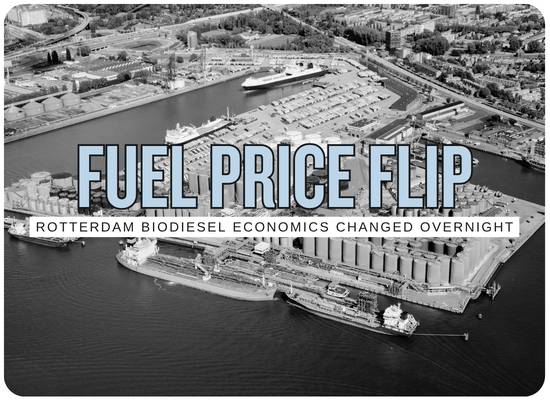
Rotterdam recently produced a fuel-price relationship that would have looked improbable only months earlier. B100 biodiesel fell as low as $985 per tonne before rebounding toward $1,240, while marine gasoil moved above $1,500 per tonne.

But one tonne of B100 does not replace one tonne of MGO. FAME biodiesel contains about 37 MJ/kg of energy versus roughly 42.7 MJ/kg for marine gasoil. Equal energy therefore requires approximately 15.4% more B100 by mass.

Apply that correction to $1,240 B100 and the effective MGO-energy-equivalent price becomes roughly $1,431 per tonne. Against $1,528.50 MGO, biodiesel is still about $97 cheaper per equivalent tonne before EU carbon compliance enters the calculation.

The price inversion

One bunker price produces three different answers

Headline price -$288.50
B100 per physical tonne The obvious headline advantage versus $1,528.50 MGO, before adjusting for lower energy content.
Energy corrected -$97
B100 per MGO-equivalent tonne The additional B100 mass absorbs roughly two thirds of the headline discount, but does not eliminate it.
Higher B100 case +$154
Energy-adjusted premium at $1,418 B100 The September 18 assessment shows how quickly the energy-only comparison can flip before compliance is counted.
Energy normalization

The tonne price is the wrong comparison

B100 FAME energy
37 MJ/kg
EU renewable-fuel reference.
MGO energy
42.7 MJ/kg
FuelEU fossil MGO reference.
Additional B100 mass
+15.4%
Required for equal MGO energy.
B100 MGO-equivalent
~$1,431
At a $1,240/t B100 bunker price.
Fuel decision board

B100 still clears MGO after the energy correction

VLSFO remains the harder economic hurdle before compliance effects.
Rotterdam fuel economics Scroll horizontally for the full comparison
Fuel Price Energy Equal-energy quantity Normalized cost Current position
B100 FAME $1,240/t 37.0 MJ/kg 1.154 t per MGO-equivalent tonne $1,431/MGOe Below MGO
MGO $1,528.50/t 42.7 MJ/kg 1.000 t $1,528.50/MGOe Approximately $97/MGOe above B100
VLSFO $710/t 40.5 MJ/kg modeled 1.000 t $710/VLSFOe Cheaper on energy
VLSFO remains the tougher benchmark. At $1,240/t B100, equal VLSFO energy costs roughly $1,357. That leaves an energy-only premium of about $647 per VLSFO-equivalent tonne before ETS, FuelEU, pooling or other compliance value.
Voyage stress test

Replace 500 tonnes of MGO energy with B100

MGO reference
500 t
Reference voyage energy.
B100 required
577 t
About 77 additional tonnes.
Fuel-only difference
-$48.7K
B100 cheaper at the headline price.
Full ETS exposure
~$160K
Approximate MGO carbon cost avoided.
At an EUA price near €86.89/tCO2, MGO's fossil emission factor implies roughly $319 of ETS exposure per tonne of MGO when 100% of voyage emissions fall inside ETS scope. Eligible sustainable B100 can be zero-rated for ETS CO2 when the documentation is valid.
Voyage profile

Route exposure can change the decision

EU to EU
ETS 100% FuelEU 100% Highest B100 leverage

The full voyage energy sits inside the major EU compliance calculations, making certified low-GHG B100 most valuable here.

EU to non-EU
ETS 50% FuelEU 50% Moderate leverage

Only half of the voyage enters the principal EU calculations, reducing the regulatory value available to offset B100's cost.

Outside EU
ETS 0% FuelEU 0% Fuel economics dominate

The comparison falls back toward energy-adjusted bunker price, availability and onboard operating considerations.

Compliance crossover

B100 can cross the VLSFO line once compliance is counted

B100 vs VLSFO
-$45/t
ENGINE September 8 compliance-adjusted EU-EU comparison.
B100 vs LSMGO
-$594/t
Same energy and compliance-adjusted snapshot.
FuelEU 2026 intensity
89.34
gCO2e/MJ maximum annual GHG intensity.
Deficit penalty reference
€2,400
Per VLSFO-equivalent tonne of FuelEU deficit.
FuelEU value is not a universal credit per tonne of B100. It depends on the certified feedstock pathway, annual vessel fuel mix, pooling, banking, borrowing and the commercial value assigned to surplus compliance.
Ship readiness

The fuel price is irrelevant if the ship is not ready

B100 onboard readiness screen Scroll horizontally for the operating detail
Check Risk Failure mode Response Priority
OEM approval Engine compatibility Combustion or component problems Confirm permitted FAME concentration and OEM operating guidance. Before bunker
Proof of Sustainability Regulatory eligibility Loss of ETS or FuelEU value Match documentation to the delivered quantity and pathway. Critical
Tank water Microbial growth Sludge and filter blockage Drain water and increase tank monitoring. High
Storage duration Oxidation Acidity and deposits Avoid treating B100 as long-term inventory where possible. High
Cold-flow properties Feedstock dependent Restricted flow and blocked filters Confirm cloud point and appropriate tank temperature. Route dependent
Seals and hoses Materials compatibility Leaks or degradation Check system materials for high-FAME service. Inspect
Initial filters Solvent cleaning effect Rapid blockage after switching Carry spares and monitor closely during initial changeover. Transition
Supply reality

Rotterdam is liquid. Global B100 supply is not.

More than 60 ports have reported marine biofuel supply Availability remains concentrated, particularly in major European and Asian bunker hubs.
Rotterdam carries disproportionate market weight Price formation there can make B100 appear much more economically accessible than it is on less-developed bunker routes.
B100 is not one uniform commodity Feedstock pathway changes lifecycle GHG intensity, regulatory value, cold-flow behavior, sustainability documentation and price.
Research anchors

Data behind the comparison

Rotterdam fuel market Argus-linked reporting, ENGINE and Ship & Bunker September 2026 B100, MGO and VLSFO assessments.
Energy and compliance EU Renewable Energy Directive, FuelEU Maritime rules, European Commission ETS guidance and European carbon-market data.
Technical operation DNV marine biofuel guidance and ISO 8217:2024 fuel-quality framework.
Interactive fuel economics

B100 Break-Even Desk

Change the bunker price, voyage exposure and compliance assumptions to see exactly where B100 crosses MGO or VLSFO.


Fuel market
$1,240/t
$1,528.50/t
500 t
EU exposure
100%
€86.89/tCO2
$0/t
Additional assumptions
Effective voyage comparison
B100 is ahead in this scenario
Equal-energy fuel cost plus selected compliance effects.
$0 modeled voyage difference
How the economics move
Energy spread
$0
EU ETS benefit
$0
FuelEU value
$0
Handling cost
$0
B100 required for equal energy
0 t
Physical B100 required to replace selected fossil energy.
Energy-density penalty
0%
Additional B100 mass before operational differences.
Normalized B100 cost
$0/t
Cost per fossil-equivalent tonne of energy.
Fossil ETS cost
$0/t
Carbon cost per fossil tonne at selected scope.
Maximum B100 bunker price at parity
$0/t
B100 moves above the selected fossil option beyond this price, given the current assumptions.
Additional compliance value needed
$0/t
Additional FuelEU or pooling value required for parity.
This is a screening model rather than a bunker quotation or formal FuelEU compliance calculation. Actual economics depend on certified feedstock pathway, annual fuel mix, banking, borrowing, pooling, engine approval and vessel-specific consumption.
By the ShipUniverse Editorial Team — About Us | Contact