Inside a Modern SIGINT Ship: 10 Systems Driving the New Naval Intelligence-Vessel Market
🔔 Subscribe to ShipUniverse Weekly →
Inside a Modern SIGINT Ship: 10 Systems Driving the New Naval Intelligence-Vessel Market
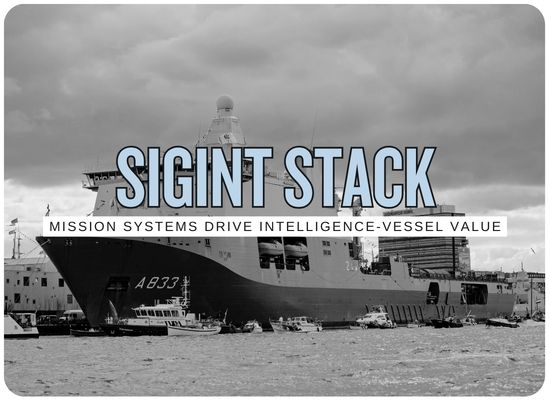
Germany’s fourth signals-intelligence ship plan is a reminder that the most valuable equipment on an intelligence vessel is not the hull steel. It is the stack of antennas, receivers, acoustic sensors, processors, storage, satellite links, cyber controls, quiet machinery and secure mission spaces that turn a ship into an intelligence platform.
The market signal in 30 seconds
Germany plans to add a fourth new signals-intelligence ship to the Class 424 program, expanding a fleet already under construction.
The new German ships replace the Oste-class intelligence vessels and are expected to start entering service from 2029.
The third vessel was already in production at Peene-Werft in Wolgast before the fourth-ship signal emerged.
Public German descriptions point to signal-gathering reconnaissance, electronic sensors, hydroacoustic reconnaissance and specialized onboard crews.
The supplier stack is high-dollar because intelligence vessels require mission systems, ship integration and lifecycle support.
Procurement read: A modern SIGINT ship is a floating sensor-and-data center. The winning suppliers will not only sell antennas or receivers. They will help navies collect, classify, protect, store and transmit sensitive intelligence without compromising the ship’s position, mission systems or data chain.
The signal-to-shore pipeline
10 systems driving the naval intelligence-vessel market
Domes, masts, apertures and direction-finding antennas are the first commercial lane. The ship needs broad frequency coverage, clean installation geometry, low self-interference and maintainable topside access.
COMINT is not only listening equipment. It requires receivers, front ends, channelization, demodulation, decoding, metadata, analyst displays, recording and mission workflow tools.
ELINT systems help identify, characterize and locate radar and electronic emitters. For a dedicated intelligence ship, the buying question is how fast the system can classify signals and preserve clean evidence.
Public German language repeatedly ties the mission to hydroacoustic reconnaissance. That creates demand for acoustic sensors, quiet handling, oceanographic inputs, classification tools and secure acoustic libraries.
Modern collection produces too much raw data for old workflows. Processing hosts, DSP, AI-assisted triage, signal classification, fusion and operator tools turn collection into usable intelligence while the mission is still active.
Storage is not a back-office item. Intelligence ships need high-capacity, time-synchronized, searchable, protected storage for live missions, forensic review, replay, model training and cross-theater correlation.
A SIGINT ship may collect near a crisis zone, but the intelligence often needs to move to shore centers, commanders and allied networks. Protected SATCOM, antennas, encryption and bandwidth management become central.
Cybersecurity covers more than the mission network. It touches sensors, storage, operator consoles, SATCOM links, removable media, access control, logging, patching, supply chain and compartment rules.
Quiet propulsion, vibration control, machinery isolation, flow-noise discipline and electromagnetic cleanliness matter because an intelligence ship is measuring other platforms, not advertising itself.
Modern intelligence vessels need mission rooms, racks, cooling, protected compartments, crew/analyst separation, training systems, classified workstations and flexible space for future payloads.
Three supplier lanes
This is the visible high-end equipment lane: masts, radomes, receivers, front ends, DF, hydroacoustic sensors and electro-optical systems.
The fastest-growing value may be in compute and software that convert raw RF and acoustic collection into usable, protected intelligence.
The ship has to move intelligence securely, remain quiet enough to collect, and give operators a protected environment to work for months at sea.
Supplier opportunity matrix
| System | High-value spend | Buyer question | Hidden risk |
|---|---|---|---|
| SIGINT antennas | DF antennas, broadband apertures, radomes, mast structures, RF routing. | Can the topside collect without creating self-interference? | Late mast changes break sensor performance. |
| COMINT | HF/VHF/UHF receivers, digitizers, channelizers, demodulators, decoders. | Can the ship process dense spectrum quickly enough? | Signals are recorded but not exploited in time. |
| ELINT | Wideband receivers, emitter characterization, geolocation, libraries, analysis tools. | Can the system classify new emitters and preserve clean metadata? | Emitter libraries fall behind threat changes. |
| Acoustic intelligence | Hydrophones, arrays, ocean sensors, acoustic processors, signature tools. | Can the ship collect underwater signatures without self-noise contamination? | Quieting is underpriced until trials. |
| Processing | DSP, GPU/CPU servers, AI triage, operator displays, fusion tools. | Can operators turn collection into intelligence during the mission? | Compute, cooling and workflow lag the sensor suite. |
| Data storage | Rugged storage, time sync, metadata, replay, archive and transfer systems. | Can the ship store wideband collection with searchable context? | Data volume grows faster than storage discipline. |
| SATCOM | Protected terminals, antennas, bandwidth management, crypto and reachback links. | Can intelligence move securely without compromising the ship? | Reachback bottlenecks high-value collection. |
| Cybersecurity | Segmentation, logging, zero trust, removable-media control, supply-chain security. | Can the ship protect classified mission data at sea? | Commercial IT habits enter sensitive mission spaces. |
| Quieting | Machinery isolation, propulsor design, vibration control, EMI/EMC management. | Can the platform stay quiet enough for its mission? | Platform noise reduces collection quality. |
| Mission spaces | Secure compartments, consoles, racks, cooling, training systems, flexible payload bays. | Can the ship support operators, analysts and future systems for decades? | The ship runs out of secure space and cooling early. |
Procurement pressure meter
Red flags before suppliers chase the market
| Red flag | Problem underneath | Supplier check |
|---|---|---|
| Antenna-first sales pitch | The collection system is not useful unless receivers, processing, metadata and operators are aligned. | Sell the full signal chain, not only the visible topside hardware. |
| No self-interference model | The ship’s own radios, electronics and machinery can contaminate collection. | Run EMI/EMC and topside-placement analysis before build freeze. |
| Compute treated as generic IT | SIGINT processing needs timing, metadata, recording, replay and mission software discipline. | Prove performance under dense, high-data-rate collection loads. |
| Storage bought by capacity only | Raw volume is useless without indexing, time sync, chain-of-custody and search tools. | Price metadata, retrieval, replay and secure transfer with storage. |
| Reachback assumed | Satellite links may be limited, jammed, monitored or policy-constrained. | Design store-forward, prioritization and low-bandwidth intelligence products. |
| Quieting postponed | Acoustic and RF intelligence quality can be damaged by platform noise and poor integration. | Treat signature control as part of the mission system. |
| Mission spaces underbuilt | Analysts, operators, racks, cooling and secure compartments grow over the ship’s life. | Reserve protected volume, power, cooling and cabling from day one. |
SIGINT Ship Supplier Fit Checker
Use this quick screen to judge whether a supplier is positioned for the modern naval intelligence-vessel market.
Generated by ShipUniverse.com. This is a practical screening aid, not procurement advice. Real intelligence-vessel programs require classified requirements, shipfit studies, EMI/EMC testing, cybersecurity approval, signature measurement, operator workflow review, communications planning, export-control review and lifecycle-cost modeling.
Procurement read
Germany’s fourth-ship signal shows why naval intelligence vessels are becoming a serious supplier market. These ships are not bought for speed, weapons load or magazine depth. They are bought for collection quality, data control, persistence and the ability to support national decision-makers from international waters.
The best commercial opportunities sit where mission systems meet ship integration: SIGINT antennas, COMINT and ELINT suites, hydroacoustic intelligence, processing, storage, SATCOM, cybersecurity, quieting and secure mission spaces. A supplier that can solve only one box may get equipment work. A supplier that can protect the full chain from antenna to analyst to shore has a much larger opportunity.
More information: Reuters, Rheinmetall, Bundeswehr, BAAINBw, Naval News, ONI, NAVSEA, U.S. Space Force.