
🔔 Subscribe to ShipUniverse Weekly →
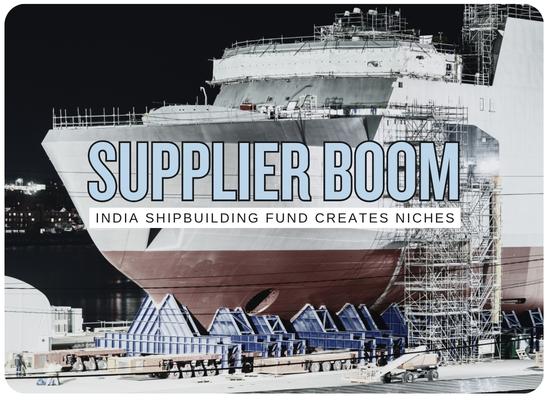
I keep coming back to India’s shipbuilding finance push because the most interesting opportunity may not be the shipyard headline at all. The new money is important, but shipyards cannot turn long-term finance, fleet-acquisition visibility, greenfield clusters and brownfield expansion into delivered vessels without a deeper supplier base. The real commercial story sits behind the yard gates: propulsion packages, marine electricals, outfitting, coatings, digital design, certification, cranes, pipe systems, training, testing labs and the smaller industrial companies that can become embedded in India’s shipbuilding supply chain before the next wave of orders arrives.
Supplier opportunity snapshot
India’s shipbuilding push is not only a financing story. It is a supplier localization, cluster buildout, shipyard productivity and newbuild execution story.
The fund creates demand, but suppliers decide execution
Shipbuilding finance can unlock orders, but orders only become vessels when thousands of procurement decisions land on time. That is why the Maritime Development Fund and the wider shipbuilding package should be watched by manufacturers, service firms and marine technology providers, not only shipyards and lenders. Long-term financing makes larger projects easier to approve. Financial assistance helps yards compete. Cluster support can reduce infrastructure bottlenecks. But the build schedule still depends on engines, gearboxes, steel work, piping, cables, switchboards, navigation systems, coatings, HVAC, firefighting systems, cranes, test services and trained people.
The supplier opportunity is not equally attractive everywhere. Some categories will be pulled by naval work, some by coastal commercial vessels, some by tugs and workboats, some by ferries and green vessels, and some by large-vessel ambitions. The best niches are the ones that solve a repeat yard problem: reduce import dependence, shorten lead times, make class documentation easier, improve quality control, cut rework, support localization targets or give foreign OEMs a reliable Indian manufacturing and service partner.
Commercial takeaway India’s shipbuilding push is not just a question of whether yards can win orders. It is a question of which suppliers can become the default local source before project pipelines harden into approved vendor lists.
10 supplier niches behind the new shipbuilding finance push
Marine propulsion packages
Propulsion is one of the hardest areas to localize because owners, yards and class societies care about reliability, fuel economy, spare parts, warranty response and long service lives. The opportunity is not only full engine manufacturing. It also includes shafts, bearings, seals, couplings, controllable-pitch systems, thrusters, gearboxes, hybrid-ready interfaces and local service networks.
- Supplier opening Local assembly, machining, aftersales support, shaft-line components, gearbox service and hybrid integration packages.
- Buyer pain Imported propulsion equipment can create currency, lead-time, documentation and service-support pressure.
- Proof needed Class approvals, endurance data, test-bench capability, service network, warranty language and spare-parts plan.
- Strongest fit Tugs, ferries, patrol vessels, coastal cargo ships, offshore support vessels and standardized series builds.
Marine electrical and power-management systems
Modern shipbuilding needs more than cables and panels. Yards need switchboards, integrated power-management systems, shore-power readiness, battery interfaces, generator controls, automation panels, cable trays, sensors and commissioning support. Suppliers that can package hardware with drawings, class documentation and yard-friendly installation support can become repeat vendors.
- Supplier opening Main switchboards, PMS, drives, cabling systems, shore-power panels, battery-ready controls and commissioning teams.
- Buyer pain Electrical integration delays can ripple into FAT, harbor trials, sea trials and delivery acceptance.
- Proof needed Type approvals, load studies, short-circuit calculations, automation documentation and cyber-ready control design.
- Strongest fit Electric ferries, tugs, patrol craft, dredgers, offshore vessels and higher-spec commercial newbuilds.
Steel processing, blocks and modular fabrication
Shipbuilding scale depends heavily on steel throughput. Plate handling, cutting, forming, blasting, priming, panel lines, block assembly, robotic welding, dimensional control and modular outfitting can decide whether a yard expands output or simply expands its backlog. This is where industrial suppliers outside traditional shipbuilding can enter the maritime chain.
- Supplier opening CNC cutting, plate prep, block fabrication, modular outfitting, robotic welding, metrology and surface-prep lines.
- Buyer pain Shipyards lose margin when steel work is slow, inaccurate, reworked or poorly sequenced.
- Proof needed Quality system, weld procedure capability, dimensional-control records, lifting plans and production-rate evidence.
- Strongest fit Greenfield clusters, brownfield yard upgrades, standardized vessel series and naval-commercial crossover work.
Piping, valves and fluid systems
Piping is not glamorous, but it is one of the most repeatable shipyard pain points. Ballast, bilge, fuel, lube oil, fire main, seawater cooling, freshwater, hydraulic, cargo and exhaust-related systems all require material control, welding quality, pressure testing, tracing, flushing and clean documentation. A strong piping supplier can save a yard from late-stage rework.
- Supplier opening Pipe spools, valves, strainers, pumps, flushing services, pressure testing, hydraulic systems and prefab modules.
- Buyer pain Late piping changes can delay commissioning, tank testing, system trials and delivery.
- Proof needed Material traceability, weld records, pressure-test reports, flushing evidence, class certificates and spare support.
- Strongest fit Tankers, workboats, dredgers, offshore vessels, coastal cargo ships and ship repair facilities.
Navigation, communications and vessel electronics
Newbuilds need bridge systems, radar, ECDIS, AIS, GMDSS, VDR, sensors, antennas, CCTV, network infrastructure and cyber-aware integration. The opportunity is less about selling boxes and more about becoming the integrator that can produce drawings, install cleanly, commission systems and support the vessel after delivery.
- Supplier opening Bridge integration, onboard networks, communication packages, sensors, cyber documentation and service support.
- Buyer pain Poor electronics integration creates trial delays, class comments and crew handover problems.
- Proof needed Type approvals, wiring diagrams, cyber documentation, FAT/SAT procedures, commissioning reports and training material.
- Strongest fit Patrol vessels, ferries, tugs, offshore vessels, research vessels and higher-spec commercial ships.
Coatings, corrosion control and cathodic protection
Shipyard expansion creates demand for coating systems, blast-and-paint facilities, humidity control, surface preparation, antifouling, ballast-tank coating, fire-protection coating and cathodic protection. Suppliers that can reduce rework and warranty claims may be more valuable than low-cost paint vendors.
- Supplier opening Coating packages, blasting services, humidity control, anodes, ICCP, inspection services and coating QA software.
- Buyer pain Coating failures create warranty risk, drydock claims, owner dissatisfaction and delivery delays.
- Proof needed NACE or equivalent inspection capability, DFT records, surface-prep reports, product approvals and warranty terms.
- Strongest fit Ballast tanks, cargo tanks, ferries, offshore craft, coastal vessels, workboats and repair yards.
Deck machinery, cranes and lifting gear
Shipbuilding growth pulls demand for mooring winches, windlasses, capstans, cargo cranes, hose-handling cranes, provision cranes, davits, ramps, towing gear and certified loose gear. This niche is attractive because it touches both newbuilds and the survey-driven service market after delivery.
- Supplier opening Winches, cranes, davits, ramps, hydraulic packs, load testing, wire rope, loose gear and commissioning services.
- Buyer pain Deck machinery delays can block trials, class certificates, cargo readiness and crew acceptance.
- Proof needed Load-test certificates, material traceability, control documentation, safety-device tests and spare-parts plan.
- Strongest fit Tugs, offshore vessels, tankers, multipurpose ships, ferries, workboats and naval support vessels.
HVAC, refrigeration and habitability packages
Crew comfort, electronics cooling, passenger spaces, galley ventilation, cold rooms, control rooms and machinery ventilation all need marine-grade HVAC and refrigeration. Suppliers with modular packages, class documentation and service support can win repeat work from yards trying to standardize vessel classes.
- Supplier opening HVAC skids, chillers, ducting, dampers, cold rooms, ventilation fans, controls and commissioning packages.
- Buyer pain HVAC problems show up late, affect sea trials and create crew or passenger acceptance issues.
- Proof needed Heat-load calculations, marine materials, fire-damper documentation, noise control, commissioning reports and spares.
- Strongest fit Ferries, passenger craft, patrol vessels, offshore vessels, research vessels and crew-heavy support ships.
Class testing, inspection and commissioning services
As orders rise, bottlenecks can move from steel and hardware to testing. Yards need NDT, load testing, pressure testing, electrical testing, sea-trial support, calibration, emissions checks, inclining experiments, noise and vibration support, BWMS commissioning, lifting-appliance certification and documentation closeout.
- Supplier opening NDT, metrology, load testing, calibration, pressure testing, commissioning support and digital handover records.
- Buyer pain A vessel can be physically complete but commercially stuck if certificates and test evidence lag.
- Proof needed Accredited procedures, qualified technicians, calibrated tools, report templates and class-recognized workflows.
- Strongest fit All newbuild categories, especially first-of-class projects and yards expanding output quickly.
Ship design, digital production and workforce training
India’s shipbuilding scale-up needs design offices, production engineers, planning systems, digital twins, nesting software, ERP integrations, AR work instructions, welding simulators, training programs and on-the-job qualification pipelines. Suppliers that improve yard productivity may benefit even if they never sell a physical ship component.
- Supplier opening Naval architecture, production design, digital planning, welding training, AR instructions, workforce analytics and QA systems.
- Buyer pain New yards can lose time through drawing gaps, immature production planning, weak skills and rework.
- Proof needed Marine project references, design-change control, production data, training outcomes and yard adoption plan.
- Strongest fit New clusters, expanding yards, foreign technical partnerships and standardized vessel programs.
Supplier opportunity map
| Supplier niche | Best commercial trigger | Barrier to entry | Best positioning | Priority |
|---|---|---|---|---|
| Propulsion packages | Series builds, tugs, ferries, workboats and larger domestic vessel ambitions. | Class approval, warranty confidence, service support and test facilities. | Partner with OEMs or build certified local service and assembly capacity. | High value |
| Electrical and PMS | Electrification, automation and cyber-ready ship systems. | Integration complexity and commissioning accountability. | Sell full documentation, FAT/SAT and lifecycle support, not only hardware. | High value |
| Steel and block fabrication | Greenfield clusters and brownfield production expansion. | Capex, quality control and production discipline. | Become a modular fabrication partner to yards under schedule pressure. | Capacity critical |
| Piping and valves | Repeat vessel programs and yard standardization. | Traceability, testing and rework control. | Offer prefabricated spools, testing records and commissioning support. | Repeatable |
| Navigation and electronics | Higher-spec commercial vessels, patrol craft and connected ship systems. | Cyber documentation, integration and service response. | Act as a bridge integrator with cyber-ready handover files. | Strategic |
| Coatings and corrosion | Warranty pressure and larger yard output. | Surface-prep quality and inspection discipline. | Sell coating QA and lifecycle performance, not only paint. | Strong service niche |
| Deck machinery | Workboat, offshore, tanker, tug, ferry and cargo vessel programs. | Load testing, hydraulics and class documentation. | Package machinery, certification, spares and annual service. | High documentation value |
| HVAC and habitability | Passenger, crew-heavy and electronics-intensive vessels. | Marine materials, noise, fire dampers and commissioning. | Standardized modules with heat-load calculations and service plans. | Selective |
| Testing and commissioning | First-of-class builds and yard ramp-up periods. | Qualified labor, instruments and recognized procedures. | Become the delivery-risk reducer for expanding shipyards. | Near-term demand |
| Design and workforce tools | Cluster setup, yard modernization and technical partnerships. | Adoption, training and production discipline. | Sell productivity improvement with measurable rework reduction. | Long-term leverage |
Practical test The best supplier niche is not simply the one with the highest price tag. It is the one that solves a repeating bottleneck for Indian yards: lead time, documentation, quality control, testing, service, localization or workforce productivity.
Supplier qualification file before approaching Indian yards
- 01. Product approval file including class certificates, type approvals, test records, standards compliance and marine references.
- 02. Localization plan showing which parts can be made, assembled, tested, stocked or serviced in India.
- 03. Yard integration package covering drawings, installation procedure, commissioning support, cable and pipe interfaces, space claims and access needs.
- 04. Warranty and service model proving the supplier can support vessels after delivery, not only during construction.
- 05. Documentation speed with report templates, material traceability, certificates, FAT/SAT forms and digital handover files.
- 06. Workforce support including training modules, technician certification, on-the-job support and troubleshooting manuals.
- 07. Indian partner strategy for foreign OEMs that need local manufacturing, assembly, sales, service or documentation support.
- 08. Finance-aware bid structure linking equipment delivery, milestone payments, testing, commissioning and warranty to funded shipyard schedules.
Yard bottlenecks suppliers can monetize
| Yard bottleneck | Supplier response | Commercial value | Evidence to show |
|---|---|---|---|
| Imported critical equipment takes too long | Local assembly, spares and service partnership. | Shorter lead time and better owner confidence. | Inventory plan, local team, OEM support and past delivery record. |
| Class comments arrive late | Prebuilt approval package and clean technical documentation. | Fewer review cycles and faster delivery closeout. | Class certificates, drawings, calculation files and test reports. |
| Rework reduces productivity | Modular fabrication, production QA and digital work instructions. | Better schedule control and labor efficiency. | Defect-rate data, dimensional records and installation support. |
| Commissioning becomes the delivery choke point | Integrated FAT, SAT and harbor-trial support. | Earlier handover and lower penalty risk. | Commissioning plan, trained technicians and closeout templates. |
| Skills are uneven across expanding yards | Training systems, certification programs and supervision packages. | Higher labor productivity and fewer quality escapes. | Training completion data, assessment records and job-specific modules. |
| New clusters need common infrastructure | Testing labs, lifting services, blasting shops, coating halls and shared fabrication support. | Lower duplicated capex and faster cluster ramp-up. | Capacity plan, service-level commitments and investment readiness. |
Supplier entry gate before chasing the fund cycle
Suppliers should not treat India’s shipbuilding finance push as a generic export opportunity. The best-positioned companies will enter with a yard-ready plan.
- Fit gate The product solves a repeat yard bottleneck, not just a one-off project need.
- Approval gate Class, type approval, testing and documentation are ready before procurement starts.
- Localization gate The supplier can explain which parts of production, service or support can move into India.
- Cluster gate The supplier can serve greenfield and brownfield yards without creating new logistics delays.
- Service gate Warranty, spares, technicians and post-delivery support are credible inside India.
- Finance gate The bid structure matches funded shipyard milestones, not only catalogue pricing.
Shipbuilding supplier opportunity calculator
This planning screen helps suppliers estimate whether a niche is worth pursuing as India expands shipyard capacity. It is not an investment recommendation, government approval or yard purchase forecast.
India supplier niche screen
Adjust the inputs to test whether the niche looks worth the localization and sales effort.
Planning note: This simplified tool does not include taxes, financing, foreign exchange, working capital, import duties, agent commissions, warranty claims, local hiring, class delays, bid bonds, price escalation, delivery penalties or government-policy changes.
The supplier mindset shift
India’s shipbuilding finance push should not be read only as a shipyard subsidy story. The bigger opportunity is the industrial ecosystem that has to form around funded orders. Shipyards need engines, panels, steel blocks, pipes, cranes, HVAC, coatings, electronics, test providers, design support, training pipelines and local service teams that can move with the project schedule.
The strongest suppliers will enter early, bring documentation, solve real yard bottlenecks and offer a credible India plan. Some will manufacture locally. Some will assemble, test or stock spares locally. Others will become service and commissioning partners for global OEMs. The common thread is simple: funded shipbuilding demand favors suppliers that reduce execution risk.
We welcome your feedback, suggestions, corrections, and ideas for enhancements.
Please click here to get in touch