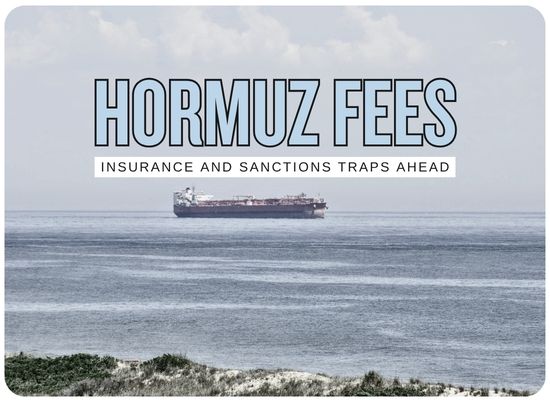
Hormuz Transit Fees: The Top Insurance and Sanctions Traps Shipowners Should Price Before Passage
🔔 Subscribe to ShipUniverse Weekly →
I think the first question is not how much the Hormuz fee costs, but what the payment does to cover, compliance and recovery. The larger problem is the chain reaction that can follow a payment connected to safe passage: hull cover, war-risk cover, P&I support, sanctions screening, banking, charterparty reimbursement, cargo interests, vessel data disclosure and post-voyage claims handling. A shipowner can price a visible toll, charge or service fee before passage, but the real decision is whether the owner remains insured, compliant and commercially protected after the payment is made.
Risk snapshot before passage
A Hormuz transit fee is not just a line item. It can become an insurance wording issue, a sanctions issue, a payment-processing issue and a charterparty dispute at the same time.
Shipowner takeaway Treat any Hormuz transit fee, toll, charge, guarantee or safe-passage service as a formal risk event. It belongs in the insurance file, sanctions file, payment file and charterparty file before the vessel commits to passage.
9 insurance and sanctions traps shipowners should price before passage
The fee label does not control the risk
A transit payment can be described as a toll, service fee, insurance fee, administrative charge, clearance payment, guarantee, route fee or facilitation cost. The label may help the invoice look ordinary, but insurers, banks and sanctions counsel will focus on the substance: whether value is being provided for safe passage through a restricted or politically controlled route.
- Owner check Review the beneficiary, collection agent, authority, service description and payment purpose before accepting any fee label.
- Hidden cost A charge may be commercially described as a service but legally viewed as safe-passage value.
- Pricing point Add sanctions counsel, bank review and payment-characterization cost before comparing the fee with waiting or rerouting.
- Red flag Any instruction that says the payment is “not really a toll” should trigger deeper review, not comfort.
Hull cover may stop responding after payment
The major insurance trap is not simply that the fee itself may be unrecoverable. The larger issue is whether policy wording treats the payment as an event that affects ongoing cover for the vessel. A shipowner should not assume a war-risk quote or hull policy remains fully responsive after a transit payment unless the wording is reviewed and the underwriter’s position is clear.
- Owner check Ask whether the vessel’s hull and war-risk policies contain a Hormuz transit-fee condition, sanctions clause or similar payment trigger.
- Hidden cost The owner could be most exposed immediately after taking the action intended to enable passage.
- Pricing point Model the potential loss of cover, claims dispute, legal cost and replacement-market availability.
- Red flag Verbal comfort is weak protection if the claim later turns on written policy language.
War-risk premium does not answer the sanctions question
Owners can pay additional premium for physical war-risk exposure and still have a separate problem with the payment required for passage. A war-risk quote may address missile, mine, seizure, detention, drone, terrorism or hostile-act exposure. It does not automatically authorize a transit payment or preserve cover if payment-related wording applies.
- Owner check Separate the physical transit risk from the legal effect of paying a passage-related charge.
- Hidden cost A vessel can be priced for war perils but still face a coverage issue triggered by the payment route.
- Pricing point Include AP, deductibles, exclusions, cancellation terms, sanctions screening and payment-condition review as separate lines.
- Red flag A quote that mentions war-risk capacity but not the fee payment should not be treated as complete.
Safe-passage services may create risk even without a cash transfer
The compliance problem may not require a simple bank payment. Guarantees, approvals, clearance services, digital payments, swaps, offsets, cargo-linked settlements, informal intermediaries, donations or third-party reimbursement can all create value. Owners should avoid thinking that an indirect structure makes the risk disappear.
- Owner check Map every direct, indirect, financial and non-financial benefit connected to passage.
- Hidden cost A workaround may look clever commercially but worse legally.
- Pricing point Add forensic payment review, counsel memo, bank consultation and post-transaction disclosure risk.
- Red flag Requests involving digital assets, unrelated invoices, offshore agents or substituted beneficiaries should pause the voyage decision.
Banks may reject or freeze the transaction path
Even if the owner, charterer and broker agree commercially, the payment still needs to move through a financial system that screens counterparties, currencies, banks, agents, beneficial owners and sanctioned parties. A rejected payment can create delay. A blocked payment can create a larger legal and liquidity problem.
- Owner check Confirm the bank’s position before any invoice, agent instruction or reimbursement mechanism is accepted.
- Hidden cost Funds can be delayed, blocked, questioned or escalated while the vessel waits.
- Pricing point Add payment failure, bank review, substitute routing, delayed hire and counterparty notice costs.
- Red flag Any instruction to avoid normal payment rails should be treated as a compliance warning, not a convenience.
Charterparty reimbursement can become a second dispute
The party pushing the transit may not be the party carrying the insurance and sanctions consequence. If the charterer wants the route but the owner pays, the owner needs written authority, lawful reimbursement language and a reservation of rights. A vague commercial instruction can leave the owner with the fee, the coverage issue and the arbitration risk.
- Owner check Review employment orders, war-risk clauses, sanctions clauses, deviation rights, indemnities and reimbursement provisions.
- Hidden cost The owner can move the vessel and still lose time fighting over who pays.
- Pricing point Include legal reserve, disputed hire, reimbursement delay, arbitration and unrecovered fee exposure.
- Red flag A charterer instruction to “just transit” without fee and insurance allocation is not a clean authority file.
P&I, cargo, hull and lender positions may split
One stakeholder’s acceptance does not bind the whole risk stack. Hull insurers, war-risk underwriters, P&I clubs, cargo insurers, cargo owners, lenders, charterers and managers may all evaluate the passage differently. Owners need a single matrix that shows where each stakeholder stands before committing the ship.
- Owner check Ask each coverage and commercial stakeholder for a written position tied to the exact fee scenario.
- Hidden cost The owner may preserve one layer of support while another stakeholder later disputes the voyage.
- Pricing point Add cargo notice, lender consent, P&I correspondence, claim coordination and coverage-gap reserves.
- Red flag A general “transit approved” note is too thin if the fee structure is not described.
Vessel intelligence requests can create their own exposure
Transit clearance may involve sharing vessel identity, ownership, insurance, financing, cargo, route, management, AIS history or trading background. That information can be sensitive if it is sent to a sanctioned entity, political authority, military-linked body or questionable intermediary as part of a safe-passage process.
- Owner check Review every requested document before submitting ownership, insurance, cargo or trading-history information.
- Hidden cost Sensitive disclosures may become part of a sanctions, security or commercial-risk record.
- Pricing point Include vessel-intelligence review, counterparty screening and data-handling controls.
- Red flag Requests for beneficial ownership, lender identity, insurance details or cargo value should be escalated before release.
Waiting may be cheaper than a bad compliance file
Delay is painful, especially when cargo is valuable, charter pressure is intense and the market is moving. But a rushed fee payment can create a longer and more expensive problem than waiting for a cleaner route, clearer insurer response, stronger legal opinion or alternative fixture. The comparison should not be fee versus delay. It should be fee plus legal tail versus delay plus optionality.
- Owner check Compare immediate passage, waiting, rerouting, no-fee passage, cargo substitution and fixture cancellation.
- Hidden cost The vessel may arrive faster but leave behind an insurance and sanctions file that costs more later.
- Pricing point Add post-voyage legal review, insurer response, payment audit, charter claim and regulator inquiry risk.
- Red flag Any decision memo that prices delay but not loss of cover is incomplete.
Transit-fee pricing map for owners
| Trap | Cost owner may miss | File to prepare | Party to involve | Priority |
|---|---|---|---|---|
| Fee label | Payment reclassified as safe-passage value. | Payment characterization memo. | Sanctions counsel and broker. | Immediate |
| Coverage trigger | Hull or war-risk cover affected after payment. | Policy wording and underwriter response. | Hull and war-risk broker. | Immediate |
| AP false comfort | War-risk premium paid without resolving payment wording. | AP quote plus exclusion review. | War-risk underwriter. | High |
| Non-cash value | Offset, swap, guarantee, crypto or third-party payment treated as value. | Full transaction-chain record. | Legal, finance and compliance. | Immediate |
| Bank rejection | Funds blocked, delayed or reported. | Bank clearance and screening record. | Bank compliance team. | Immediate |
| Charter recovery | Fee paid but reimbursement disputed. | Charterparty authority and indemnity memo. | Chartering desk and maritime lawyer. | High |
| Stakeholder split | P&I, hull, cargo, lender and charterer positions do not match. | Coverage and stakeholder matrix. | Broker, P&I club, lender and cargo interests. | High |
| Vessel data request | Sensitive ownership, insurance or cargo data sent to risky recipient. | Data disclosure review. | Compliance and vessel-intelligence provider. | Watch |
| Delay comparison | Transit appears cheaper because legal tail is excluded. | Wait, reroute and transit scenario model. | Operations, legal, chartering and insurance. | Immediate |
Practical test If the owner can show the fee amount but cannot show policy wording, underwriter response, sanctions-screening result, payment path, bank position, charter authority and reroute model, the Hormuz passage has not been fully priced.
Passage file owners should build before committing the vessel
- 01. Policy wording pack covering hull, war-risk, P&I, cargo, sanctions, terrorism, transit-fee and claims-response provisions.
- 02. Underwriter response file confirming whether any fee, toll, service charge, guarantee or indirect value transfer affects cover.
- 03. Sanctions-screening file listing payee, collector, authority, agent, bank, intermediary, currency, beneficial owner and service description.
- 04. Payment-path memo covering direct payment, third-party payment, crypto, offset, in-kind settlement, reimbursement and blocked-payment risk.
- 05. Charterparty authority review showing who ordered the transit, who pays, who reimburses, and which clause supports the decision.
- 06. Stakeholder matrix showing hull, war-risk, P&I, cargo, lender, charterer, manager and flag positions.
- 07. Vessel data disclosure review covering any requested ownership, insurance, financing, cargo, AIS, route or management information.
- 08. Scenario cost model comparing immediate transit, waiting, reroute, no-fee passage, cargo substitution and abandoned fixture.
- 09. Master’s instruction package giving the vessel clear routing, communication, AIS, escalation and emergency-response guidance.
Stakeholder conflict table
| Stakeholder | Likely concern | Owner question before passage | Document to collect |
|---|---|---|---|
| Hull underwriter | Payment may trigger a policy condition, exclusion or sanctions clause. | Does the proposed payment affect cover for this vessel? | Written underwriter response and wording review. |
| War-risk underwriter | Additional premium may not resolve payment-triggered legal exposure. | Does AP remain effective if a fee or guarantee is paid? | AP terms, exclusions and fee-condition review. |
| P&I club | Sanctions, crew safety, detention, deviation and liability response. | Does the club support the transit plan and payment position? | Club correspondence and risk memo. |
| Charterer | Route order, cost allocation, lawful reimbursement and delay responsibility. | Who pays, and what happens if insurers or banks object? | Charter instruction, indemnity and reservation of rights. |
| Cargo interests | Delay, coverage, route risk and transit-cost pass-through. | Are cargo insurers and buyers aligned with the route decision? | Cargo notice, insurance response and sale-contract review. |
| Bank | Blocked payee, sanctioned service, unusual currency or indirect settlement. | Will the bank lawfully process the transaction? | Bank compliance response and payment approval file. |
| Flag and manager | Master instructions, crew safety, incident reporting and route control. | Does the vessel have a clear operational decision tree? | Voyage risk assessment and emergency contact list. |
Owner decision gate before paying any Hormuz transit fee
A fee decision should pass a formal gate before finance, operations, chartering or the master takes action.
- Coverage gate Hull, war-risk, P&I and cargo positions have been confirmed in writing for the exact fee scenario.
- Sanctions gate The payee, authority, service, guarantee and payment path have been screened by qualified counsel.
- Bank gate The payment method, currency, intermediary and recipient have been reviewed by financial compliance.
- Charter gate The party ordering the transit has accepted lawful cost allocation and insurance consequences in writing.
- Data gate Any vessel, ownership, cargo, finance or insurance information requested for clearance has been reviewed before release.
- Alternative gate Waiting, rerouting, no-fee passage and cancelled-fixture scenarios have been priced against the payment scenario.
Hormuz transit fee exposure calculator
This planning screen helps owners compare the visible fee against wider insurance, sanctions, delay and charter-recovery exposure. It is not legal advice, sanctions clearance, insurance confirmation or a recommendation to transit.
Transit fee risk screen
Adjust the inputs to compare the visible fee against insurance, sanctions, banking and charter recovery risk.
Planning note: This tool does not include death, injury, pollution, detention, seizure, cargo loss, salvage, military escalation, regulatory penalties, exact sanctions exposure, insurer declinature, court outcome, exchange-rate issues, crew refusal, port closure or government intervention.
The owner mindset shift
Hormuz transit fees should not be treated like a canal invoice, port disbursement or ordinary voyage surcharge. The fee may look like the cost of movement, but it can also become the act that creates the owner’s insurance and sanctions problem. That changes the decision from a freight calculation into a board-level risk question.
The better approach is to price the whole chain. Confirm the policy wording, get the underwriter response, screen the payment path, check the bank position, document charter authority, protect vessel data, notify key stakeholders and compare waiting or rerouting against a bad passage file. A Hormuz transit may still be commercially necessary for some owners, but the fee must be priced as a legal and insurance exposure before it is priced as a voyage cost.
We welcome your feedback, suggestions, corrections, and ideas for enhancements.
Please click here to get in touch