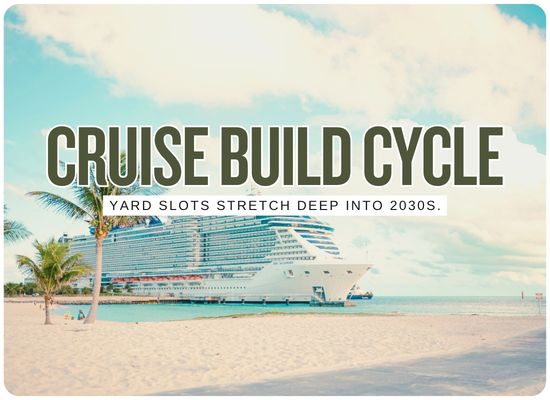
The cruise industry's next construction cycle is already moving well into the 2030s. Cruise Industry News counted 84 cruise ships, 229,384 berths and approximately $88.8 billion of newbuild investment through 2039 in its September orderbook, while Seatrade's narrower methodology counted 81 firm orders worth more than $94 billion plus over 30 additional vessels covered by options or memoranda of understanding. At the same time, CLIA estimates its member fleet at 327 ships and roughly 692,000 lower berths in 2026, with global cruise passenger volume forecast to rise from 38.3 million this year to 42.1 million in 2029. Fincantieri says European cruise production capacity is saturated and describes a new industrial cycle in which orders are again exceeding deliveries, while Royal Caribbean has separately secured access to Meyer Turku capacity through 2036. The result is that cruise lines ordering today are increasingly making decisions about fleet requirements five, ten or even thirteen years ahead, rather than simply filling the next available delivery window.
Cruise Shipbuilding Outlook · September 2026
The Next Cycle Is Already Occupying the 2030s
Cruise lines are no longer ordering only for the next fleet replacement window. Long series, options and framework agreements are pushing strategic shipbuilding decisions toward the end of the next decade.
Global Pipeline84 Ships
Cruise Industry News' September global orderbook count.
New Lower Berths229,384
Capacity represented by the current orderbook through 2039.
Investment~$89B
Estimated value of the current global newbuild pipeline.
Furthest Delivery2039
Princess orders have already pushed major European yard visibility to the end of the 2030s.
The New Cruise Shipbuilding Clock
26
2026Orderbook Rebuild
Ordering momentum returns across contemporary, premium, luxury and expedition fleets.
27
2027–2028Heavy Delivery Wave
Around 15 ships are scheduled for 2027, followed by another large group in 2028.
Norwegian, Oceania, Regent, Carnival and other long programs continue delivering ships ordered years earlier.
39
2038–2039Slots Already Claimed
Princess Voyager-class deliveries demonstrate how far forward major European capacity is already being allocated.
Industrial SignalEuropean Capacity Is Tight
Fincantieri explicitly identifies saturation of European cruise production capacity as one of the drivers shaping the industry's next construction cycle.
A Shipyard Slot Is Becoming a Strategic Asset
Royal Caribbean's Meyer Turku framework extends access through 2036. Long-dated programs at Fincantieri and Chantiers create similar visibility. For a line considering a large new platform in the middle of the 2030s, the shipbuilding decision can no longer be separated from securing industrial capacity.
Fleet Architecture · 2030s
The Next Cycle Will Not Have One Ship Size
Cruise shipbuilding is splitting into several distinct fleet strategies rather than converging on a single larger platform.
Mega ResortMaximum onboard economics
Typical Scale~227K–251K GT
Roughly 5,000–6,200 lower berths.
ProgramsIcon · Carnival · Norwegian
Destination ships designed to capture a larger share of guest spending onboard.
Next-Cycle LogicScale + Private Destinations
Economics increasingly connect the ship with beach clubs, islands and controlled destination infrastructure.
Large MainstreamMore deployment flexibility
Typical Scale~150K–180K GT
Around 4,000–5,400 passengers depending on design.
ProgramsAIDA · TUI · MSC Frontier
Large enough for strong onboard revenue but easier to deploy than the very largest resort ships.
Next-Cycle LogicFleet Workhorse
This size band may become increasingly important where port access and itinerary flexibility constrain mega-ships.
PremiumLower density, higher yield
Typical Scale~60K–90K GT
Approximately 700–1,400 guests.
ProgramsOceania · Regent · Crystal
Long-dated series orders show confidence in smaller, higher-spend passenger segments.
Next-Cycle LogicYield Over Volume
More space per guest and destination access can support a different return profile from mainstream capacity growth.
Small Ocean LuxurySeries growth is accelerating
Typical Scale~20K–54K GT
Roughly 190–1,000 passengers.
ProgramsViking · Four Seasons
Repeatable platforms allow brands to add capacity without entering the mega-ship arms race.
Next-Cycle LogicFleet Replication
Standardized sister ships can lower design risk while giving brands predictable capacity additions.
Yacht / ExpeditionNew yards are entering
Typical Scale~15K–30K GT
Commonly 180–400 guests.
ProgramsSeaDream · Atlas · Poseidon
Chinese builders are gaining projects that previously would have been heavily concentrated in Europe.
Next-Cycle LogicSpecialization
Smaller projects create an entry point for additional yards and unconventional propulsion concepts.
FincantieriVisibility to 2039
Large, premium, luxury and expedition programs give the group unusually broad exposure across the cycle.
Meyer TurkuFramework to 2036
Royal Caribbean has secured long-term capacity around its Icon program and future development.
ChantiersLarge-ship pipeline
MSC World Class, Royal Caribbean and Celebrity keep Saint-Nazaire positioned around high-complexity vessels.
ChinaNew capacity emerging
Domestic large-ship construction is now being joined by export-oriented luxury and expedition projects.
57%of ships on order had multi-fuel capability
CLIA's spring 2026 orderbook snapshot shows fuel flexibility becoming a defining specification rather than a niche feature.
Propulsion Uncertainty Is Shaping Design
The next building cycle must operate across tightening emissions rules without knowing which zero- or near-zero-carbon fuel will ultimately scale globally. That favors multi-fuel engines, shore-power capability, energy-efficiency systems and designs that preserve future conversion options rather than locking a ship into one fuel pathway for its entire service life.
Ship Universe Cruise Fleet Model
Next Building Cycle Capacity Planner
Estimate the number of new lower berths and ships needed to support a selected fleet-growth path while replacing retiring capacity.
Capacity implied by the selected annual growth rate.
Capacity Retired30,500
Modeled lower berths removed during the planning horizon.
New Berths Required367,000
Growth capacity plus modeled replacement demand.
Equivalent New Ships135
Theoretical ship count at the selected average size.
Modeled Program Scale
Current fleet692,000 berths
Capacity growth4.5% annually
Planning period9 years
Approx. newbuild capital$142B
InterpretationThis Is a Capacity Proxy, Not an Order Forecast
Cruise-passenger growth does not translate one-for-one into lower-berth growth. Occupancy, cruise duration, itinerary mix, ship productivity, fleet retirements and pricing all matter. The model is designed to show the industrial scale implied by different assumptions, not predict the number of ships that will actually be ordered.
Scenario model:
the 692,000-berth default comes from CLIA's 2026 fleet estimate. The 4.5% preset mirrors Fincantieri's cited cruise-passenger growth assumption for 2024–2032. The average 2,730-berth ship is derived from the current Cruise Industry News global orderbook and should not be interpreted as a preferred future ship size.
Feedback Welcome
We welcome your feedback, suggestions, corrections, and ideas for enhancements.