🔔 Subscribe to ShipUniverse Weekly →
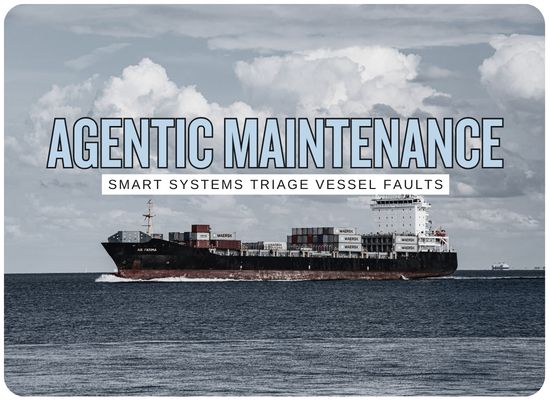
The first useful shipboard agents may not steer the ship. They may keep it running.
Autonomous ships get the headlines, but maintenance may get the earlier payback. A vessel already throws off engine alarms, generator data, fuel trends, vibration signals, work orders, manuals, spare-part records and OEM notes. Agentic AI becomes interesting when it stops acting like a chatbot and starts doing the maintenance desk work around those signals.
Agentic maintenance is different from another alarm dashboard
A normal condition-monitoring system detects the signal. An agentic maintenance system should pull the evidence, compare it with operating mode, check the manual, look at history, draft the work order, identify parts, involve the right expert and preserve an audit trail for the superintendent.
The serious shift is tool-grounded reasoning
The important research pattern is not “LLM reads raw sensor data.” It is an agent using tools: anomaly model output, measured values, derived metrics, operating mode, historical cases and technical references. That matters on ships because machinery behavior changes with load, DP mode, weather, fuel, maintenance state and redundancy requirements.
Do not buy “agentic AI” because it talks. Buy it only if it can prove which data it used, which tool it called, which fault it suspects, and which human must approve the action.
Maintenance work agentic AI could take over first
Anomaly triage
Sort alarms, sensor deviations and trend changes into normal variation, watch items and urgent exceptions.
Fault diagnosis support
Connect symptoms across engine load, temperatures, pressures, vibration, fuel and operating mode.
Work-order drafting
Create clear maintenance jobs with suspected cause, affected asset, urgency, checks, tools and safety notes.
Spare-parts matching
Check installed equipment, manuals, inventory, lead time and substitute parts before the vessel reaches port.
Remote expert packet
Package logs, screenshots, trends, alarms, parts, history and crew notes before OEM support joins.
Dynamic maintenance scheduling
Move jobs around operating windows, port calls, class items, crew load, parts arrival and failure risk.
Maintenance report writing
Turn messy notes into consistent defect reports, closeout records, lessons learned and fleetwide patterns.
Survey and evidence packs
Assemble condition trends, maintenance records, tests, photos, certificates and exception notes for review.
Where agents fit, and where humans stay in charge
| Job | Agent role | Human role | Data needed | Main risk | Fit |
|---|---|---|---|---|---|
| Anomaly triage | Rank signals and suppress noise | Confirm urgency and vessel impact | Sensor trends, alarms, operating mode | Alarm fatigue or missed weak signal | Very high |
| Fault diagnosis | Suggest likely causes and checks | Approve diagnosis and next action | History, manuals, measured values, model output | Wrong cause with confident language | High |
| Work-order drafting | Draft task, urgency and checklist | Edit, approve and assign | PMS, equipment hierarchy, defect note | Poor scope creates wasted labor | Very high |
| Spares matching | Identify part candidates and lead time | Authorize purchase or substitution | Inventory, maker manuals, purchase history | Wrong part or obsolete reference | High |
| Remote expert packet | Prepare evidence for shore or OEM | Control access and approve support | Logs, trends, photos, screenshots, work history | Data leak or uncontrolled vendor access | High |
| Dynamic scheduling | Recommend best maintenance window | Balance commercial and safety priorities | Port calls, jobs, risk score, spares, crew | Commercial plan overrides engineering reality | Medium high |
| Report writing | Standardize defect and closeout records | Sign off technical accuracy | Notes, photos, job history, asset register | Clean prose hides weak evidence | Very high |
| Survey evidence | Assemble auditable maintenance package | Validate before class or vetting review | Certificates, tests, trends, closeouts, exceptions | Missing source record | High |
Procure the workflow, not the buzzword
| Buyer demand | Weak answer | Strong answer | Document to request | Priority |
|---|---|---|---|---|
| Tool-grounded reasoning | LLM analyzes vessel data | Agent calls approved tools, models and sources with visible evidence | Agent architecture note | Very high |
| Fault coverage map | Detects equipment problems | Lists supported assets, fault types, confidence limits and unknowns | Fault library and coverage matrix | Very high |
| Data quality controls | Uses real-time data | Flags stale, missing, conflicting and outlier signals before diagnosis | Data validation method | Very high |
| Maintenance-system integration | Connects to PMS | Asset hierarchy, work orders, spares, running hours and closeouts mapped | PMS integration map | High |
| Human approval | Crew remains in control | Named approver, action limits, override, escalation and audit trail | Authority matrix | Very high |
| OEM and cyber controls | Remote experts can assist | Timed access, named users, session logs, data limits and closeout revocation | Remote-support procedure | High |
| Performance proof | Reduces downtime | Lead time, false positives, missed detections, accepted work orders and avoided failures shown | Pilot results report | Very high |
Agentic AI should not create maintenance actions in the dark. Every recommendation should show the source data, the suspected fault, the confidence level, the required human approval and the rollback path if the action is wrong.
Agentic Maintenance Readiness Scorecard
Use this quick screen to judge whether a vessel is ready for agentic maintenance workflows or only basic condition-monitoring alerts.
Planning tool only. Final deployment should reflect vessel class, criticality, machinery configuration, crew competence, OEM requirements, PMS quality, cyber architecture, flag, class and the company safety management system.
Maintenance agents arrive before autonomous ships because the job is narrower
Agentic AI does not need to command the vessel to be useful. It can start by doing the maintenance desk work humans already struggle to keep tidy: triaging anomalies, explaining likely faults, drafting jobs, matching spares, preparing OEM packets, rescheduling work, cleaning reports and building evidence files. The winning systems will be the ones that stay grounded in real vessel data and keep engineers, superintendents and class clearly in the approval loop.