
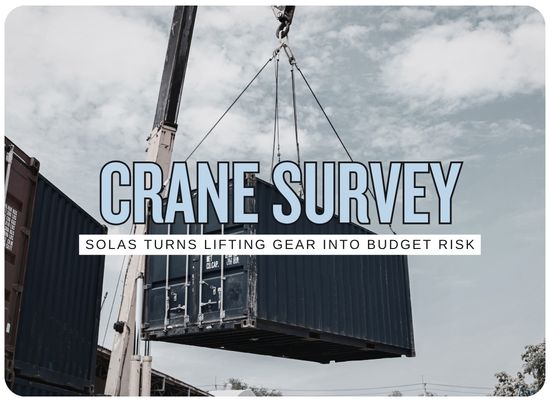
Your Ship’s Cranes Are Now a SOLAS Issue: 10 Costs Owners Should Budget Before the Next Renewal Survey

Your Ship’s Cranes Are Now a SOLAS Issue: 10 Costs Owners Should Budget Before the Next Renewal Survey
A ship crane that has worked for years can still become a renewal-survey problem in 2026. That is why we keep coming back to cranes. SOLAS has turned cargo cranes, hose-handling cranes, stores cranes, engine-room cranes and related loose gear into a more formal examination, testing, marking and documentation file. The cost is not only the surveyor. It can be load testing, SWL evidence, NDT, wire ropes, brakes, hydraulics, controls, manuals, class attendance and a replacement decision if the crane can no longer prove the load it is expected to lift.
Certificates, SWL marks and test records are clean
The crane already has a credible test and examination history, the SWL is marked, loose gear is documented and the survey file is complete.
The crane works, but the proof file is thin
The owner may need load testing, documentary SWL evidence, updated manuals, register entries, class attendance and corrective repairs.
Testing exposes structure, brake or control problems
NDT findings, wire-rope defects, brake slippage, hydraulic leakage, slew-bearing play or obsolete controls can push the crane from certification into major repair.
The new cost is the evidence behind the lift
The 2026 SOLAS change does not mean every ship crane suddenly needs to be replaced. It means owners need a stronger file showing that lifting appliances and associated loose gear are safe to operate, tested where required, thoroughly examined, marked with safe working load and supported by documentary evidence.
That changes the renewal-survey budget. A crane that has been treated as a working deck asset now needs to be treated as a statutory-survey asset. If the certificate history, load-test record, SWL marking, loose-gear register, operations manual, maintenance record or inspection routine is weak, the owner may discover the real cost only when the survey window is already tight.
Owner takeaway: The cheapest approach is not waiting for the renewal survey. It is building the crane evidence file early, finding the defects before the surveyor does, and deciding whether the vessel needs simple certification work, a targeted overhaul or a major crane replacement package.
10 costs owners should budget before the next renewal survey
Crane inventory and applicability review
The first cost is administrative, but it prevents expensive surprises. Owners need a shipboard inventory of lifting appliances and loose gear: cargo cranes, hose-handling cranes, stores cranes, engine-room cranes, monorails, lifting beams, chain blocks, shackles, hooks, grabs, spreaders and any special gear used with the crane.
Survey file review, onboard walkdown, equipment list, SWL list, serial numbers and certificate gap report.
Small gear can delay the file if it is used in the lifting arrangement but has no valid certificate or clear traceability.
SWL marking and documentary evidence
The crane may have a visible rating plate, but the survey file needs more than paint. Owners may need to confirm the safe working load, maximum or minimum radius, boom angle limits, configuration restrictions and documentary evidence that supports the marked SWL.
SWL verification, permanent marking, rating-plate renewal, load chart updates and supporting certificate file.
If the original design information is missing, the nominated SWL may need engineering review and proof testing.
Competent-person examination and class attendance
The survey does not start with the crane lifting a test weight. It starts with competent examination, planning and attendance. The owner may need class, an approved service provider, OEM technicians, a bunker or cargo terminal window, and a safe test area.
Class attendance, competent-person inspection, travel, port coordination, access equipment and certification issue fees.
Waiting for the right service provider or surveyor can become more expensive than the examination itself.
Load testing, test weights and safe test setup
Load testing can be one of the largest practical costs. The owner may need calibrated weights, water bags, load cells, rigging, barge or quay support, ballast planning, weather windows, exclusion zones and post-test examination.
Test weights or water bags, load-cell calibration, rigging, safety plan, crane operator, port time and post-test inspection.
A failed load test can turn the renewal survey into structural repair, brake overhaul or crane derating.
NDT of booms, pedestals, foundations and welds
Thorough examination can expose cracks, corrosion, deformation, old repairs, pedestal concerns, foundation questions, boom damage or weld indications. NDT is where a working crane can become a steel-repair project.
MPI, UT, thickness gauging, weld inspection, access staging, coating removal, engineering review and repair drawings.
Small findings can grow when access is opened, coatings are removed or historical repairs are traced.
Wire ropes, sheaves, hooks, blocks and loose gear
Wire ropes and loose gear are not side items. They are part of the certified lifting chain. Broken wires, corrosion, poor lubrication, damaged sheaves, worn hooks, questionable shackles, missing certificates or unknown history can trigger replacement before the crane file is accepted.
New wire ropes, rope end terminations, sheave inspection, hook/block overhaul, loose-gear test certificates and register updates.
Changing rope or gear can trigger retesting, brake checks or load-limiter calibration before return to service.
Brakes, winches, slew bearings and mechanical drives
Brake performance is central to safe lifting. Owners may need brake testing, adjustment, lining replacement, winch inspection, gearbox work, slew-bearing clearance readings, bolt checks, lubrication analysis or major mechanical overhaul.
Brake test kit, brake linings, winch service, gearbox inspection, slew-bearing readings, bolt torque checks and mechanical spares.
Slew-bearing play or brake slippage can become one of the most expensive findings in the survey file.
Hydraulics, hoses, cylinders and leak control
Hydraulic cranes can pass casual visual checks but still carry survey risk through leaking hoses, tired seals, cylinder scoring, pump weakness, control-valve faults, contaminated oil or pressure settings that no longer support safe operation.
Hydraulic hoses, cylinder seals, pumps, valves, filters, oil flushing, pressure testing, leak repairs and HPU service.
Hydraulic work can affect brake, luffing, slewing and hoisting performance, which may require functional retesting.
Controls, load limiters, sensors and data records
Modern crane compliance is increasingly tied to control reliability. Load moment indicators, overload protection, encoders, limit switches, PLCs, HMIs, alarms, emergency stops and calibration records can become survey blockers if they are obsolete or unreliable.
Sensor replacement, load-limiter calibration, control cards, PLC/HMI service, alarm checks, display replacement and software support.
Obsolete electronics can force owners toward a controls modernization even when the steel and hydraulics are acceptable.
Derating, replacement or major modernization decision
The final cost is the decision no one wants at survey week. If the crane cannot prove its original SWL, if repair costs are rising, if the OEM no longer supports key parts or if the vessel’s cargo profile has changed, derating or replacement may be more rational than another cycle of emergency repairs.
Engineering review, derating plan, replacement crane quote, yard integration, foundation checks, controls package and off-hire model.
A crane replacement can pull in steel work, electrical work, hydraulics, class approval, yard slot timing and cargo-operation downtime.
Renewal-survey cost map
| Cost line | Budget trigger | Evidence needed | Risk if delayed | Likely posture |
|---|---|---|---|---|
| Inventory and applicability | Ship has multiple cranes, lifting beams, loose gear or undocumented small gear. | Equipment list, SWL, serial numbers, location and certificate status. | Survey file gaps appear too late. | Start early |
| SWL marking | SWL is not clear, permanent, visible or supported by documents. | Marking, load chart, certificate and operating limits. | Derating or retesting may be needed. | Evidence gap |
| Load testing | Existing test certificates are absent, expired or not acceptable to the Administration. | Test plan, calibrated load, competent-person report and post-test exam. | Port delay and failed renewal item. | Major cost |
| NDT and structure | Cracks, corrosion, old repairs, pedestal concerns or overload history. | NDT report, repair drawings, material records and class acceptance. | Steel work expands under survey pressure. | High uncertainty |
| Wire ropes and loose gear | Rope wear, corrosion, broken wires, missing certificates or unknown gear origin. | Rope certificates, loose-gear test certificates and register entries. | Crane cannot be certified as a complete lifting arrangement. | Common spend |
| Brakes and winches | Brake test fails, winch slips, gearbox wear or slew-bearing readings exceed limits. | Brake test, service report, clearance readings and functional test. | Load test failure or operational restriction. | Critical repair |
| Hydraulics and controls | Leaks, pressure instability, sensor drift, obsolete PLC/HMI or calibration failures. | Service report, calibration records, pressure tests and alarm records. | Functional limitations and unreliable safe-operation proof. | Upgrade review |
| Replacement or derating | Repair cost approaches asset value or original SWL cannot be defended. | Engineering assessment, new SWL, replacement quote and business case. | Long off-hire, lost cargo capability or recurring non-compliance. | Board decision |
Budget grows when...
- The crane has no clear prior test and thorough examination certificate.
- The SWL is unclear, undocumented or no longer trusted.
- Loose gear has missing certificates or mixed ownership history.
- Hydraulic leaks, brake issues or control faults appear during testing.
- NDT finds pedestal, boom, foundation or weld concerns.
Budget stays controlled when...
- The owner starts the evidence review before the renewal window.
- OEM manuals, certificates, load charts and register entries are complete.
- Wire ropes, hooks, blocks and shackles have clean traceability.
- Known defects are repaired before the load test.
- Class, competent person and service provider are aligned on scope.
Service markets created by the SOLAS crane file
The spend is not only on crane steel. It is on proof, testing, traceability and safe return to service.
Owners preparing for renewal survey may need a package that combines class attendance, OEM service, load testing, NDT, rope and loose-gear certification, brake testing, hydraulic overhaul, controls calibration and updated documentation.
Supplier opportunity map
| Provider niche | Owner pain | High-value offer | Buyer trigger |
|---|---|---|---|
| Crane OEM service | Owners need parts, expertise and an approved service pathway. | Inspection, brake testing, hydraulic service, controls support, spares and modernization. | Existing crane has OEM support but rising reliability issues. |
| Load-testing providers | Survey requires safe, documented proof of lifting capacity. | Water bags, calibrated load cells, rigging, test planning and competent-person reports. | First renewal survey after 1 January 2026 or post-repair testing. |
| NDT and structural firms | Hidden cracks, corrosion or foundation problems can block certification. | MPI, UT, thickness gauging, pedestal checks, boom inspection and repair recommendations. | Older cranes, heavy lifts, overload history or visible corrosion. |
| Wire-rope and rigging suppliers | Rope, hooks, blocks and shackles need condition and certificate confidence. | Certified rope supply, terminations, loose gear, testing and register documentation. | Rope wear, missing certificates or gear replacement before load test. |
| Hydraulic service companies | Leaks, pressure loss and actuator problems affect safe lifting. | Hoses, cylinders, pumps, valves, filters, oil flushing and pressure setting. | Hydraulic alarms, crane drift, weak luffing or oil contamination. |
| Controls and automation firms | Load limiters, HMIs, PLCs and sensors may be obsolete or uncalibrated. | Calibration, control-card replacement, load-moment system upgrade and data records. | Alarm faults, unsupported electronics or surveyor concern about overload protection. |
| Class and compliance advisors | Owners need an acceptable pathway for old or undocumented cranes. | Gap audit, certificate review, modification pathway, survey planning and register setup. | Missing SWL evidence, past modifications or non-OEM substitutions. |
Renewal-survey preparation workflow
Use this sequence before the vessel arrives at the survey window.
Crane renewal-survey budget calculator
This planning screen estimates whether the next renewal survey is likely to be a routine certification event, a repair-heavy crane overhaul or a replacement decision.
SOLAS crane survey budget screen
Adjust the inputs to estimate whether the crane file is routine, repair-heavy or replacement-risk.
Planning note: This simplified screen does not include exact flag instructions, class pricing, port-specific test constraints, crane SWL, water-bag availability, weather delays, cargo disruption, yard mobilization, final NDT findings, replacement crane lead time, tax, insurance, charterparty recovery or final Administration approval.
The owner mindset shift
A working crane is no longer enough. The owner needs a crane that can be tested, examined, marked, documented, maintained and defended through the next renewal survey. That is a different standard from “the crew used it last port and it worked.”
The best commercial move is to treat the SOLAS lifting-appliance file like a mini-drydock work package. Identify the cranes, test the proof file, inspect the steel, check the ropes, verify the brakes, service the hydraulics, calibrate the controls and decide early whether the asset deserves another repair cycle. The survey cost is visible. The larger risk is discovering too late that the crane cannot prove the lift.
We welcome your feedback, suggestions, corrections, and ideas for enhancements.
Please click here to get in touch