Maersk’s Fleet Ceiling Crack Signals a New Container Capacity Race
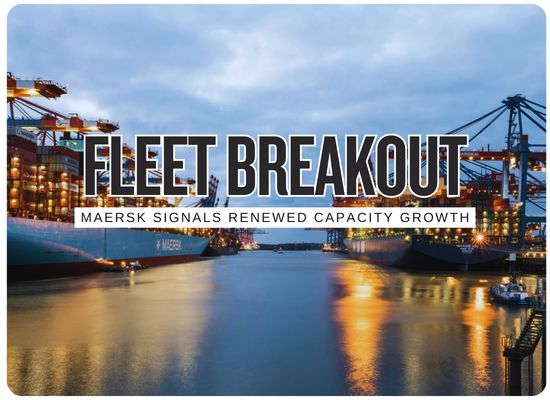
Maersk appears to be moving toward a new phase in its container fleet strategy after years of emphasizing capacity discipline, fleet renewal, decarbonisation and integrated logistics over aggressive slot growth. The reported shift follows second-quarter comments that Maersk needs to ensure it has enough capacity to grow, a notable change for a carrier that previously said newbuilding and charter deals were meant to replace older tonnage rather than expand its overall fleet beyond roughly 4.3 million TEU. The timing is important because the market around Maersk has changed quickly. Rival carriers have expanded faster, MSC has widened its fleet-share lead, global container demand has stayed stronger than expected, and port congestion plus Red Sea and Middle East disruption have absorbed vessel supply. At the same time, the industry orderbook is already heavy, meaning any Maersk growth push would land in a market where shipyard slots, fuel choices, vessel size, charter exposure and overcapacity risk all matter.
Ship Universe Container Strategy Watch
Operator Impact Snapshot
Maersk’s capacity discipline may be giving way to a more growth-oriented fleet plan.
Fleet ceiling pressure
Maersk had framed renewal orders around keeping fleet size near 4.3 million TEU, but recent comments point toward more capacity for growth.
Rival growth gap
Linerlytica’s comparison of 2% Maersk growth versus 11.7% among key rivals puts the strategic pressure in simple terms.
Renewal still matters
Fleet expansion would not replace the decarbonisation story. Dual-fuel ships, older-vessel replacement and emissions rules remain central.
Ordering-cycle risk
A new ordering phase would arrive while the global containership orderbook is already historically large.
Network constraint signal
Port congestion, strong Asian exports and Red Sea disruption have made vessel availability feel tighter than headline fleet capacity suggests.
Mid-size vessel gap
Drewry’s comment on Maersk’s orderbook suggests growth may not only mean mega-ships. Smaller and regional tonnage could matter more.
Fleet Strategy Board
Capacity Discipline Meets Growth Pressure
The strategic question is moving from fleet renewal to fleet sufficiency.
Maersk’s 2024 renewal plan said incoming vessels would replace older ships and keep fleet size around this level.
Linerlytica’s figure cited by Splash, compared with 11.7% among key rivals.
Maersk said its orderbook stood at 33 vessels after signing for eight 18,600 TEU ships.
| Strategy Piece | Latest Detail | Commercial Signal | Risk or Limit | Pressure Meter |
|---|---|---|---|---|
| Capacity CeilingOld discipline model | Fleet renewal was previously framed around maintaining overall fleet size near 4.3 million TEU. | That restraint supported capital discipline and reduced late-cycle overcapacity exposure. | If demand stays firm, the ceiling can become a market-share and network-growth constraint. | High |
| Renewed Growth SignalManagement tone shift | Maersk has now indicated it needs enough capacity to grow after reaching the limits of the current fleet. | That language moves the story beyond pure replacement tonnage. | The market will watch whether this becomes orders, charters, acquisitions, or network redesign. | High |
| Rival ExpansionMarket-share pressure | MSC’s capacity lead has widened while Maersk followed a more disciplined fleet path. | A capacity gap can affect schedule depth, blank-sailing flexibility, alliance leverage and customer allocation. | Growth may be needed to protect network relevance, not only to chase volume. | High |
| Large-Ship Orderbook18,600 TEU series | Eight large dual-fuel ships are scheduled for 2029 and 2030 delivery. | The ships offer mainline scale while staying below the very largest 400-meter class designs. | Large ships help core lanes, but they do not solve every feeder, regional or inland-network problem. | Medium High |
| Small and Mid-Size GapRegional trade need | Drewry noted Maersk’s orderbook is far heavier in vessels above 15,000 TEU than in ships below 6,000 TEU. | Growth in intra-regional trades may require a different vessel mix than Asia-Europe mainline renewal. | The next strategic move may involve charters or smaller newbuildings, not just ultra-large tonnage. | Watch |
| Orderbook BackdropIndustry supply cycle | The global containership orderbook exceeded 12 million TEU at the start of 2026. | Maersk would be expanding into a market already carrying major newbuilding supply. | Timing matters. New ships ordered now may arrive when congestion and Red Sea disruption no longer absorb capacity. | High |
Fleet Growth Breakpoint Tool
Estimate the capacity gap created when a disciplined fleet ceiling meets a new growth target.
Target Fleet Size
5.0M TEU
Fleet size implied by the selected growth target and planning window.
Total Capacity Need
1.4M TEU
Growth capacity plus replacement capacity required during the planning window.
Uncovered Capacity Gap
596,000 TEU
Estimated capacity still needed after committed renewal capacity.
Ship Equivalent
40 ships
Estimated number of vessels needed at the selected average ship size.
Fleet Strategy Signal
The model shows a meaningful gap between a capped fleet and the selected growth target. Additional orders, charters or capacity partnerships may be needed.
We welcome your feedback, suggestions, corrections, and ideas for enhancements.
Please click here to get in touch