IAEA Launches ATLAS to Bring Nuclear Power Back to Civilian Shipping as IMO Targets New Rules by 2030
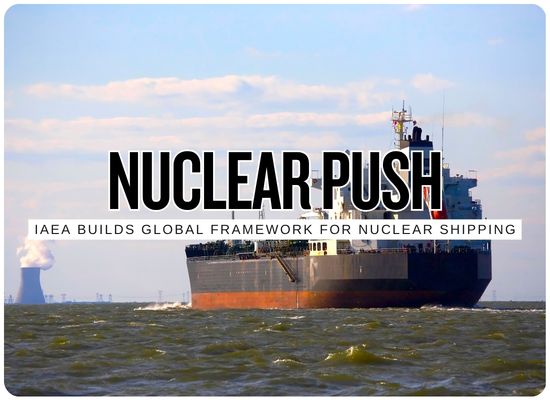
Nuclear-powered merchant shipping moved a significant step closer to becoming an organized international industry on August 26 when the International Atomic Energy Agency launched ATLAS, Atomic Technologies Licensed for Applications at Sea, in Washington. The initiative brings nuclear regulators, maritime authorities, classification societies, shipowners, ports, reactor developers and governments into one framework for the first time specifically to address civilian nuclear-powered ships and floating nuclear power plants. Around 600 participants from more than 50 countries are attending the two-day launch, while more than two dozen governments signed the accompanying joint statement. Six ATLAS project groups will now begin work on safety standards, maritime law, classification, safeguards, security and the practical deployment infrastructure needed to take reactors from concepts into ships. The timing is important because the IMO is simultaneously rewriting its 1981 Code of Safety for Nuclear Merchant Ships, with the current work plan targeting a revised Nuclear Code and amendments to SOLAS Chapter VIII in 2030. The IAEA says advances in reactor design, fuel and maritime engineering mean some commercial maritime nuclear concepts could potentially be ready for deployment during the 2030s.
Operator Impact Snapshot
The biggest change is not a new reactor design. It is the beginning of a coordinated international attempt to create rules allowing nuclear-powered commercial ships to be licensed, classified, insured and accepted by ports.
Around 600 participants are connecting governments, ports, shipowners, nuclear companies and regulators.
Safety, law, classification, safeguards, security and the deployment roadmap are being addressed separately.
SOLAS Chapter VIII still points to a framework written decades before today's advanced SMR concepts.
IMO's current work plan targets completion and adoption of an updated Nuclear Code and SOLAS changes.
Some maritime nuclear designs could potentially reach deployment during the next decade if regulatory and commercial barriers are resolved.
The Six Problems ATLAS Has to Solve
Each project group addresses a different barrier between today's reactor concepts and a merchant vessel that can routinely trade between international ports.
| ATLAS Project Group | Problem Being Addressed | Direct Maritime Question | Current Industry Signal | Near-Term Work |
|---|---|---|---|---|
|
GROUP 1 International Safety Codes & Standards |
Nuclear standards and maritime safety rules were developed largely in separate regulatory systems. | Which rules govern collision protection, grounding, reactor containment, emergency systems, fire, flooding and ship accidents? | IMO's Nuclear Merchant Ship Code dates from 1981 and is now being revised alongside SOLAS Chapter VIII. | Inventory existing IAEA and IMO requirements, identify gaps and recommend revisions and harmonization. |
|
GROUP 2 Legal & Regulatory Framework |
A mobile reactor can cross several legal jurisdictions during a single voyage. | Which regulator licenses the reactor? Which state carries liability? Can a port refuse entry? Which insurance regime applies after nuclear damage? | The U.S. NRC began work in 2026 on a white paper addressing licensing pathways for floating reactors and nuclear propulsion. | Map nuclear law, maritime law, licensing, jurisdiction, liability and insurance gaps. |
|
GROUP 3 Maritime Classification |
Class approval and nuclear licensing use different standards, terminology and inspection systems. | Who certifies the reactor-to-hull interface, shielding, electrical systems, propulsion train and safety-critical structures? | Lloyd's Register and ABS have already issued approvals in principle for several Korean nuclear-powered ship concepts. | Compare design assessment and inspection practices and develop common classification interfaces. |
|
GROUP 4 IAEA Safeguards |
Traditional nuclear safeguards were designed primarily around fixed land facilities. | How does the IAEA maintain knowledge of nuclear material aboard a vessel moving between countries? | Mobile reactors create new questions around inspector access, international movements and cross-jurisdiction verification. | Develop deployment scenarios, gap assessments and Safeguards-by-Design recommendations. |
|
GROUP 5 Nuclear Security |
Ships are mobile assets exposed to cyber threats, criminal activity and physical attack in ways land reactors generally are not. | Which physical protection, cyber, crew-trustworthiness, emergency and contingency measures should follow the ship globally? | ATLAS says nuclear-powered ships require dedicated security guidance beyond frameworks developed for conventional nuclear installations. | Review current security instruments and identify requirements requiring clarification or new guidance. |
|
GROUP 6 Technology, Infrastructure & Fuel Cycle |
Even a fully licensed reactor is unusable without shipyards, ports, fuel services and lifecycle infrastructure. | Where is a ship fuelled, serviced, refuelled, defuelled and eventually decommissioned? | Ports and governments are already beginning site-specific nuclear-readiness studies. | Develop deployment roadmaps covering technology readiness, logistics, fuel cycle, refuelling, relocation and decommissioning. |
Nuclear Propulsion Fuel-Avoidance & Break-Even CAPEX Analyzer
Estimate how much conventional bunker and carbon cost a reactor-powered vessel could avoid, then test how much incremental nuclear capital cost those operating savings could economically support.
We welcome your feedback, suggestions, corrections, and ideas for enhancements.
Please click here to get in touch