Gulf Bypass Buildout Accelerates as Hormuz Risk Rewrites Energy Logistics
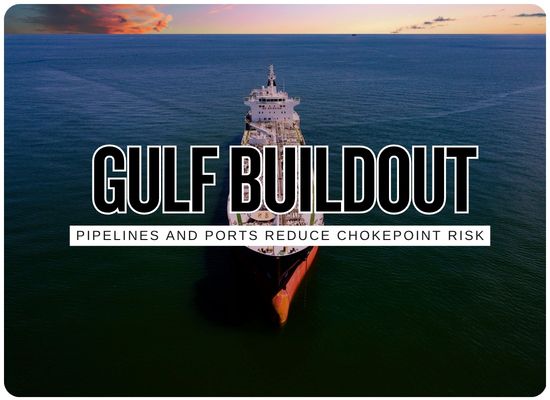
Gulf states are moving faster to build around the Strait of Hormuz as shipping risk, insurance pressure and uneven traffic recovery turn the region’s main chokepoint into a long-term infrastructure problem. The UAE is expanding Fujairah’s role as an east-coast outlet with new DP World terminals and a crude pipeline push designed to lift export capacity outside the Gulf. Saudi Arabia is looking at adding capacity to its East-West crude system toward the Red Sea while Jeddah’s container terminal investment points to a broader Red Sea logistics buildout. Oman is gaining leverage through Sohar, Duqm and Salalah as sea-land corridors pull cargo around the strait, while Qatar, Kuwait and Bahrain remain more exposed because they lack the same scale of direct bypass infrastructure.
Gulf Trade Is Building a Second Exit Plan
Pipeline capacity, east-coast terminals, Red Sea ports and Oman corridors are becoming practical insurance against Hormuz disruption.
UAE East-Coast Push
Fujairah is becoming the UAE’s main non-Hormuz pressure valve through crude pipeline expansion, container capacity and inland logistics links.
Saudi Red Sea Hedge
Saudi Arabia’s East-West crude system and Red Sea port investment are turning Yanbu and Jeddah into more important Gulf bypass nodes.
Oman Gains Route Value
Sohar, Duqm and Salalah give cargo owners ports outside the tightest Gulf risk zone, especially when paired with customs corridors and trucking.
Qatar Remains Exposed
Qatar’s LNG scale still depends heavily on Hormuz, making alternative gas export infrastructure far harder than container or crude rerouting.
Inland Logistics Becomes Strategic
Ports alone are not enough. The winning bypass routes need depots, customs lanes, trucking, pipelines, storage and rail-style connectivity.
The operating signal is that Gulf infrastructure is being repriced as resilience capacity. A port, pipeline or inland depot that avoids Hormuz is no longer just an efficiency project, it is now part of the region’s export security architecture.
Hormuz Bypass Infrastructure Board
The buildout is spreading across crude pipelines, east-coast terminals, Red Sea ports, inland depots, Oman corridors and alternative loading strategies.
The most important shift is that Gulf exporters are no longer treating Hormuz disruption as a short interruption. Infrastructure spending now points to a more permanent hedging strategy, with each country trying to reduce the number of critical cargoes that must wait for a narrow maritime corridor to normalize.
Approximate share of global oil and LNG shipments previously moving through Hormuz.
Target year for the UAE’s expanded Fujairah crude export capacity to become operational.
Potential added Saudi pipeline capacity being considered toward the Red Sea.
Saudi RSGT and CMA CGM investment plan for Terminal 4 at Jeddah Islamic Port.
Bypass Route Development Table
| Country / Route | Latest Signal | Commercial Read | Stakeholders | Status |
|---|---|---|---|---|
| UAE, Fujairah crude outlet | The UAE is accelerating a new oil pipeline project to expand crude export capacity through Fujairah. | Fujairah becomes a higher-value loading and storage node because it sits outside the inner Gulf side of Hormuz. | ADNOC, tanker owners, storage firms, traders, insurers | High |
| UAE, DP World Fujairah terminals | DP World reached an agreement in principle for a 50-year concession covering Al Rugaylat and Dibba terminals. | The east coast is being positioned as a cargo gateway, not only an oil export workaround. | Container lines, cargo owners, forwarders, ports, truckers | Positive |
| UAE inland depots | DP World is also working on inland container depots and wider inland logistics connectivity. | The bypass only works if cargo can move quickly from east-coast terminals into Dubai, Abu Dhabi and regional markets. | Warehouse operators, customs brokers, carriers, cargo owners | Medium |
| Saudi East-West pipeline | Saudi Arabia is considering adding up to 1 million to 2 million bpd of capacity toward the Red Sea. | Saudi Arabia has the clearest large-scale crude alternative because oil can move west to Yanbu instead of through Hormuz. | Aramco, VLCC owners, Red Sea ports, refineries, Asian buyers | High |
| Saudi Red Sea ports | RSGT and CMA CGM signed a $434 million deal to develop Terminal 4 at Jeddah Islamic Port. | Jeddah’s investment supports a wider Red Sea gateway strategy for containerized cargo and inland distribution. | Container lines, shippers, Saudi logistics firms, terminal operators | Positive |
| Oman Sohar, Duqm and Salalah | Omani ports are being used and promoted as alternative sea-land entry points for Gulf cargo. | Oman gains strategic value because cargo can land outside Hormuz and move overland into UAE and wider GCC markets. | Omani ports, GCC importers, hauliers, customs authorities | Medium |
| Sharjah-Oman corridor | Sharjah launched an integrated logistics corridor with Oman covering Sohar, Duqm and Salalah. | Customs and land-border coordination are becoming as important as port capacity for non-Hormuz cargo flows. | UAE importers, Oman ports, forwarders, trucking firms | Positive |
| Qatar LNG exposure | Qatar’s LNG system remains heavily tied to Ras Laffan and Hormuz access. | Pipeline and port bypass strategies are harder for LNG because liquefaction, storage, shipping and buyers are locked into large fixed assets. | QatarEnergy, LNG buyers, utilities, gas carriers, lenders | Watch |
| Kuwait and Bahrain | Both remain constrained by geography and lack Saudi/UAE-scale direct bypass capacity. | These markets may rely more on Saudi routes, Oman gateways, trucking, stockpiles and flexible procurement. | Importers, refiners, ports, logistics providers, insurers | Watch |
| STS and offshore loading | Some cargoes are being shifted by shuttle and ship-to-ship activity near Fujairah, Sohar, India and Malaysia. | STS can move cargo faster than building new infrastructure, but it adds custody, insurance, weather and compliance complexity. | Tankers, surveyors, STS providers, insurers, cargo traders | Medium |
Hormuz Bypass Route Cost Estimator
Compare the cost of direct Hormuz exposure against a pipeline, east-coast port, Red Sea or Oman sea-land workaround.
Estimated cost of using the direct Hormuz-exposed route.
Estimated cost of the alternate route after route-factor and risk adjustments.
Positive means the bypass route is cheaper under the selected assumptions.
Bypass route cost spread across the entered cargo quantity.
The modeled case shows the alternate route beating direct Hormuz exposure after delay, insurance and reliability value are included.
Use capacity earlyThis tool is for editorial and commercial sensitivity only. It does not replace live freight quotes, pipeline nominations, terminal availability, war-risk insurance terms, port-agent updates, customs requirements, charter-party review, cargo pricing or professional voyage planning.
We welcome your feedback, suggestions, corrections, and ideas for enhancements.
Please click here to get in touch