
🔔 Subscribe to ShipUniverse Weekly →
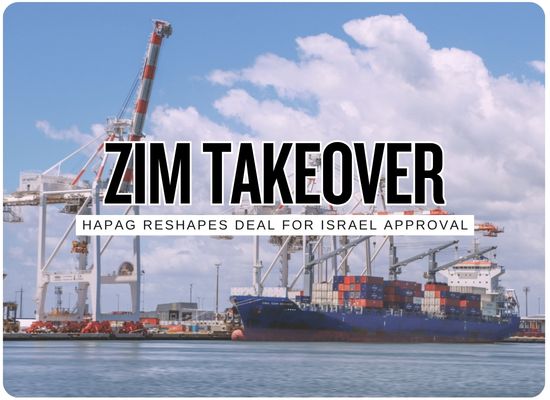
Hapag-Lloyd’s $4.2 billion ZIM takeover is no longer just a container-line acquisition. It has become a test of national shipping control, emergency cargo access, foreign ownership limits and Israel’s Golden Share protections. The German carrier and Israeli private equity firm FIMI are now preparing a revised structure after government pushback threatened the deal. The core transaction still values ZIM at $35 per share in cash, but the approval fight has shifted to the carved-out Israeli liner business, the number of strategic routes it controls, the foreign ownership threshold, access to Asian cargo lanes, and whether Israel believes the new structure can keep essential goods moving during a regional crisis.
Ship Universe Container M&A Watch
Operator Impact Snapshot
The deal now turns on Israeli control, route access and whether the carve-out can satisfy national-security concerns.
$4.2B offer still alive
Hapag-Lloyd’s cash proposal remains built around a $35-per-share acquisition of ZIM, but the approval path is harder.
ZIM Israel becomes the pivot
FIMI would own the Israeli-controlled carve-out, with expanded responsibility for the Golden Share framework.
Carve-out fleet stays central
The revised plan still centers on a 16-vessel Israeli liner platform designed to preserve direct strategic connections.
Government objections remain
Officials are focused on route coverage, essential cargo, foreign influence, ZIM Israel’s size and long-term independence.
Asia access moves up the list
The improved proposal is expected to strengthen Israel’s shipping connections with key destinations in the Far East.
Workers still oppose the sale
ZIM’s labor side remains a major political and operational pressure point as approval talks continue.
ZIM Takeover Restructuring Board
Golden Share, Routes, Carve-Out Fleet and Approval Pressure
The revised offer tries to turn a foreign takeover into a structure Israel can treat as controlled maritime access.
Cash proposal for ZIM at $35 per share, subject to approvals and closing conditions.
FIMI’s ZIM Israel platform would hold the Israeli-controlled strategic liner business.
The revised proposal would cut the threshold from 24% before Israeli government approval is required.
Expected annual synergy range cited by Hapag-Lloyd for the business combination.
| Deal Piece | Latest Detail | Commercial Reading | Stakeholder Effect | Pressure Meter |
|---|---|---|---|---|
| Revised ProposalSubmission by late September | Hapag-Lloyd and FIMI are restructuring the deal after repeated meetings with Israeli ministries and regulators. | The transaction has shifted from standard liner consolidation into a national-access negotiation. | Owners, shippers and investors need to track regulatory terms as closely as deal price. | High |
| Golden ShareIsraeli state rights | ZIM Israel would take broader responsibility for the obligations connected to Israel’s special state rights. | The government wants control over emergency maritime access, not just a promise of commercial support. | Sensitive cargo, defense logistics, essential imports and crisis routing become approval conditions. | Severe |
| Foreign Ownership Limit24% cut to 10% | The revised structure would lower the single foreign investor threshold that triggers Israeli government approval. | This is designed to reduce future foreign influence over ZIM Israel. | Potential outside investors would face tighter control rules and less freedom to build stakes quietly. | High |
| Israeli Listing CommitmentNo foreign exchange listing | FIMI has committed not to list ZIM Israel shares outside the Israeli market. | This keeps the carved-out company closer to Israeli oversight and domestic capital-market supervision. | The tradeoff is less future financial flexibility for ZIM Israel compared with a global listing path. | Medium High |
| Route CoverageAsia access in focus | The revised plan is expected to strengthen shipping links between Israel and the Far East. | A 16-ship carve-out may not be enough unless strategic routes are broad enough for crisis conditions. | Importers, exporters, forwarders and Israeli authorities will focus on service durability, not just vessel count. | Severe |
| Carve-Out FleetZIM Israel vessel base | FIMI’s Israeli-controlled business would operate 16 vessels and gain access to Hapag-Lloyd’s network and container pool. | The fleet may satisfy the legal structure, but the market will test whether it is commercially strong enough. | Vessel size, reefer capacity, charters, crews, network slots and contingency rights become practical details. | High |
| Sensitive CargoForeign interference concern | Hapag-Lloyd says the revised agreement would prevent foreign interference in transportation of Israel’s sensitive cargo. | This is aimed directly at government fears over control, wartime logistics and outside shareholders. | Cargo screening, information systems, booking controls and customer data separation may become decisive terms. | Severe |
| Labor and PoliticsStill unresolved | ZIM workers and Israeli political figures continue to oppose the takeover. | Even a stronger structure may not eliminate political resistance if the deal is viewed as loss of national control. | Employee commitments, headquarters functions and Israeli maritime employment could become part of the bargain. | High |
| Scale RationaleHapag-Lloyd global position | Hapag-Lloyd says the combination would secure its position as the world’s fifth-largest container shipping company. | The deal gives Hapag access to ZIM’s fleet, people, customer base and network position. | Rivals would face a stronger mid-tier global carrier with more than 3 million TEU of standing capacity. | Very High |
| Standalone ZIM LeverageStronger 2026 guidance | ZIM’s 2026 adjusted EBITDA guidance is $2.0 billion to $2.4 billion. | If the deal fails, ZIM is not negotiating from a weak operating year. | Shareholders may weigh cash certainty against dividends, standalone earnings and container-rate volatility. | Medium High |
ZIM Takeover Approval Pressure Tool
Model whether a revised structure improves deal approval odds without weakening Hapag-Lloyd’s commercial case too far.
Synergy Payback Multiple
10.5x
Deal value divided by expected annual synergies. Lower is easier to justify commercially.
Foreign Influence Reduction
58%
Reduction from a 24% foreign-investor threshold to the selected revised threshold.
Carve-Out Coverage Score
72%
Planning score based on vessels, route count and information-system separation.
Commercial Strain Score
53%
Pressure created by deal value, concessions and reduced economic flexibility.
Deal Signal
The revised structure improves Israeli control, but political resistance and route-access demands still keep approval risk high.
We welcome your feedback, suggestions, corrections, and ideas for enhancements.
Please click here to get in touch