
🔔 Subscribe to ShipUniverse Weekly →
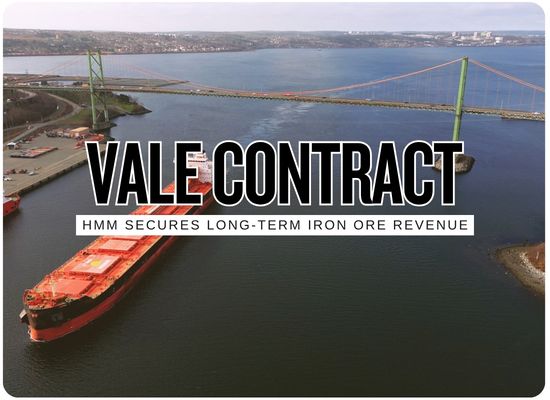
HMM’s new Vale contract is not a normal dry-bulk fixture. It is a 25-year-per-ship revenue lock tied to eight 210,000 dwt Newcastlemax bulkers, giving the Korean carrier one of the clearest long-duration earnings platforms in the Brazil-China iron ore trade. The contract also says something about where the top end of dry bulk is going: larger ships, dedicated cargo, lower fuel exposure, rotor sails, methanol and ethanol capability, plus future LNG and ammonia optionality. For HMM, this is a serious move away from being viewed mainly as a container carrier. For Vale, it is another step toward controlling the freight-cost gap created by shipping Brazilian ore much farther to China than Australian rivals.
HMM Locks In a 25-Year Iron Ore Revenue Base
Eight green Newcastlemaxes give HMM long-duration bulk earnings while giving Vale fuel flexibility and dedicated Brazil-China freight capacity.
Contract Scale Is the Story
KRW 4.697 trillion over 25 years per vessel creates a long-backed revenue stream rather than a short-cycle dry-bulk market bet.
Eight Newcastlemaxes Get Covered
The contract supports eight 210,000 dwt newbuildings ordered for Vale employment, with deliveries scheduled from 2030.
Tri-Fuel Design Moves Center Stage
The ships are planned with engines able to use methanol, ethanol and conventional bunker fuel, plus future LNG and ammonia conversion readiness.
Rotor Sails Add Fuel Hedge
Wind-assist equipment matters because Vale’s long Brazil-China haul makes bunker exposure a direct competitiveness issue.
Execution Still Matters
The upside depends on delivery timing, yard performance, alternative-fuel availability, retrofit economics and long-term ore volumes.
The operating signal is that top-tier dry bulk is moving toward long contracts attached to fuel-flexible vessels. Spot exposure still matters, but major miners and carriers are using dedicated newbuild programs to control cost, emissions and supply reliability over decades.
HMM Vale Iron Ore Contract Board
The contract links long-term cargo, newbuilding finance, fuel flexibility, Brazil-China freight costs and HMM’s push beyond container volatility.
The strongest read is that HMM is turning bulk into a contracted infrastructure business. Vale gets a dedicated fleet with lower fuel-option risk, and HMM gets 25-year cargo cover for ships that would otherwise be exposed to the cycle.
Reported contract value with Vale International SA.
Newcastlemax bulkers assigned to the contract.
Approximate size of each Newcastlemax vessel.
Employment period per vessel, starting from 2030.
Contract value as a share of HMM’s recently reported annual revenue base in Korean filing coverage.
Commercial read: this is a fleet-finance story, not just a cargo story. A 25-year Vale contract can support newbuilding capital, reduce earnings volatility and give HMM a bulk-growth platform while the container market remains harder to forecast.
Deal Signal Table
| Signal | Latest Detail | Commercial Read | Stakeholders | Status |
|---|---|---|---|---|
| Contract award | HMM signed a KRW 4.697 trillion long-term transportation contract with Vale International SA. | The size makes this one of the most important dry-bulk cargo commitments in HMM’s current portfolio shift. | HMM, Vale, banks, shipyards, dry-bulk investors | Very High |
| 25-year ship employment | The contract runs for 25 years per vessel, with transport beginning from 2030. | Long-term cargo cover can make large newbuildings easier to finance and less exposed to spot-market swings. | Owners, lenders, charterers, brokers | Very High |
| Eight Newcastlemaxes | HMM will deploy eight 210,000 dwt Newcastlemax bulk carriers ordered in June. | The contract connects ship orders directly to cargo demand, reducing speculative newbuild exposure. | Shipyards, equipment makers, class, technical managers | High |
| Tri-fuel propulsion | The ships are planned for methanol, ethanol and conventional bunker fuel capability. | Vale and HMM are buying optionality rather than betting everything on one future fuel pathway. | Engine makers, fuel suppliers, charterers, regulators | Medium |
| LNG and ammonia readiness | The ships are also planned with future LNG or ammonia conversion potential. | Retrofit readiness may protect asset value if fuel economics or regulation shift during the contract life. | Owners, class societies, yards, fuel-system vendors | Watch |
| Rotor sails | Rotor sails are planned to support fuel efficiency and emissions reduction. | Wind assist is especially relevant on long-haul iron ore routes where fuel cost can swing delivered economics. | Wind propulsion vendors, yards, technical managers, charterers | Medium |
| HMM diversification | HMM’s bulk fleet reportedly increased to 61 vessels in the first half of 2026 from 44 at end-March 2025. | The carrier is building a broader revenue base outside container shipping, where rate volatility can dominate earnings. | HMM shareholders, cargo customers, ship managers | High |
| Vale freight strategy | Vale has been expanding fuel-saving and fuel-flexible ore-carrier arrangements. | Brazil’s distance to China makes freight efficiency a core competitive issue against Australian supply. | Vale, Asian mills, shipowners, bunker suppliers | High |
| Earlier Vale contracts | HMM signed two 10-year Vale contracts in 2025 before this larger 25-year deal. | The latest contract looks like a deepening customer relationship, not a one-off fixture. | Vale, HMM commercial teams, lenders, fleet planners | Medium |
| Execution risk | Deliveries start in 2030, and the propulsion package depends on future fuel availability and technical performance. | The contract is attractive, but the hardest work is still yard delivery, fuel contracting, crew training and maintenance planning. | HMM, yards, engine makers, ports, fuel suppliers | Watch |
Perhaps the bigger point is that Vale’s shipping strategy is becoming a technology strategy. Freight cost, fuel cost, emissions, route distance and vessel specification are now tied together. A long-haul iron ore carrier is no longer just a big hull with a cargo contract attached. It is a fuel-risk hedge with cargo certainty attached.
Newcastlemax Contract Economics Tool
Estimate annual contract revenue, cargo lift, capital coverage, fuel-option value and delivery risk for a long-term Vale-style iron ore shipping contract.
Total contract value divided across the contract years.
Implied annual revenue per contracted vessel.
Estimated annual iron ore volume moved by the contracted fleet.
EBITDA before financing compared with estimated annual capital cost.
The modeled case combines long employment, solid capital coverage and meaningful fuel-option value.
Long-term cargo supports fleet investmentThis tool is for editorial and commercial sensitivity only. It does not replace audited contract terms, shipbuilding contracts, charter-party review, fuel-price curves, dry-bulk broker guidance, class approval, financing documents, technical due diligence or professional investment analysis.
We welcome your feedback, suggestions, corrections, and ideas for enhancements.
Please click here to get in touch