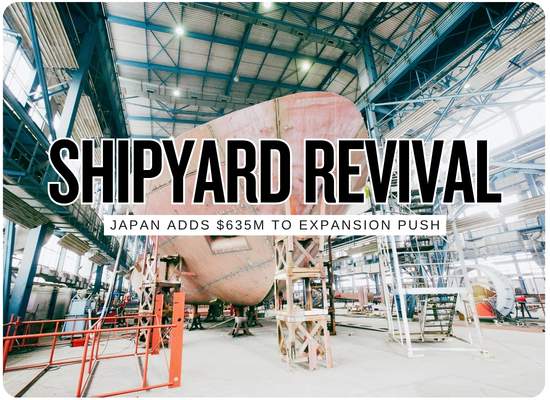
Japan Adds $635M to Shipyard Revival Push as Five More Yard Groups Win Support
🔔 Subscribe to ShipUniverse Weekly →
Japan has approved a second round of shipbuilding capacity investments under its Shipbuilding Industry Revitalisation Fund, authorizing up to ¥98 billion, about $635 million, in government support for five plans led by Oshima Shipbuilding, Kawasaki Heavy Industries, the Shin Kurushima Dockyard group, Naikai Zosen and Mitsubishi Shipbuilding. The projects are expected to generate about ¥280 billion in public and private investment over roughly the next decade. Combined with three plans approved on September 4, the program now covers eight projects representing around ¥900 billion in planned investment and up to approximately ¥311 billion in government support. The funding is aimed at automation, labor-saving production equipment, dock and berth improvements, cranes and other infrastructure as Japan works toward raising annual shipbuilding capacity from roughly 9 million gross tons to 18 million gross tons by 2035.
Second-Round Shipyard Investment Snapshot
Japan has approved another five shipbuilding capacity plans as its industrial revival program moves rapidly from policy targets into physical yard investment.
Maximum support authorized for the five newly approved supply-security plans.
Public and private investment expected across the five projects over roughly the coming decade.
Approximate investment represented by both approval rounds combined.
Maximum fund support approved in the September 4 and September 11 rounds.
Japan is targeting roughly double its current annual shipbuilding volume.
Second-Round Shipyard Investment Board
The latest awards spread government support across major independent yards, diversified heavy-industry groups and specialized regional builders.
| Yard / Group | Maximum Grant | Disclosed Investment | Approved Capacity Program | Known Equipment / Facility Work | Plan Position |
|---|---|---|---|---|---|
| LARGEST ROUND-2 GRANT Mitsubishi Shipbuilding | ¥40.0B Approximately 41% of the maximum grants approved in the second round. | A company-specific total investment figure was not separately disclosed in MLIT's September 11 announcement. | Installation of advanced facilities intended to increase the supply capacity of ship hulls under the government's economic-security framework. | MLIT's fund supports eligible large-scale measures including labor-saving and automated equipment, dock expansion and crane installations. Mitsubishi-specific equipment details were not published in the government release. | Approved September 11 for support during FY2026 through FY2034. |
| 4-COMPANY PLAN Shin Kurushima Group Shin Kurushima Dockyard, Toyohashi Shipbuilding, Kochi Heavy Industries and Sanoyas Shipbuilding. | ¥32.0B Second-largest maximum award in the new round. | A detailed group-wide investment figure was not separately stated in MLIT's public award table. | Group plan approved to introduce advanced facilities that increase hull-production and shipbuilding capacity. | The four-company structure allows the approved plan to cover multiple production locations within the Shin Kurushima group. | Approved as one joint supply-security plan under the Shipbuilding Industry Revitalisation Fund. |
| SAKAIDE WORKS Kawasaki Heavy Industries | ¥15.6B Maximum government contribution. | ~¥45.0B Kawasaki's disclosed investment program at Sakaide Works in Kagawa Prefecture. | Capacity expansion focused on strengthening the yard's ability to build liquid-gas carriers. | Advanced labor-saving and automation systems plus crane renewal and other production equipment. | Kawasaki says the investment is intended to reinforce domestic vessel supply and economic security. |
| CAPACITY EXPANSION Oshima Shipbuilding | ¥6.1B Maximum government contribution. | Oshima has not publicly detailed the total investment amount in the material released with the approval. | Approved for introduction of advanced facilities that strengthen shipbuilding and hull supply capacity. | Detailed equipment specifications were not disclosed with the September 11 approval. | Oshima described the purpose as strengthening vessel construction capacity. |
| THROUGH FY2034 Naikai Zosen | ¥4.3B Maximum government support. | ¥11.1B Planned investment through FY2034. | Production upgrades spanning fabrication, assembly, launching and outfitting operations. | Higher-capacity cranes, cutting and press machinery, automated welding lines, slipway modifications, dolphin mooring facilities and an AI-assisted design system. | The smallest second-round grant, but one of the most detailed publicly disclosed equipment programs. |
Japan Shipyard Revival Funding & Capacity Analyzer
Compare approved government support with planned yard investment and model the remaining capacity increase required to reach Japan's 2035 shipbuilding target.
We welcome your feedback, suggestions, corrections, and ideas for enhancements.
Please click here to get in touch