
🔔 Subscribe to ShipUniverse Weekly →
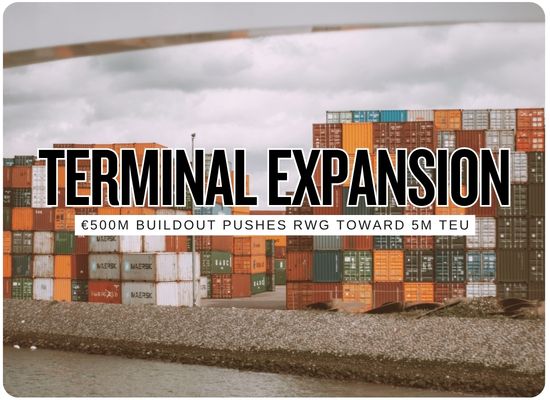
Rotterdam World Gateway has completed the largest financing in its history to support the next stage of its automated container terminal expansion at Maasvlakte 2, combining a senior U.S. private placement with a subordinated private-credit tranche. Société Générale acted as financial adviser and sole private placement agent, while Clifford Chance advised RWG on the transaction. The financing supports a final development phase valued at approximately €500 million, although the amount of the financing package itself has not been publicly disclosed. RWG plans to add its fourth and final deep-sea berth, five quay cranes, 11 storage modules containing 22 automated stacking cranes and 24 automated guided vehicles, while also evaluating a roughly 30,000-TEU BoxBay system for empty containers. The terminal currently has handling capacity of about 2.6 million TEU and is targeting approximately 5 million TEU after the expansion, with the third berth expected to enter commercial service in 2027 and the additional fourth-berth capacity planned before 2030. The project will bring cumulative investment in RWG's development to roughly €2 billion.
RWG Expansion Snapshot
Rotterdam World Gateway has closed its largest financing to date as it moves toward the fourth and final deep-sea berth in its Maasvlakte 2 development.
The package combines a senior U.S. private placement with a subordinated private-credit tranche.
The €500 million figure refers to the value of the final expansion phase. The exact debt package size has not been publicly disclosed.
RWG reports current annual handling capacity of about 2.6 million TEU, implying a major increase as the remaining phases enter service.
The final berth is intended to handle the world's largest deep-sea container ships and use RWG's full allocated quay capacity.
RWG says completion of the latest phase will bring total investment in development of the terminal to approximately €2 billion.
RWG Expansion Execution Board
The financing closes one piece of a multi-stage buildout that combines additional deep-sea berths, automated yard capacity, electric equipment infrastructure and expanded landside handling.
| Workstream | Status / Timing | Confirmed Scope | Terminal Effect | Commercial / Operating Exposure | Key Detail |
|---|---|---|---|---|---|
| Expansion Financing | CLOSED Largest RWG Financing Announced in September 2026. | Senior U.S. private placement combined with a private-credit subordinated tranche. | Provides funding flexibility for the next stage of RWG's Maasvlakte 2 development. | Expands the terminal's funding base beyond a conventional single-tranche bank structure and brings institutional capital into the project. | Société Générale served as financial adviser and sole private placement agent. Clifford Chance advised RWG. |
| Third Deep-Sea Berth | UNDER DEVELOPMENT Commercial 2027 | Part of the phased expansion first announced in 2023, which covered approximately 45 hectares and 920 metres of additional quay. | Adds another large-vessel handling position before completion of the final fourth berth. | Additional berth windows can increase scheduling flexibility for deep-sea services and reduce dependence on the original terminal configuration. | The latest RWG schedule places commercial operation in 2027. |
| Fourth Deep-Sea Berth | FINAL PHASE Before 2030 | Fourth and final deep-sea berth capable of handling the world's largest container vessels. | Uses the remaining quay capacity allocated to RWG by the Port of Rotterdam Authority. | Creates additional capacity for large mainline calls and completes the planned deep-sea berth configuration. | Development will proceed in phases while the existing terminal remains operational. |
| Ship-to-Shore Equipment | ORDERED / PLANNED 5 Quay Cranes | Five additional quay cranes form part of the final €500 million development phase. | Expands crane capacity alongside the additional deep-sea berth. | More crane positions support larger exchanges from ultra-large container vessels and additional berth activity. | RWG has not publicly identified the supplier in its expansion announcement. |
| Automated Yard | EXPANDING 11 Modules | Eleven storage modules equipped with 22 automated stacking cranes. | Extends RWG's automated yard architecture to support the increased quay capacity. | Yard density, equipment availability, charging infrastructure and terminal-system integration become increasingly important as volume rises. | RWG's existing operation already uses extensive automated stacking-crane and AGV systems. |
| Horizontal Transport | EXPANDING 24 New AGVs | Twenty-four additional automated guided vehicles will move containers between quay and yard. | Adds automated transport capacity as additional cranes and storage modules come online. | Charging, fleet management, maintenance and software availability remain central operating requirements. | RWG is simultaneously increasing charging capacity for electric terminal equipment. |
| Empty-Container Storage | UNDER STUDY ~30,000 TEU | RWG is evaluating a BoxBay high-bay storage solution for empty containers. | Could increase storage density and provide direct access to individual containers compared with conventional stacked storage. | Empty-container management has become increasingly relevant as Rotterdam handles imbalanced import and export flows. | The BoxBay installation has not yet been confirmed as part of the final configuration. |
| Landside & Support Infrastructure | EXPANDING Multi-Modal | Gate capacity, maintenance facilities, electrical charging capacity and storage for non-standard cargo will be expanded. | Extends the buildout beyond the waterfront so additional marine capacity can move through the terminal and into the hinterland. | Truck, rail, barge, feeder and terminal-gate performance determine how efficiently added deep-sea capacity can be absorbed. | Earlier phases also included shore-power preparation and connection to the Container Exchange Route. |
RWG Capacity & Utilization Scenario Analyzer
Compare a modeled annual container volume against RWG's current 2.6 million TEU capacity and its planned 5 million TEU configuration.