Hormuz Tanker War Erupts, Trading Blows in the Biggest Wave Yet
🔔 Subscribe to ShipUniverse Weekly →
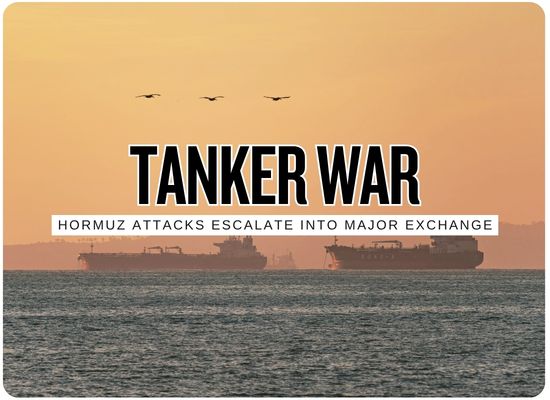
The Hormuz conflict has moved into a more dangerous phase as both sides target shipping, energy assets and military-linked vessels in the same compressed waterway. U.S. forces said they destroyed five Iranian oil tankers after Iranian ballistic missile attempts against a U.S. Navy warship, while Iran said it retaliated by attacking two U.S. vessels and eight oil tankers near the strait. The escalation has already hit markets and vessel confidence: Brent crude breached $100 a barrel, visible Hormuz commodity-vessel traffic remains far below normal, merchant vessels are being caught in disabling fire, and operators now face a route where tanker movement, naval posture, insurance, AIS visibility, sanctions exposure and crew safety are all part of the same decision.
Hormuz Has Become an Active Tanker Battlefield
The latest escalation turns the strait from a chokepoint risk into a direct vessel-targeting, escort, insurance and cargo-flow crisis.
U.S. Hits Five Iranian Tankers
U.S. forces said the strikes followed Iranian ballistic missile attempts against a U.S. Navy warship, with crews ordered to abandon ship before the tankers were hit.
Iran Claims Ten Ship Attacks
Iran said it attacked two U.S. vessels and eight oil tankers near Hormuz in response, creating the largest declared tit-for-tat shipping exchange of the war.
Merchant Ships Caught in Fire
UKMTO reported several merchant vessels struck by disabling fire, while a fuel-oil tanker was separately hit by a drone in Iraqi waters.
Traffic Data Is Breaking Down
Visible vessel counts remain low, but dark crossings, delayed imagery and inconsistent flow estimates make actual oil movement harder to measure.
Oil and Diesel Shock Spreads
Brent moved above $100 and U.S. diesel hit a fresh high as markets priced the risk that shipping attacks turn into real supply disruption.
The operating signal is that Hormuz is no longer just a high-risk passage. It is now a contested traffic-control zone where a tanker can be delayed, diverted, challenged, attacked, moved under escort, or forced into an insurance and compliance dispute before cargo ever reaches the buyer.
Hormuz Tanker War Escalation Board
The latest wave links direct tanker strikes, Iranian retaliation claims, merchant-vessel damage, regional missile attacks and a widening oil-market confidence problem.
The strongest commercial read is that tanker risk has crossed from threat environment into active loss environment. The strait is still moving some cargo, but the number of ships willing to cross visibly is low, and the number of parties willing to underwrite that passage is narrowing.
Iranian oil tankers the U.S. military said it destroyed after attempted missile attacks on a U.S. Navy warship.
Vessels Iran said it attacked near Hormuz, including two U.S. vessels and eight oil tankers.
Visible commodity vessels reported through Hormuz on Tuesday, below the 10-day average.
Brent crude breached $100 a barrel as markets repriced Hormuz risk and regional energy attacks.
Approximate Iraqi fuel-oil cargo aboard New Andros when the tanker was struck by a drone in Iraqi waters.
Current commercial read: the most important risk is no longer one individual tanker casualty. It is the new retaliation loop. Each attempted strike, U.S. tanker response, Iranian counterclaim, merchant-vessel incident and port threat can trigger another layer of delay, higher war-risk cost and lower owner confidence.
Latest Hormuz Development Table
| Development | Latest Signal | Commercial Read | Stakeholders | Watch Level |
|---|---|---|---|---|
| U.S. tanker strikes | U.S. forces said they destroyed five Iranian oil tankers after IRGC missile attempts against a U.S. Navy warship. | The U.S. response has moved from escort and blockade enforcement into direct attacks on Iranian tanker assets. | Tanker owners, flag states, insurers, cargo buyers, naval planners | Critical |
| Iran retaliation claim | Iran said it attacked 10 ships near Hormuz, including two U.S. vessels and eight oil tankers. | The claim creates immediate uncertainty around vessel identity, damage status, casualty exposure and route safety. | Shipowners, brokers, P&I clubs, hull insurers, cargo traders | Critical |
| Jordan missile strike | Iran said it fired missiles at a U.S.-used base near Al Azraq, while Jordan said most missiles were intercepted. | The maritime conflict is tied to regional bases, meaning the tanker war can widen beyond the waterway quickly. | U.S. forces, Jordan, Gulf states, energy markets, naval commands | Watch |
| New Andros hit | A Panama-flagged tanker carrying Iraqi fuel oil was struck by a drone in Iraqi territorial waters. | The strike shows non-Iranian cargo and neutral-flag tonnage can still be caught inside the expanding conflict envelope. | Iraqi exporters, product traders, tanker owners, crew managers | Critical |
| UKMTO disabling-fire reports | UKMTO reported several merchant vessels hit by disabling fire in the northern Gulf and Gulf of Oman. | Multiple simultaneous merchant-vessel reports make the incident environment harder to isolate or price. | Masters, underwriters, rescue assets, naval forces, charterers | Critical |
| Port Rashid listing vessel | A vessel near Port Rashid was seen listing while at anchor after a possible projectile attack. | Anchorage risk is now part of the exposure, not only underway transit through the narrowest section. | Port authorities, insurers, salvors, terminal operators | Watch |
| Khor Fakkan LNG report | A maritime security source reported an LNG tanker damaged in the Emirati port of Khor Fakkan. | Even unconfirmed gas-carrier damage reports can move LNG risk pricing because cargo substitution is difficult. | LNG carriers, utilities, Qatar/UAE exporters, portfolio traders | Watch |
| Kuwait and Bahrain threats | Iran threatened oil tankers in Kuwaiti and Bahraini ports, according to state-media reporting cited by Reuters. | Threats against ships in port can push owners to avoid calls even before a direct attack occurs. | Product tankers, crude tankers, Gulf ports, refiners, banks | Critical |
| Visible traffic remains low | Kpler data cited by Reuters showed six visible commodity vessels through Hormuz on Tuesday. | Low visible movement signals weak owner confidence, even if some vessels are crossing dark or under escort. | Energy traders, shipbrokers, insurers, port agents | Critical |
| Oil-flow uncertainty | Reuters market analysis says estimates now vary widely because of dark crossings and incomplete visibility. | Markets are pricing uncertainty itself, not only confirmed barrels lost. | Oil traders, refiners, governments, bunker buyers | Watch |
| Red Sea spillover | Houthi attacks on Saudi cities and oil facilities add a second regional energy-security front. | Hormuz and Bab el-Mandeb pressure can stack together, raising route, insurance and energy-price risk at the same time. | Tankers, liners, Saudi exporters, Red Sea ports, insurers | Critical |
| Contract and claims risk | Repeated attacks make force majeure, deviation, off-hire, war-risk and crew-consent language harder to apply cleanly. | Every new incident increases the chance that voyage disruption becomes a legal and insurance dispute. | Owners, charterers, cargo interests, lawyers, P&I clubs | Critical |
The cleanest takeaway is that the tanker war is now feeding on itself. A strike meant to restore deterrence can become the next reason for retaliation, and retaliation can hit ships that were never part of the original military exchange. That is the risk owners cannot fully model with normal freight math.
Hormuz Tanker War Exposure Tool
Estimate voyage exposure from tanker-war conditions, including war-risk premium, attack reserve, delay, escort cost, sanctions risk, cargo timing and freight premium coverage.
Delay, deviation, war-risk, sanctions, attack reserve and security exposure before recovery.
Remaining exposure after recoverable cost assumptions.
Freight premium minus net exposure. Negative means the premium looks thin.
Net exposure spread across entered cargo units.
The modeled freight premium does not fully cover remaining exposure after tanker-war and recovery assumptions.
Reprice before fixingThis tool is for editorial and commercial sensitivity only. It does not replace live naval advisories, UKMTO reporting, war-risk insurance quotes, P&I guidance, port-agent updates, sanctions screening, charter-party review, crew-consent procedures, salvage planning, pollution liability review or professional voyage planning.
We welcome your feedback, suggestions, corrections, and ideas for enhancements.
Please click here to get in touch