CMA CGM’s $2.4B Terminal Deal Signals a Bigger Race for Port Control
🔔 Subscribe to ShipUniverse Weekly →
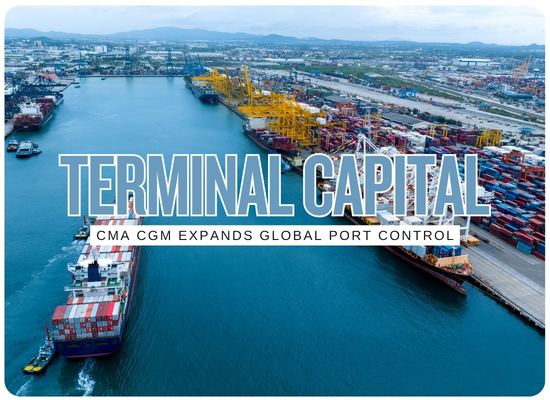
CMA CGM’s new terminal partnership with Stonepeak puts port ownership and gateway control back at the center of container shipping strategy. The deal creates United Ports LLC, a U.S.-based joint venture that will hold 10 CMA CGM-operated terminals across major trade locations including Los Angeles, New York and Bayonne, Santos, Valencia, Bilbao, Algeciras, Nhava Sheva, Kaohsiung, and Cai Mep. Stonepeak is investing $2.4 billion for a 25% minority stake, while CMA CGM keeps 75% ownership and operational control. The structure gives CMA CGM fresh capital for terminal expansion while keeping the carrier connected to key gateways that influence vessel schedules, berth priority, cargo flow, inland connections, and customer service.
Carrier-Controlled Terminals Get Fresh Capital
The Stonepeak investment gives CMA CGM more financial room to expand terminal capacity while keeping operating control.
Gateway Control
The joint venture covers strategic terminals in the U.S., Europe, South America, and Asia, giving CMA CGM deeper influence over key cargo nodes.
Infrastructure Capital
Stonepeak’s $2.4 billion investment creates a large funding base for terminal modernization, expansion, and future projects.
Operational Continuity
CMA CGM retains operating control, which keeps terminal strategy tied closely to carrier schedules and logistics service quality.
Supplier Demand
Terminal upgrades can support demand for cranes, yard systems, automation, gate technology, power systems, dredging, civil works, and digital tools.
Approval Timeline
The deal still depends on regulatory approvals, including antitrust and foreign direct investment reviews.
Operator Readout
This is a terminal-control story with a capital-markets engine behind it. Carrier-owned gateways are becoming more valuable as shipping lines look for more reliable berth access, better inland flow, and stronger control over the customer experience.
United Ports Investment Watch
The terminal platform combines carrier control with infrastructure-fund capital for gateway expansion.
The deal gives CMA CGM a larger terminal investment platform without giving up operating control. The portfolio stretches across six countries and includes several gateways that matter for transpacific, transatlantic, Latin American, Indian subcontinent, and Asian cargo flows.
Stonepeak investment for a 25% minority stake in United Ports LLC.
CMA CGM-operated port assets contributed to the new joint venture.
Potential additional Stonepeak funding for future joint terminal projects.
Terminal Growth Table
| Deal Area | Latest Signal | Commercial Meaning | Stakeholders Affected | Watch Level |
|---|---|---|---|---|
| Joint venture structure | United Ports LLC formed as a U.S.-based terminal platform | Creates a dedicated investment vehicle for existing and future terminal assets. | Carriers, investors, port authorities, regulators | High |
| Stonepeak investment | $2.4 billion for a 25% minority stake | Infrastructure capital is moving deeper into container terminal ownership. | Infrastructure funds, lenders, terminal operators | High |
| CMA CGM control | 75% ownership and full operational control retained | The carrier keeps operational alignment with its liner network and logistics customers. | Shippers, BCOs, terminal labor, port customers | Positive |
| Asset portfolio | Terminals across the U.S., Brazil, Spain, India, Taiwan, and Vietnam | Gateway coverage spans several major container trade lanes and regional growth markets. | Ports, forwarders, exporters, importers, inland carriers | Medium |
| Future projects | Stonepeak may contribute up to $3.6 billion more | The partnership could support new terminal projects or expansion work beyond the first portfolio. | Shipyards, contractors, crane makers, technology vendors | Watch |
| Closing path | Expected in the second half of 2026, subject to approvals | Antitrust and foreign investment reviews remain part of the timeline. | Regulators, investors, port authorities, customers | Watch |
Planning note: The clearest signal is that terminal capacity is becoming a strategic control point for large carriers, not just a place where containers are lifted on and off ships.
Terminal Capital Impact Estimator
Estimate modernization capacity, throughput value, and payback sensitivity for a port terminal investment program.
Estimated portion of capital available for terminal upgrades and expansion work.
Estimated upgrade budget allocated across each terminal in the platform.
Estimated annual value from added throughput and operating efficiency.
Estimated years to recover the modeled upgrade budget.
The modeled terminal program creates value over the selected evaluation period.
Gateway expansion caseThis tool is for editorial and commercial sensitivity only. It does not replace terminal concession terms, actual project capex, crane pricing, labor agreements, berth productivity data, terminal tariff structures, shipper contracts, regulatory approvals, or professional infrastructure investment analysis.
We welcome your feedback, suggestions, corrections, and ideas for enhancements.
Please click here to get in touch