Red Sea Risk Spreads as Houthis Target Saudi Port Calls
🔔 Subscribe to ShipUniverse Weekly →
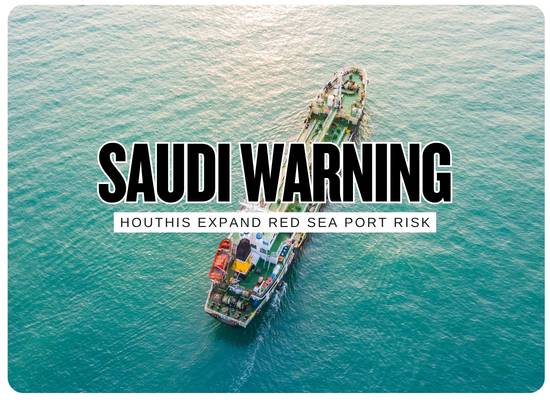
The Houthis have widened their maritime threat messaging by warning shipping companies not to call at Saudi ports, with an email reportedly sent to multiple companies saying vessels are “banned from loading or discharging cargo at or from any Saudi ports.” The warning followed a Houthi announcement of a maritime embargo against Saudi Arabia, raising a fresh route-risk issue for shipowners, charterers, insurers, ports, and cargo interests already managing Red Sea, Bab el-Mandeb, Gulf of Aden, and Horn of Africa security exposure. The move adds a Saudi-port dimension to a disruption cycle that has already pushed many operators to reroute around the Cape of Good Hope, increased voyage distance and bunker exposure, and kept naval-warning, insurance, and AIS decisions near the top of bridge and operations-room planning. U.S. MARAD continues to warn that vessels with certain U.S., UK, Israeli, or Israel-port-call links may face elevated risk from Houthi hostile action in the southern Red Sea, Bab el-Mandeb, and Gulf of Aden, while the latest Saudi-port warning signals an attempt to expand pressure on regional trade and energy logistics beyond the original Red Sea target set.
Saudi port exposure is now part of the Red Sea risk screen
The Houthi warning adds port-call history and Saudi-linked routing to an already complex maritime security environment.
Shipping companies with Saudi loading or discharge plans may face new security, insurance, and routing review pressure.
The warning lands in a corridor already shaped by Houthi attacks, naval advisories, rerouting, and elevated bridge-watch requirements.
Underwriters may review vessel links, cargo, route, Saudi calls, owner structure, AIS behavior, and security posture.
Jeddah, Yanbu, and other Saudi-linked calls may require closer coordination around arrival windows, cargo timing, and security updates.
More uncertainty around Red Sea and Saudi-linked voyages can extend support for longer Cape of Good Hope routing.
Saudi port warning signal map
The table converts the Houthi warning into practical signals for owners, charterers, insurers, masters, ports, and cargo interests.
| Signal | Current status | Commercial effect | Operator read | Next item to watch | Level |
|---|---|---|---|---|---|
| Saudi port warning | Shipping companies were warned against loading or discharging at Saudi ports. | Adds Saudi calls to the Red Sea security screening process. | Voyages with Saudi port exposure may require renewed risk review. | Follow-up Houthi statements and vessel-specific threats. | High |
| Declared embargo | Houthis announced a maritime embargo aimed at Saudi Arabia. | Raises uncertainty around Red Sea and Saudi-linked cargo movements. | Operators should separate declared threat from actual enforcement capability, but price the exposure. | Any attempted attack tied to Saudi port calls. | Watch |
| Red Sea transit | The corridor remains under elevated security advisories. | More owners may continue Cape routing or require added security terms. | Port-call exposure now sits alongside vessel affiliation and cargo risk. | UKMTO, MARAD, JMIC, and naval advisories. | High |
| Saudi west coast ports | Jeddah and Yanbu are commercially important Red Sea-facing ports. | Container, energy, bulk, project cargo, and feeder schedules may face added scrutiny. | Port agents and chartering desks need clearer arrival and security coordination. | Terminal circulars, vessel lineups, and port-delay data. | Watch |
| War-risk cover | Underwriters may review voyage sequence and port-call history. | Premiums and exclusions can affect fixture economics. | Confirm cover before committing to Saudi-linked Red Sea legs. | Listed-area updates and premium changes. | Watch |
| Charter-party exposure | Delay, deviation, security cost, refusal, and premium allocation may become contested. | Unclear language can shift disruption cost between owner and charterer. | Saudi call language should be reviewed before fixing. | War-risk clauses, safe-port language, and cancellation rights. | Medium |
Saudi Port Exposure Meter
A practical tool for estimating voyage exposure when Red Sea routing, Saudi port calls, cargo type, and security posture overlap.
This voyage has high exposure because Saudi port-call risk, Red Sea routing, cargo profile, and security assumptions all require active review.
We welcome your feedback, suggestions, corrections, and ideas for enhancements.
Please click here to get in touch