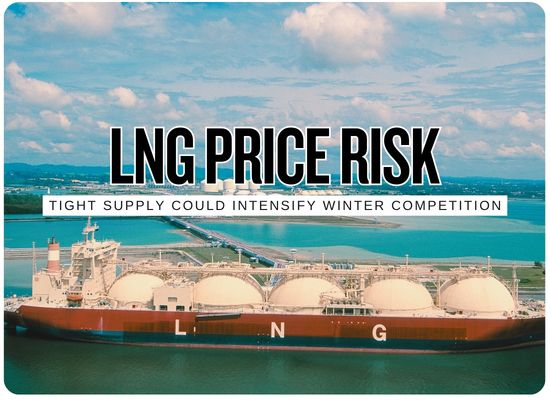
LNG Prices Projected to Spike as Europe Enters Winter With Low Gas Stocks
🔔 Subscribe to ShipUniverse Weekly →
Europe is approaching the 2026-27 heating season with gas inventories well below normal levels while LNG exports from Qatar and the United Arab Emirates remain heavily constrained by disruption in the Strait of Hormuz. Reuters reported EU stocks at about 67% full on September 17, while Gas Infrastructure Europe showed 68.66% on its latest September 16 reading, compared with a seasonal five-year norm around 84%-85%. Shell estimates the Gulf disruption has removed about 36 million tonnes of LNG supply during 2026. Asian spot LNG is trading near $27-$30/MMBtu, and Wood Mackenzie says prices could reach around $40/MMBtu if Europe and North Asia experience a colder-than-normal winter simultaneously. Europe is increasingly positioned to compete for flexible U.S. LNG cargoes, although rising American export capacity and currently weaker Asian demand provide some additional supply relief.
Europe enters the final storage window with a smaller gas cushion
Low inventories, constrained Gulf LNG exports and rising Asian spot prices are putting more attention on flexible Atlantic Basin cargoes as the Northern Hemisphere moves toward winter.
Roughly 90% of LNG moving through the Strait of Hormuz went to Asian markets in 2025. Reduced Qatari and UAE availability therefore forces Asian buyers toward alternative suppliers, including flexible U.S. and Atlantic Basin cargoes also sought by Europe.
U.S. LNG exports averaged 17.4 Bcf/d during the first half of 2026, up 23% year over year, as Plaquemines, Corpus Christi Stage 3 and Golden Pass added supply.
The Winter LNG Tug-of-War
| Market Factor | Current Position | Europe | Asia | LNG Shipping / Cargo Effect | Winter Signal |
|---|---|---|---|---|---|
| European Storage | EU inventories about 67%-69% full. Germany is near 56% and the Netherlands near 53%. | Smaller stored-gas buffer entering the final weeks of the injection season. | Low European stocks increase Europe's ability to bid against Asian buyers. | More Atlantic cargoes can remain oriented toward European terminals. | Tightening |
| Qatar + UAE LNG | Strait disruption has removed about 36 Mt of LNG supply during 2026. | Europe historically receives a smaller share directly from Hormuz. | Asia normally receives roughly 90% of LNG moving through the strait. | Replacement demand migrates toward U.S., Australian and other flexible supply. | Major Constraint |
| U.S. LNG Supply | U.S. exports averaged 17.4 Bcf/d in H1 2026, 23% above H1 2025. | Increasingly important source of flexible replacement LNG. | Also available to Northeast Asian and South Asian buyers willing to pay. | Atlantic Basin positioning becomes increasingly important for vessel deployment. | Supply Relief |
| Asian Spot Demand | High prices have already reduced purchases in several price-sensitive markets. | Weak Asian demand currently leaves more spot cargoes accessible to Europe. | China, India and other buyers can re-enter if weather or prices change. | A sudden return of Asian buying could redirect flexible cargoes eastward. | Weather Sensitive |
| Asian LNG Price | Spot LNG is around $27-$30/MMBtu after trading near $10 before the war. | High Asian bids increase the price Europe must offer to retain flexible LNG. | Prices are already suppressing some industrial and power-sector demand. | Higher destination spreads create stronger incentives for cargo diversion. | Elevated |
| Cold-Winter Scenario | Wood Mackenzie has cited roughly $40/MMBtu in a colder-than-normal scenario. | Heating demand would increase withdrawals from already-low storage. | Cold Northeast Asian weather could create simultaneous buying pressure. | Europe and Asia could compete directly for U.S. and other flexible cargoes. | Highest Risk |
| U.S. to North Asia | Reuters cites roughly 45 days for the voyage from the U.S. to North Asia. | Europe has a geographic advantage for Atlantic Basin LNG. | Longer sailing time reduces Asia's ability to replace missing supply quickly. | Vessel availability and voyage duration become part of the cargo economics. | Logistics Factor |
| EU Supply Security | European Commission says there is currently no immediate security-of-supply risk. | Higher LNG import capacity and lower structural gas demand provide resilience. | Does not eliminate competition if Asian demand rebounds strongly. | Market pressure may show first through prices rather than physical shortages. | Buffer |
Winter LNG Cargo Competition Model
Measure Europe's gross storage gap and compare today's LNG price level with a higher winter stress scenario.
We welcome your feedback, suggestions, corrections, and ideas for enhancements.
Please click here to get in touch