$669M Delaware Container Terminal Breaks Ground for 1.2M-TEU Edgemoor Buildout
🔔 Subscribe to ShipUniverse Weekly →
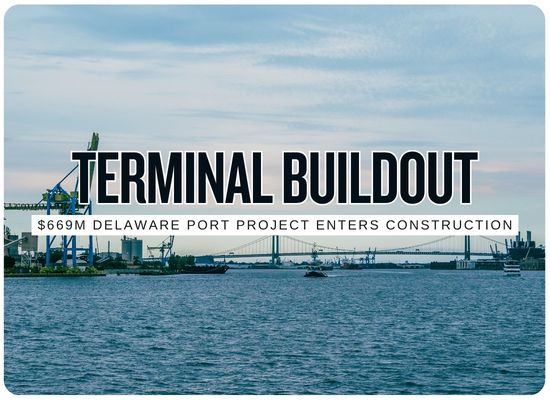
Enstructure and the Diamond State Port Corporation have broken ground on the $669 million Delaware Container Terminal at Edgemoor, moving the long-planned project into construction after years of permitting and financing work. The 137-acre terminal on the Delaware River is scheduled to open in early 2029 and is designed for annual throughput of 1.2 million TEU, a 2,700-foot quay, 45-foot water depth and containerships of up to 16,000 TEU. The completed facility is planned with seven electric ship-to-shore cranes and 24 electric rubber-tired gantry cranes. Funding consists of $325 million from Delaware, $225 million from Enstructure and $119 million in federal grants. Construction is advancing even as two legal challenges filed this summer continue to contest the project, including one brought by Philadelphia terminal operators challenging the reissued federal permits.
Delaware Container Terminal Moves From Plan to Build
Groundbreaking marks the transition into the construction phase for a new deepwater, electrified container terminal designed to handle significantly larger ships than Delaware's existing facility.
The financing package combines state, private and federal capital.
The new terminal will materially expand Delaware's container-handling ceiling.
The deeper berth is designed for large post-Panamax container ships.
Construction, crane installation, testing and commissioning continue through the build period.
Separate litigation targets federal permits and the state-private development agreements.
Delaware Container Terminal Execution Board
Construction combines major waterfront civil works with an unusually large electric cargo-handling package and a three-source capital structure.
| Workstream | Status | Confirmed Scope | Operating Effect | Supplier / Contractor Exposure | Current Watchpoint |
|---|---|---|---|---|---|
| Marine Construction | UNDERWAY 2026 Start Major construction follows the September groundbreaking. | Removal of existing marine structures, berth-pocket dredging, construction of a new bulkhead and sitewide earthworks. | Creates a 45-foot-deep berth and 2,700 feet of quay for large container vessels. | Walsh Group and Soletanche Bachy joint venture serves as EPC contractor, with Jacobs as lead designer. | Construction must proceed alongside continued legal challenges to the federal permits and project agreements. |
| Full Terminal Build | TARGET 2029 1.2M TEU | 137-acre dedicated container terminal with road access, Class I rail connectivity and modern truck-gate infrastructure. | Adds enough physical capacity for up to 1.2 million TEU annually and vessels of up to 16,000 TEU. | Civil works, pavement, rail interfaces, gate systems, reefer infrastructure and terminal operating technology all form part of the wider buildout. | Earlier planning documents describe a phased ramp-up before the full 1.2-million-TEU configuration is reached. |
| Quayside Equipment | ELECTRIC 7 STS Cranes | Seven electric ship-to-shore gantry cranes are planned for the completed terminal. | Provides the reach and crane capacity required to service substantially larger container ships than Delaware's current terminal configuration. | Crane electrification also creates demand for high-voltage infrastructure, controls, drives, maintenance systems and specialist engineering. | Earlier project scope includes conversion of existing crane assets as well as procurement of new electric equipment. |
| Yard Electrification | ZERO-EMISSION PACKAGE 24 RTGs | The completed terminal is planned around electric RTGs and supporting electric cargo-handling equipment. | Reduces diesel use across routine container-yard movements and supports EPA Clean Ports objectives. | Earlier procurement plans identify electric terminal tractors, top handlers, fast chargers and expanded electrical distribution. | ENR reported a package including 110 electric terminal tractors, 15 electric top handlers and 54 DC fast chargers. |
| Capital Structure | $669M TOTAL 3 Funding Sources | $325M Delaware + $225M Enstructure + $119M federal grants. | The public-private structure spreads construction and equipment costs across state, operator and federal capital. | Federal Clean Ports funding supports zero-emission equipment, charging, monitoring, workforce development and community engagement. | The project estimate increased materially from earlier plans because of inflation, electrification scope changes and tariff-related cost escalation. |
| Permit Litigation | ACTIVE Federal Challenge | Philadelphia-area terminal operators filed suit challenging the Army Corps' reissued permits. | The permits authorize wharf construction and dredging following additional navigation and safety analysis. | Construction scheduling, marine works and project finance remain exposed to the outcome of litigation. | The lawsuit remains active while construction proceeds. |
| State Agreement Challenge | ACTIVE Delaware Case | A separate taxpayer action challenges the validity of agreements between DSPC and Enstructure. | The case focuses on governance and authorization rather than terminal operating specifications. | No publicly reported order had stopped the groundbreaking or construction milestone at the time of publication. | A Delaware state senator subsequently sought to intervene in the taxpayer case. |
Diamond State Port Corporation acquired the former industrial waterfront site.
Army permits cleared wharf and dredging work after additional reviews.
Enstructure and DSPC formally moved the development into its construction phase.
Current project schedule calls for the new terminal to begin operations.
Delaware Container Capacity & Capital Analyzer
Test how the new Edgemoor terminal changes Delaware's theoretical container capacity and see how the $669 million project is divided among state, private and federal funding.
We welcome your feedback, suggestions, corrections, and ideas for enhancements.
Please click here to get in touch