HD Hyundai and BAR Technologies Advance 174,000-CBM Wind-Assisted LNG Carrier Design
🔔 Subscribe to ShipUniverse Weekly →
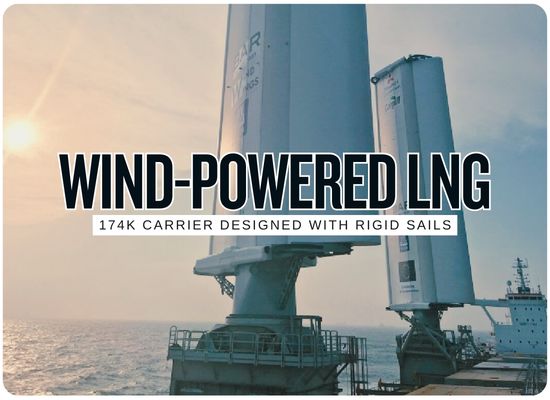
HD Hyundai Heavy Industries, BAR Technologies, Korean Register and the Liberian International Ship & Corporate Registry have launched a joint development project for a 174,000-cbm LNG carrier incorporating BAR Technologies’ WindWings wind-assisted propulsion system. The agreement was signed September 15 at Gastech 2026 in Bangkok. HD Hyundai’s vessel uses a forward-accommodation arrangement that frees additional upper-deck space for the rigid wing system. HD Hyundai will lead the basic vessel design and review, BAR Technologies will supply WindWings arrangement, structural, operating and fuel-saving data, and KR and the Liberian Registry will assess safety and regulatory compliance with a view toward possible Approval in Principle. No shipowner, construction contract, final WindWings count or vessel-specific fuel-saving figure has been announced.
Rigid sails move into the design of a 174,000-cbm LNG carrier
The four-party project brings the wind propulsion system into the vessel design process rather than treating it solely as a later retrofit.
Crew accommodation is positioned toward the bow, creating additional usable upper-deck space where WindWings integration can be evaluated.
The partners have not disclosed the final number of wings, construction schedule, shipowner, vessel price or project-specific fuel savings.
What Has to Be Solved Before WindWings Reach an LNG Carrier
| Design Area | Engineering Issue | Current Project Approach | Status |
|---|---|---|---|
| Upper-Deck Space | Large rigid sails require significant deck footprint, foundations and a clear operating and folding envelope. | HD Hyundai's forward-accommodation arrangement creates additional upper-deck space for WindWings integration. | Design Feature |
| Navigation Visibility | Tall wind-propulsion structures can affect bridge sight lines depending on their location and vessel arrangement. | Moving accommodation and bridge functions toward the bow changes the sight-line geometry and available sail positioning. | To Be Verified |
| Structural Loads | Aerodynamic loads from each wing have to be transferred safely through foundations and into the ship structure. | BAR Technologies will provide structural-strength and system specification data for the design review. | Under Assessment |
| Wing Arrangement | Placement affects aerodynamic interaction, deck access, vessel systems and overall wind-assisted performance. | BAR will provide arrangement and specification data while HD HHI integrates the system into the basic ship design. | Under Assessment |
| Operations | Wings must operate around changing wind conditions and be managed during pilotage, port calls and adverse weather. | BAR's existing WindWings technology includes automated orientation, depowering and a folding mechanism. | Existing Technology |
| Safety & Rules | The completed arrangement must satisfy applicable classification, statutory and international requirements for the LNG carrier. | Korean Register and the Liberian Registry will jointly assess safety and technical suitability. | Formal Review |
| Approval in Principle | The concept needs technical acceptance before further commercial development can proceed. | KR says it will consider granting AiP based on the outcome of the technical and safety assessment. | Future Gate |
| Commercial Vessel | An approved concept still requires a customer, final specification, contract and construction program. | No shipowner or construction order has been disclosed as part of the September announcement. | Not Announced |
Wind-Assisted LNG Savings Scenario
Explore how wing count, operating days and assumed performance could translate into annual fuel displacement, direct CO₂ reduction and fuel cost savings.
We welcome your feedback, suggestions, corrections, and ideas for enhancements.
Please click here to get in touch