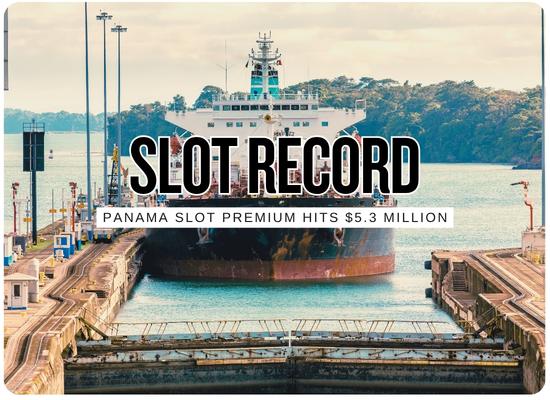
Panama Canal Slot Auction Hits Record $5.3M as El Niño Tightens Capacity
🔔 Subscribe to ShipUniverse Weekly →
South Korea’s SK Gas paid a record $5.3 million auction premium to secure a September 1 northbound Panama Canal transit for the LPG carrier G. Spirit, according to canal officials and shipping reports. The payment was for the reservation slot and was separate from the vessel’s normal canal toll. G. Spirit, a 2018-built 54,502-dwt VLGC, crossed from the Pacific side toward the Atlantic before continuing to Houston. The record came as Middle East disruption pushed more energy shipping toward Atlantic supply sources and the Panama Canal prepared to reduce available transit capacity because of below-expected rainfall associated with El Niño. Panama reduced available slots to nine Neopanamax and 23 Panamax transits per day from September 15, while the August-through-October container peak season is adding another source of demand for canal capacity.
From $140K to $5.3M
Auction pricing has moved from a scheduling tool into a multimillion-dollar competition for scarce passage as energy cargo rerouting meets falling canal capacity.
Panama Canal Pressure Stack
The record auction price is emerging from several independent stresses arriving at the waterway at roughly the same time.
| Pressure | Current Evidence | Capacity Effect | Shipping Response | Segments Exposed | Current Status |
|---|---|---|---|---|---|
| DEMAND SURGE Middle East Rerouting | Energy buyers have redirected crude, refined products and liquefied gases toward Atlantic Basin sources as Middle East tanker routes remain disrupted. | More tankers and gas carriers are competing for Panama reservations that would otherwise be available to other vessel classes. | Traffic through the canal averaged close to 44 vessels per day from March-May, according to LSEG data cited by Reuters. | LPG, LNG, crude/product tankers and ships supporting Asia-bound U.S. energy exports. | Energy cargoes remain one of the strongest sources of incremental demand for canal access. |
| SUPPLY CUT El Niño Water Constraint | Below-expected precipitation has reduced inflows into the freshwater watershed supplying Gatun Lake and the canal locks. | 36 → 32 Slots Available daily capacity has been reduced in stages during September. | ACP is conserving water, adjusting reservation availability and continuing to monitor allowable drafts. | All canal users, particularly vessels that arrive without a secured reservation. | From September 15 the system provides nine Neopanamax and 23 Panamax daily slots. |
| SEASONAL DEMAND Container Peak Season | August through October is normally the strongest northern-hemisphere retail shipping period ahead of Black Friday and Christmas. | LSEG data cited by Reuters show fully laden Long Beach imports during those months typically run about 15% above the monthly average. | Asia-U.S. East and Gulf Coast services that use Panama may compete increasingly with energy cargoes for reservations. | Container lines, retailers, NVOCCs, beneficial cargo owners and inland logistics networks. | The seasonal demand wave is now occurring while canal capacity is below the earlier 36-slot level. |
| PRICE SIGNAL Auction Premiums | Typical bids of roughly $135K-$140K rose to averages around $385K-$425K in April-May before individual bids moved into the millions. | Auction pricing allocates scarce last-minute capacity toward customers placing the highest value on transit certainty. | G. Spirit's $5.3M bid set a reported record after earlier bids around $4M and a previous $4.6M high. | Time-sensitive gas carriers, tankers and any vessel exposed to high delay or cargo-timing costs. | The record premium is almost 39 times the midpoint of the earlier $135K-$140K typical range. |
| ALLOCATION CHANGE Segmented Auction Groups | ACP reorganized daily auction availability into four groups beginning September 3. | LNG and LPG now compete in Group 1, while container/RoRo/refrigerated ships form Group 3. | The structure is designed to spread scarce reservation access more evenly among vessel segments. | LNG/LPG, dry bulk, container/RoRo, refrigerated cargo, chemical and oil tankers. | Full containerships receive Neopanamax allocation priority based on TEU capacity, with customer ranking used as a tiebreaker. |
Panama Slot Auction vs Delay & Detour Analyzer
Stress-test the economics behind a multimillion-dollar canal bid by comparing the auction premium with waiting costs and a longer alternative routing.
We welcome your feedback, suggestions, corrections, and ideas for enhancements.
Please click here to get in touch