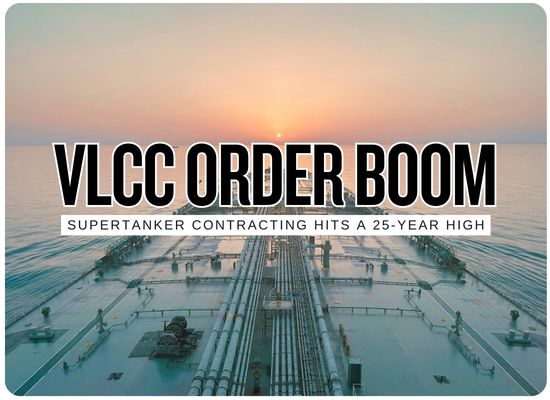
Supertanker Ordering Surges to 25-Year High as VLCC Owners Bet on Longer Oil Routes
🔔 Subscribe to ShipUniverse Weekly →
Shipowners have ordered more than twice as many Very Large Crude Carriers in 2026 as they did during all of 2025, pushing supertanker contracting to its highest level in at least 25 years. Signal Group counts 217 VLCC orders so far this year versus 93 in 2025, while Allied Shipbroking counts 164 versus 83, reflecting differences between shipping databases but the same sharp acceleration in contracting. The investment exceeds $20 billion, with a typical new VLCC currently costing around $130 million. The ordering wave coincides with longer crude trading routes caused by disruptions around the Strait of Hormuz, growing Atlantic Basin exports to Asia, record tanker freight markets and an aging fleet in which roughly one-fifth of VLCCs are more than 20 years old. Some of the vessels being contracted today will not enter service until 2029 or 2030.
The Supertanker Orderbook Has Changed Fast
Owners are locking in VLCC construction slots several years ahead as crude trades stretch across longer routes, tanker earnings remain elevated and replacement pressure grows across an aging fleet.
Inside the 2026 VLCC Ordering Wave
Different ship databases produce different absolute order counts, but all show historically exceptional contracting and a heavy concentration of deliveries in 2028 and 2029.
| Indicator | Current Reading | Previous / Comparison | Market Detail | Shipyard / Owner Signal |
|---|---|---|---|---|
| 2026 VLCC Orders | 217 vessels | 93 during all of 2025 | 25-Year High+ | Signal Group dataset. Allied Shipbroking separately counts 164 versus 83 in 2025. |
| H1 Contracting | 177 vessels 54.5M dwt |
Previous annual dwt record: 32.6M dwt in 2006 | Record | MSI says the first six months alone surpassed every previous full calendar year by deadweight. |
| Orderbook / Fleet | ~35% | About 2% in 2023 | Rapid Expansion | The increase raises the amount of replacement and incremental capacity scheduled later this decade. |
| 2028-29 Deliveries | 83% | Share of H1 2026 orders | Concentrated | Most of the current contracting surge does not affect near-term fleet supply immediately. |
| Chinese Yard Share | ~89% | H1 2026 VLCC contracts | Dominant | MSI reports Chinese builders captured nearly nine out of ten VLCC contracts placed in the first half. |
| Hengli Position | ~55% | Share of Chinese H1 VLCC contracting cited by MSI | Major Yard | Hengli has become one of the central beneficiaries of the current crude-tanker investment cycle. |
| Western Owners | ~50% | H1 orders | Greek-Led | MSI says Western owners, primarily Greek companies, accounted for about half of first-half contracting. |
| Asian Owners | ~25% | H1 orders | Active | Asian buyers represented roughly one-quarter of the first-half VLCC order flow. |
| Newbuild Cost | ~$130M | Approximately $131.5M quoted for Korean-built VLCCs in June | High Capex | Individual prices vary by yard, specification, propulsion package and contract timing. |
| Fleet Age | 18-20% | VLCCs already above 20 years old | Replacement Pressure | Frontline cited an industry figure of 18.3%; Veson estimates around 20%. |
| Spot Freight | $500K+/day | About $132K/day in February | Exceptional | Middle East disruption, vessel positioning and longer voyages have sharply tightened available capacity. |
| Atlantic Supply Growth | +2.5M bpd | Potential East South America growth through 2030 | Long-Haul | Vortexa expects Brazil, Guyana and Argentina to drive additional crude flows toward Europe and Asia. |
A larger VLCC backlog expands future demand for main engines, pumps, boilers, inert-gas systems, valves, cargo-control equipment and deck machinery.
Recent tanker specifications increasingly include Tier III compliance, efficiency packages, scrubbers on selected vessels and digitally monitored machinery systems.
Each delivered vessel subsequently creates recurring requirements for coatings, spares, inspections, drydocking, class work, navigation systems and maintenance support.
VLCC Newbuild Breakeven Rate Calculator
Estimate the daily TCE required to support a new VLCC based on acquisition cost, financing, operating expenses, utilization and residual value.
Breakeven Versus Selected Freight Levels
We welcome your feedback, suggestions, corrections, and ideas for enhancements.
Please click here to get in touch