New EPA Filing Reveals 275-VLCC Annual Scale of Planned Blue Marlin Offshore Port
🔔 Subscribe to ShipUniverse Weekly →
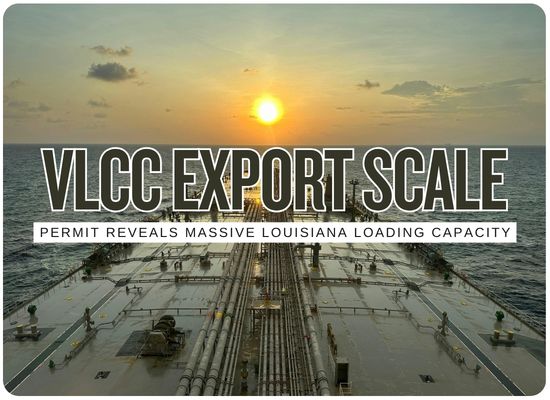
The U.S. Environmental Protection Agency opened public review on September 28 for draft Clean Air Act permits covering Energy Transfer's proposed Blue Marlin Offshore Port, exposing new operational detail on the scale of the planned Louisiana offshore crude-export facility. EPA's permitting case assumes as many as 275 VLCC loadings annually from two CALM buoys connected to the converted West Cameron 509 platform complex, with crude supplied from Energy Transfer's Nederland Terminal through a new 37-mile, 42-inch pipeline and the repurposed 36-inch Stingray Mainline. The system is designed for crude flow of up to 80,000 barrels per hour, or 1.92 million barrels per day. EPA's draft permits remain subject to public comment through October 29 and are only one part of the approval process. MARAD and the Coast Guard issued the project's Final Environmental Impact Statement in July, but Blue Marlin has not yet received its federal deepwater-port license.
A crude export chain designed around direct VLCC loading offshore Louisiana
Instead of moving a partially loaded VLCC through a constrained ship channel and topping it off offshore, Blue Marlin is designed to receive crude by pipeline and fully load the tanker at sea.
How a barrel reaches the VLCC
Blue Marlin combines new onshore construction with repurposed offshore gas infrastructure rather than building an entirely new marine corridor.
Crude enters the Blue Marlin system from Energy Transfer's existing Nederland terminal in Jefferson County, Texas.
A new 42-inch crude line would run from Nederland to Station 501 in Cameron Parish.
The existing 36-inch natural-gas mainline would be converted for crude service and connected to the modified offshore platform complex.
Subsea lines connect the platform to two offshore loading buoys. Floating crude and vapor-return hoses connect the selected buoy to the tanker.
The Permit Reveals More Than an Emissions Number
| Project Layer | Current Detail | Operational Meaning | Next Step / Limitation | Status |
|---|---|---|---|---|
| EPA Air Permits | Draft PSD preconstruction permit R6PSD-DWP-GA10 and draft Title V operating permit R6TV-DWP-GA10. | Establishes proposed emission limits, controls, monitoring, testing and operating requirements for the offshore source. | Public comments remain open through October 29. EPA must consider comments before issuing or denying final permits. | Public Review |
| Deepwater-Port License | MARAD and USCG published the Final Environmental Impact Statement in July 2026. | The federal environmental review has reached its final EIS stage. | A favorable Record of Decision and deepwater-port license are still required before the project can proceed as licensed. | Still Pending |
| Annual Vessel Case | 275 VLCCs EPA's operating assumptions use up to 275 loaded vessels annually. | Equivalent to roughly one loading every 31.9 hours averaged across the full year. | Actual throughput would depend on parcel sizes, weather, vessel scheduling and commercial utilization. | Permit Basis |
| Loading System | Two CALM buoys, subsea crude lines and floating hoses connected back to WC 509. | Allows deep-draft tankers to load offshore without entering a shallow or constrained ship channel. | Current project descriptions indicate approximately one VLCC-scale loading stream per day. | Designed |
| Vapor Capture | 99% Expected collection efficiency during routine operations. | Displaced hydrocarbon vapor is returned from the tanker rather than vented directly during normal loading. | Capture performance must be demonstrated through testing and monitored under the permit. | Draft Requirement |
| Vapor Destruction | Three VCUs with minimum 95% VOC destruction/removal efficiency. | Captured loading vapor is combusted offshore at the platform. | BMOP must submit an Initial Performance Test plan before startup. | Control System |
| Redundancy | Each buoy gets two parallel vapor pathways containing filters and detonation arrestors. | A single pathway failure does not automatically require uncontrolled loading. | EPA says the maintenance scenario applies only if both pathways serving the same buoy fail. | 2 Paths / Buoy |
| Maintenance Scenario | Vessel vapors may be discharged through the ship's mast riser if both vapor pathways for the active buoy are unavailable. | Loading can continue under a defined maintenance allowance while vapor-control equipment is serviced. | BMOP's permit application estimated up to 629 hours annually for this maintenance allowance. | Special Scenario |
| Pipeline Reuse | Existing 36-inch Stingray natural-gas infrastructure would be converted to crude service. | Reuses an existing offshore corridor and WC 509 platform assets. | A new 37-mile, 42-inch line is still required between Nederland and Station 501. | Reuse + New Build |
| Commercial Anchor | TotalEnergies signed a non-binding 2023 HOA covering four million barrels per month. | Equivalent to roughly two full 2-million-barrel VLCC parcels monthly. | The agreement was subject to definitive contracts and Energy Transfer taking a final investment decision. | Non-Binding HOA |
Largest listed regulated pollutant by mass.
Potential allowable sitewide emission rate.
Above the PSD significant emission rate.
Makes the facility a Title V major source.
Potential-to-emit value used in PSD review.
BMOP's air-permit application estimated an annual maintenance allowance of 629 hours. During a qualifying maintenance scenario, when both vapor pathways serving the active buoy are unavailable, displaced loading vapor is modeled as uncaptured and may leave through the tanker's mast riser. EPA's September notice makes clear that this is not the routine operating mode.
Blue Marlin VLCC Throughput & Loading Calendar
Test what EPA's annual vessel count means for barrels exported, loading hours and the amount of calendar time available between tanker calls.
That residual period would have to absorb the average effect of vessel approach, hose connection, disconnection, turnover, weather and other non-pumping time if the facility operated as a single active loading stream. Actual operations can vary substantially from this simplified calendar.
We welcome your feedback, suggestions, corrections, and ideas for enhancements.
Please click here to get in touch