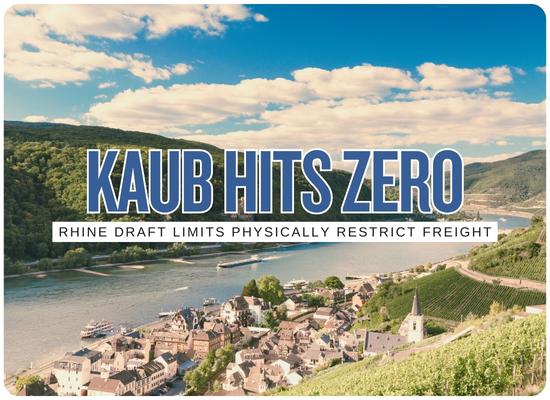
The Rhine's 2026 low-water crisis has moved beyond higher freight prices into physical limits on cargo movement. Germany's federal waterways authority recorded the critical Kaub gauge at 1 cm at 05:00 and 0 cm at 13:00 on September 30, after readings had already fallen below zero in recent days. A zero gauge does not mean a dry river: official WSV reference data indicate the navigation channel is still roughly 1.1–1.2 meters deep around that reading, but that is shallow enough to strip most of the useful draft from conventional freight barges. In Düsseldorf, the 135-meter Dutch barge Terra 2, carrying 168 Mercedes-Benz Sprinter vans, grounded on a sandbar while leaving the harbor, returned to its berth and began unloading vehicles so it could attempt the voyage to Rotterdam with less weight. Container operators are warning that regular barge services may become commercially or physically unviable on parts of the Upper and Middle Rhine, while rail and trucks are absorbing cargo that can no longer move normally by river.
Rhine Low Water · September 30, 2026
Zero on the Gauge Is Not Zero Water
The problem is not that the Rhine has disappeared. The problem is that so little usable draft remains that normal freight payloads become impossible.
Kaub Gauge
0 cm
Recorded at 13:00 on September 30 after several readings below zero during the preceding days.
What the Number Actually Means
WSV Equivalent Low-Water Level
77 cm
The official reference level used in the navigation-channel definition at Kaub.
Channel Depth at That Reference
190 cm
WSV's stated navigation-channel depth beneath the equivalent low-water level.
Approximate Depth at Zero Gauge
~1.13 m
An approximate reference calculation, before under-keel clearance and local depth variation.
Why Barges Lose Payload So Fast
Navigation Depth~1.1 m
−
Safety ClearanceRequired
=
Usable Vessel DraftVery Limited
Terra 2135 m
Dutch-flagged vehicle barge that grounded while leaving Düsseldorf harbor.
Cargo Onboard168 Vans
Mercedes-Benz Sprinters were bound for Rotterdam before the vessel grounded.
Immediate FixUnload Cargo
Vehicles were removed so the vessel could reduce draft and attempt departure again.
A gauge reading cannot be used as vessel draft directly. Actual safe draft depends on the navigation channel, local shoaling, vessel geometry, under-keel clearance and operational requirements.
Germany's Freight Displacement Chain
Less Water Does Not Just Mean Less Cargo Per Ship
Once payload falls far enough, the economics of the entire inland transport chain change: more vessels are needed, freight rates rise, departures become less reliable and cargo begins spilling into rail and road networks.
Stage 1Draft Restriction
Barges must reduce cargo weight to keep sufficient water beneath the hull.
→
Stage 2Payload Collapses
The vessel still consumes crew, fuel and time while carrying only a fraction of its normal cargo.
→
Stage 3Cargo Leaves the River
Rail, trucks, pipelines and inventory drawdowns must absorb freight that barges can no longer move economically.
Industries Exposed Along the Rhine
Chemicals
BASF, Bayer, Covestro and other Rhine-based producers depend heavily on bulk movement of raw materials and finished chemicals.
Fuel & Energy
Refined products, coal and other energy cargoes become more expensive to position as tanker-barge payloads fall.
Containers
Inland boxes moving between Rotterdam, Antwerp and German terminals face surcharges, rerouting and possible service suspension.
Vehicles
The Terra 2 grounding shows that even finished-goods export logistics are now being altered by available draft.
2025 German Inland Waterway Freight171.6M tonnes
Total cargo transported on Germany's inland waterways last year.
Rhine Share~80%
Historical research identifies the Rhine as carrying roughly four-fifths of German inland-waterway freight.
ARA → Basel Freight€215 / tonne
S&P Global reported this rate on September 18, up €50 per tonne in only one week.
Wider Economic Effect
Small Transport Share, Large Industrial Exposure
Road dominates German freight overall, but inland barges specialize in enormous volumes of dense bulk commodities that cannot simply be replaced one-for-one by trucks. That is why a disruption concentrated in one transport mode can still propagate into chemicals, energy, steel and manufacturing.
Ship Universe Rhine Capacity Model
How Low Water Destroys Barge Payload
Estimate how available water depth can translate into usable draft, cargo capacity, additional barge trips and equivalent truck movements.
m
Approximate zero-gauge scenario near Kaub.
m
m
m
tonnes
tonnes
tonnes
Modeled Usable Draft0.95 m
Channel depth minus selected under-keel clearance.
Modeled Payload398 t
Simplified cargo capacity under the selected draft constraint.
Barge Trips Required7
Trips needed to move the entered cargo at modeled low-water payload.
Payload Remaining16%
Share of normal modeled payload retained.
Normal vs. Low-Water Payload
Normal Payload
2,500 t
Low-Water Model
398 t
Road Replacement Equivalent
100 trucks
Approximate number of 25-ton truckloads required to move the same 2,500 tonnes if the entire shipment were transferred to road.
Illustrative model only:
payload does not scale perfectly linearly with draft, and every vessel has its own hydrostatic characteristics, loading limits and under-keel-clearance requirements. The 1.15 m starting depth is an approximate Kaub zero-gauge reference, not a guaranteed depth throughout the Rhine. This calculator is intended to illustrate why small changes in available water can cause very large commercial capacity losses.
Feedback Welcome
We welcome your feedback, suggestions, corrections, and ideas for enhancements.