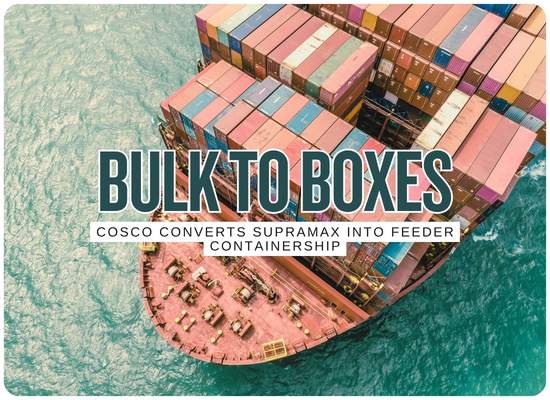
COSCO Turns 53,000-DWT Supramax Bulker Into 2,528-TEU Containership
🔔 Subscribe to ShipUniverse Weekly →
COSCO (Guangdong) Shipyard has completed the conversion of the 2007-built, 53,000-dwt open-hatch Supramax Pu Tuo Hai into the 2,528-TEU containership Singapore River after a little more than three months in the yard. The vessel entered the Guangzhou facility on June 10 and emerged with its four cargo cranes removed, its wheelhouse raised by two decks, container cell guides installed inside the former bulk holds and capacity for deck stacks reaching seven tiers. Length and beam remain essentially unchanged at 190 meters and 32.29 meters, while design draft has been reduced from about 12.6 meters to 12 meters and deadweight from roughly 53,000 to 48,000 tonnes. The original MAN B&W 6S50MC-C main engine remains aboard, giving a reported maximum speed of approximately 15.5 knots. Singapore River has already secured employment with X-Press Feeders and is expected to enter scheduled liner service in October after repositioning to Ningbo. A sister Diamond 53, Jiu Hua Hai, is already undergoing the same conversion at COSCO Guangdong and is expected to join X-Press Feeders later this autumn.
Same 190-meter hull. Completely different cargo system.
COSCO kept the basic hull and propulsion plant of a 19-year-old Supramax, but rebuilt the cargo interface around standardized containers.
Conversion anatomy: bulk carrier → cellular boxship
Simplified technical profile based on the publicly reported conversion scope. It illustrates the major functional changes rather than exact construction drawings.
Five large box-shaped holds received loose commodities through wide hatch openings. Four centerline cranes gave the vessel its own cargo-handling capability.
Cell guides now constrain containers vertically inside the former holds, while deck securing arrangements support the container stacks carried above them.
What Had to Change to Turn a Bulker Into a Boxship
| System | Pu Tuo Hai | Singapore River | Engineering Reason | Public Evidence | Status |
|---|---|---|---|---|---|
| Cargo Cranes | Four centerline cargo cranes, historically listed at approximately 36 tonnes each. | All four removed. | Clears the centerline and hatch-area geometry for container stacks and shore-crane handling. | Explicitly reported by Alphaliner via Splash. | Confirmed |
| Wheelhouse | Original Diamond 53 accommodation and bridge height. | Raised approximately two deck levels. | Higher container stacks forward of the bridge alter the line of sight. Raising the navigation position helps preserve required bridge visibility. | Physical modification confirmed. Detailed visibility study not published. | Modified |
| Cargo Holds | Five wide, flush-sided box-shaped bulk holds. | Former holds fitted with container cell guides. | Guides locate containers vertically, transfer transverse loads and allow cellular container stowage below deck. | Cell-guide installation explicitly reported. | Confirmed |
| Container Arrangement | Loose bulk, breakbulk and project cargo. | 2,528 TEU with 13 container rows and stacks reaching seven tiers. | Standardized container geometry replaces volume-based bulk stowage. | Capacity, rows and tier height reported by Alphaliner. | Confirmed |
| Deck / Hatch Loads | Structure designed primarily for distributed bulk-cargo and weather loads. | Must accommodate concentrated container-corner and securing loads. | Container stacks transmit high point loads through sockets, foundations and hatch-cover support structures. | DNV identifies this as a core conversion check. Vessel-specific strengthening details have not been released. | Class Verification |
| Lashing System | No cellular container securing arrangement. | Container securing and lashing infrastructure required. | Deck containers need approved foundations, fittings and securing arrangements. | Earlier project reporting referenced basic lashing bridges, but detailed plans are not public. | Details Undisclosed |
| Stability / Windage | Low-profile bulk cargo generally carried largely below deck. | Tall container stacks create substantially more vertical center-of-gravity and wind-area considerations. | Deck-container loading requires revised stability and longitudinal-strength assessment under class guidance. | Engineering requirement is established generally; vessel-specific calculations have not been published. | Recalculation Required |
| Draft | Approximately 12.6 m summer design draft. | Approximately 12.0 m. | Revised loading condition and container configuration reduce maximum deadweight. | Reported by Alphaliner. | −0.6 m |
| Deadweight | Approximately 53,000 tonnes. | Approximately 48,000 tonnes. | Conversion changes structural weight, draft and allowable loading condition. | Reported reduction of roughly 5,000 tonnes. | −9.4% |
| Hull Dimensions | 190 m × 32.29 m. | 190 m × 32.29 m. | Conversion extracts a new cargo role without lengthening or widening the hull. | Dimensions reported unchanged. | Unchanged |
| Main Engine | MAN B&W 6S50MC-C. | Original engine retained. | Avoids a major propulsion replacement but leaves the ship relatively slow compared with purpose-built liner tonnage. | About 15.5-knot top speed reported after conversion. | Retained |
Supramax bulk-cargo configuration.
Approximately 5,000 tonnes lower.
Regional feeder-sized slot capacity.
Total deadweight divided by nominal TEU capacity.
Singapore River Slot-vs-Weight Model
Test how average container weight affects the usable capacity of the converted 2,528-TEU ship.
At an average 14 tonnes per TEU, the ship reaches its physical slot capacity before exhausting the modeled cargo deadweight.
We welcome your feedback, suggestions, corrections, and ideas for enhancements.
Please click here to get in touch