Maritime Weekend Conflict Update: Hormuz Slowdown and Port Attacks
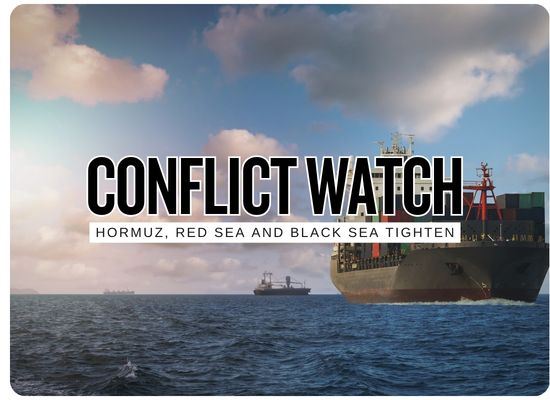
The weekend maritime conflict map tightened across three major operating zones. In the Gulf, shipping through the Strait of Hormuz slowed again after tanker attacks, with Kpler data showing only five commodity vessels passing on Saturday and none on Sunday, far below the 31 vessels recorded the previous weekend. Iran and Oman are still discussing a route framework for commercial transit, but Tehran is tying normal reopening to U.S. concessions, keeping the gap between mapped passage and usable passage wide. In the Red Sea, Mocha port halted commercial and maritime activity after repeated Houthi missile attacks, while Saudi-linked export movements remain harder to track as the threat picture around Bab el-Mandeb and Red Sea energy routes stays active. In the Black Sea, Novorossiysk resumed oil loadings after a drone-related halt, Russia dismissed a proposed Black Sea shipping ceasefire, and Odesa’s port infrastructure remains under attack pressure tied to Ukraine’s export corridor.
Three Corridors Are Moving at Once
Hormuz is about passage confidence, the Red Sea is about active port and energy risk, and the Black Sea is about export-route resilience.
Hormuz Transit Confidence
Very low weekend traffic shows that a route framework is not enough until crews, insurers, charterers and navies trust the passage conditions.
Red Sea Port Disruption
Mocha’s halt in commercial activity moves the risk picture beyond transiting ships and into port access, local cargo flow and emergency response.
Black Sea Export Pressure
Novorossiysk returned to oil loading after disruption, but the quick stop-start pattern keeps cargo timing, tanker scheduling and insurance terms unstable.
Ceasefire Track Stalls
Russia’s rejection of a Black Sea shipping pause leaves grain, oil and port infrastructure exposed to more short-notice disruption.
The weekend signal is not a single chokepoint emergency. It is a layered route problem across Gulf energy flows, Red Sea port access and Black Sea export infrastructure.
Weekend Corridor Status Board
Each corridor is under pressure for a different reason: negotiation risk in Hormuz, attack risk in the Red Sea, and port-war risk in the Black Sea.
The main weekend pattern is divergence. Hormuz is not fully closed, but confidence is weak. The Red Sea is not only a transit lane problem, because port operations and Saudi-linked oil movements are now part of the risk picture. The Black Sea is still functioning in pieces, but oil and grain routes are exposed to drone, missile and port-infrastructure disruption.
Commodity-vessel passages reported through Hormuz on Saturday and Sunday.
Mocha port said it was hit by repeated Houthi missile attacks before halting activity.
Approximate Novorossiysk oil-export capacity tied to the Sheskharis terminal.
Regional Conflict Update Table
| Corridor | Latest Signal | Commercial Read | Stakeholders | Status |
|---|---|---|---|---|
| Strait of Hormuz | Weekend commodity traffic dropped sharply after recent tanker attacks. | The biggest issue is not charted routing. It is whether insurance, naval posture and political terms allow normal fixtures. | VLCC owners, LNG carriers, Gulf exporters, charterers, insurers | High |
| Iran-Oman lane talks | Iran says a route arrangement is moving forward, but reopening remains tied to U.S. concessions. | A draft lane can reduce uncertainty only if payment, enforcement and inspection rules are commercially usable. | Legal teams, P&I clubs, flag states, energy buyers, port agents | Watch |
| Red Sea and Mocha | Mocha port halted commercial and maritime activity after repeated missile attacks. | Port shutdown risk adds another layer to Red Sea exposure beyond open-water drone and missile attacks. | Regional cargo ships, port operators, aid cargo, agents, crews | High |
| Saudi Red Sea exports | Saudi-linked tanker visibility remains strained as Houthi threats grow around Red Sea oil routes. | Reduced visibility complicates freight positioning, sanctions checks, cargo timing and war-risk pricing. | Tanker pools, refiners, AIS intelligence firms, underwriters, traders | Watch |
| Novorossiysk | Oil loading resumed after a drone-related halt at Russia’s Black Sea export hub. | Rapid restart limits immediate supply loss, but the port remains a repeat disruption point for Russian and Kazakh flows. | Crude traders, Suezmax owners, Kazakhstan shippers, terminal operators | Medium |
| Odesa corridor | Russian attacks damaged Odesa port infrastructure during renewed pressure on Ukraine’s export route. | Grain and bulk flows still face vessel-call hesitation, port damage risk and added insurance friction. | Dry bulk owners, grain houses, insurers, Ukrainian ports, food buyers | High |
| Black Sea diplomacy | Russia dismissed a proposed shipping ceasefire after Ukraine’s reported effort to pause attacks on civilian ships. | The absence of a pause keeps both sides’ port and shipping infrastructure vulnerable heading into export season. | Turkey, grain traders, oil exporters, port authorities, shipowners | Watch |
Maritime Conflict Route Exposure Tool
Compare wait, proceed and reroute pressure for Hormuz, Red Sea and Black Sea voyages.
Total estimated exposure before recoveries.
Remaining exposure after recoverable cost assumptions.
Delay cost after cargo urgency is applied.
Pressure score balancing cost, route trust and cargo urgency.
The route remains usable only with senior voyage, insurance and compliance review.
Review before fixtureThis tool is for editorial and commercial sensitivity only. It does not replace live naval guidance, flag-state instructions, insurer approval, sanctions counsel, voyage routing, charter-party review or professional security advice.
We welcome your feedback, suggestions, corrections, and ideas for enhancements.
Please click here to get in touch