Global Navy Shipbuilding Update: Allied Yards, Steam Catapults and a Worldwide Frigate Race
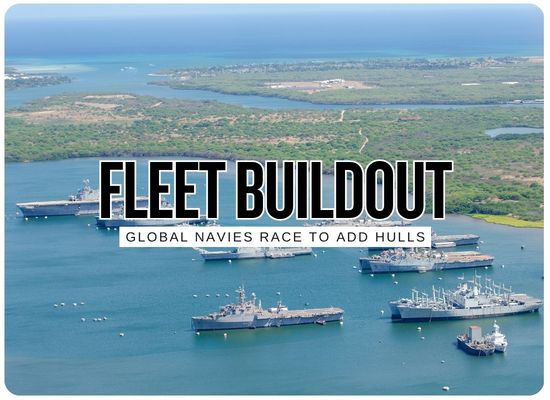
Naval shipbuilding is entering a faster and more politically complicated phase, with the United States now debating overseas allied-yard construction and a return to steam catapults, while Europe, Asia and allied Pacific fleets accelerate submarines, frigates, destroyers, corvettes and unmanned-capable ships. The White House memorandum adds a major U.S. policy turn by directing a carrier launch-system reversal for CVN-81 and creating a pathway for selected foreign-built ships under a model that requires allied suppliers to invest in American shipyards. At the same time, Canada is moving toward a 12-submarine program with TKMS, Australia is bringing Japan’s upgraded Mogami-class frigate into its fleet plan, Vietnam has started work on a domestically built anti-submarine frigate, South Korea is advancing its next-generation destroyer program, and European yards are trying to balance new orders with capacity pressure.
Navies Want More Hulls, Faster Yards and Deeper Allied Production
The new shipbuilding cycle is being shaped by carrier redesign fights, submarine programs, frigate shortages, allied-yard models and domestic industrial policy.
U.S. Policy Turn
The White House memo pushes two major changes: a carrier catapult reversal and a path for selected allied foreign-yard construction tied to U.S. yard investment.
Submarine Demand Surge
Canada, AUKUS, Italy, India, Pakistan and South Korea all point to a stronger global submarine cycle, with nuclear and conventional programs moving together.
Frigate Export Race
Japan’s Mogami, Britain’s Type 26, Germany’s MEKO, Spain’s F-110 and Brazil’s Tamandaré show how frigates are becoming the hottest exportable naval platform class.
Asian Self-Reliance Push
Vietnam, India, China, South Korea and Turkey are using shipbuilding programs to reduce dependence on outside suppliers and strengthen local defense industries.
Capacity Bottleneck
Shipyards, design offices, engine suppliers, combat-system integrators, skilled welders and naval electronics firms are becoming the pacing items.
Market Readout
The naval market is no longer just adding ships. It is reorganizing who builds them, where follow-on hulls are constructed, which allies share designs, and how much production risk governments are willing to accept to get ships faster.
Regional Navy Shipbuilding Board
The global build cycle is spreading across submarines, frigates, destroyers, carriers, corvettes, auxiliaries and unmanned-capable platforms.
The regional map is changing quickly. The U.S. is testing a new allied-yard model, Europe is trying to turn naval demand into industrial capacity, Asia-Pacific fleets are adding submarines and frigates, and Middle East navies are continuing corvette and surface-combatant programs while the Black Sea conflict accelerates interest in drones and coastal strike systems.
U.S. FY27 shipbuilding request for 18 battle-force ships and 16 auxiliary ships.
Submarines in Canada’s next-generation patrol submarine negotiation with TKMS.
Australia’s decade-level commitment for new general-purpose frigates built around the upgraded Mogami class.
Reported value of South Korea’s KDDX next-generation destroyer program led by Hanwha Ocean.
Global Shipbuilding Update Table
| Region | Latest Shipbuilding Signal | Program or Platform | Industrial Meaning | Supplier Niches | Watch Level |
|---|---|---|---|---|---|
| United States | White House memo directs steam and hydraulic plan for CVN-81 and opens limited allied foreign-build pathway. | Ford-class carrier, surface combatants, ro-ro ships, replenishment tankers | The U.S. is trying to add capacity without abandoning domestic yard investment. | Carrier systems, catapults, shipyard upgrades, auxiliary builders, ASW frigate suppliers | High |
| United States | FY27 Navy request seeks 34 ships including Columbia, Virginia, FF(X), Arleigh Burke, amphibious ships, medium landing ships and auxiliaries. | Submarines, destroyer, frigate, amphibs, oilers, tenders | The budget confirms a high-low mix, more logistics hulls and a bigger support-ship push. | Nuclear suppliers, combat systems, ship-to-shore connectors, landing ships, tenders | High |
| North America | Canada selected TKMS as preferred supplier for up to 12 Type 212CD submarines. | Canadian Patrol Submarine Project | Canada is turning Arctic and Atlantic patrol requirements into a major NATO submarine procurement. | AIP systems, combat systems, Arctic equipment, sustainment, training, Canadian workshare | High |
| Europe | TKMS and Navantia are advancing submarine cooperation while Germany moves MEKO A-200 frigates and Canada negotiations forward. | 212CD submarines, MEKO frigates, international submarine programs | European yards are being pushed toward shared capacity and export partnerships. | Submarine modules, sonar, batteries, combat systems, engineering and certification | High |
| Europe | Fincantieri strengthened Italy’s U212 NFS program and flagged more defense orders including destroyers and support ships. | U212 NFS, DDX destroyers, J3MS, LSS | Italy is building a larger underwater and surface-combatant industrial lane. | Submarine technologies, propulsion, sensors, logistics ships, lifecycle services | Medium |
| United Kingdom and Nordics | UK Dreadnought funding and the Type 26 partnership with Norway keep British yards tied to nuclear deterrence and North Atlantic ASW. | Dreadnought SSBN, Type 26 frigates, Type 31 frigates | British naval construction is being reinforced by deterrent funding and export-linked frigate work. | Nuclear supply chain, ASW sensors, mission bays, propulsion, modular build halls | High |
| Australia and Japan | Australia locked in the first three upgraded Mogami-class frigates with Japan, with later ships tied to Western Australia. | General-purpose frigate program | Japan’s warship export role is expanding while Australia protects continuous local shipbuilding. | VLS, radar, anti-air systems, ASW packages, local production transfer | High |
| AUKUS | AUKUS ministers say Pillar I remains on track, while Australia adds yard funding and supply-chain qualification work. | Virginia-class transition, SSN-AUKUS, UUV payloads | The submarine program is becoming a multi-decade industrial workforce and yard-construction project. | Nuclear workforce, combat systems, submarine sustainment, UUV payloads, supply-chain qualification | Watch |
| China | China’s Type 076 Sichuan continues trials with electromagnetic catapult and unmanned-aircraft focus. | Type 076 amphibious assault ship, Type 054B frigates | China is pairing carrier-style launch technology with amphibious and drone operations. | EM launch systems, arresting gear, UAV integration, amphibious command systems | High |
| South Korea | Hanwha Ocean was selected as preferred bidder for the KDDX lead ship, while Korean firms push harder into U.S. naval supply chains. | KDDX destroyer, U.S. naval industrial-base expansion | Korea is becoming both a domestic naval builder and a possible supplier to allied yard-capacity gaps. | Aegis-class systems, hull modules, naval design, U.S. yard investment, destroyer integration | High |
| India and Vietnam | India delivered another Project 17A frigate and Vietnam started building its largest domestic ASW warship. | Nilgiri-class frigates, Vietnamese ASW frigate | Regional navies are turning strategic competition into local shipbuilding milestones. | Stealth frigate systems, ASW suites, missiles, local electronics, training | Medium |
| Middle East and Turkey | Saudi Arabia’s second-batch Avante 2200 corvettes continue at Navantia, while Turkey advances the MUGEM carrier program. | Saudi corvettes, Turkish aircraft carrier, drone carrier systems | Regional navies are moving toward local sustainment, bigger surface ships and unmanned-air integration. | Corvette systems, MCM, carrier aviation support, unmanned aircraft, lifecycle support | Medium |
| Brazil and Latin America | Brazil commissioned the first Tamandaré-class frigate and launched the third vessel, with a second batch under discussion. | Tamandaré-class frigates | Brazil is using frigate construction to strengthen domestic naval industry and technology transfer. | Local yard workshare, propulsion, combat systems, training, lifecycle support | Positive |
Planning note: The biggest shift is not only more naval spending. It is the spread of production across allied and domestic yards, with governments trying to combine speed, sovereignty, exportability and workforce development in the same program.
Naval Shipbuilding Capacity Pressure Estimator
Model pressure on a shipbuilding program based on hull count, yard capacity, foreign-build support, supplier bottlenecks and schedule compression.
Estimated pressure based on schedule, hull count, complexity and supply-chain risk.
Estimated annual delivery shortfall after allied-yard support.
Estimated adjusted build period after complexity and supplier drag.
Estimated budget exposure from selected overrun assumption.
The modeled program needs added yard capacity, design discipline or allied build support.
Capacity plan neededThis tool is for editorial and commercial sensitivity only. It does not replace official naval procurement data, classified program schedules, shipyard capacity studies, legal review, export-control analysis, workforce modeling, cost-estimating reports or professional defense-market forecasting.
We welcome your feedback, suggestions, corrections, and ideas for enhancements.
Please click here to get in touch