Hormuz Timeline: Pressure Points That Shaped a Century of Shipping Risk
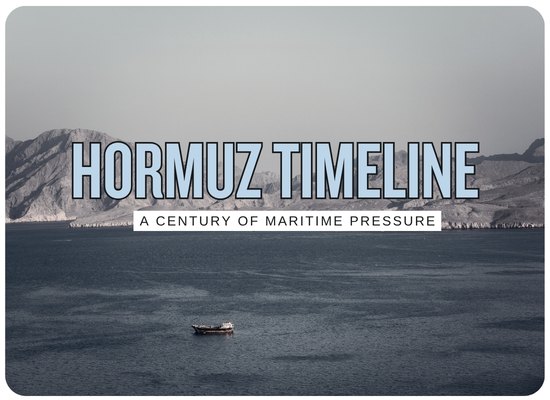
A century of pressure around the world’s most watched energy lane
Hormuz crises usually begin as political or military pressure, but they reach the maritime market through insurance, routing, escorts, tanker availability, LNG scheduling, bunker planning, crew risk, and charter clauses. The strait’s history is a repeated cycle: threat, repricing, naval posture, partial adaptation, and eventual cooling without fully removing the underlying risk.
Hormuz as a maritime risk system
The Strait of Hormuz connects the Persian Gulf with the Gulf of Oman and the Arabian Sea. It is short, narrow, heavily watched, and critical to seaborne energy trade. The route is deep enough for the largest tankers, but its value is not just physical. It sits next to Iran, Oman, the UAE, and major export infrastructure from Gulf energy producers. That makes it a shipping lane, a naval operating area, a legal flashpoint, and a market signal all at once.
Over the last century, Hormuz has rarely been fully “resolved” in the way a normal commercial dispute is resolved. Instead, crises have been managed. British withdrawal changed the regional balance. The Iran-Iraq War turned tankers into targets. Sanctions made seizures and threats more likely. Regional proxy conflict raised the cost of passage. Current tensions have reminded owners that a single chokepoint can affect crude oil, LNG, war-risk insurance, tanker positioning, port schedules, and global pricing even when only a handful of vessels are directly hit.
Operator takeaway: Hormuz history shows that maritime impact often starts before a formal closure. AIS behavior changes, ships slow or turn back, insurers reprice, charterers ask for clauses, naval forces increase presence, and energy buyers start pulling from storage or alternate supply.
Timeline of conflict and maritime impact
Oil concession politics and British Gulf security
The modern Hormuz risk story begins with oil infrastructure and imperial maritime security. Gulf oil production, tanker loading, and British naval influence made the waterway strategically important before the region became the high-volume export engine seen today.
- Maritime impact Early tanker traffic and oil concessions tied Gulf political stability to shipping security.
- Risk pattern Security was managed through outside naval influence and local arrangements rather than regional consensus.
- Cooling mechanism British maritime presence and oil company logistics kept trade moving, but also embedded external power into Gulf security.
Iranian oil nationalization and tanker market disruption
Iran’s oil nationalization crisis did not close Hormuz, but it showed how political control of Gulf oil could affect ships, buyers, cargo legality, and tanker employment. The commercial problem was not only sea passage. It was whether cargoes could be lifted, financed, insured, and sold.
- Maritime impact Tanker activity linked to Iranian oil exports became uncertain as buyers and shipowners faced legal and political risk.
- Risk pattern Oil cargo legitimacy and sanctions-like pressure affected trade even without a naval blockade.
- Cooling mechanism Political realignment and later oil-sector arrangements restored flows, but the episode taught owners that Hormuz risk can come from law and cargo ownership, not only missiles.
British withdrawal and the island dispute near the strait
As Britain withdrew from its Gulf security role, Iran took control of Abu Musa and the Greater and Lesser Tunbs, islands close to the Strait of Hormuz. The dispute became a lasting sovereignty issue involving Iran and the UAE, and it still shapes security assumptions around the waterway.
- Maritime impact Traffic continued, but the political geography around the strait became more contested.
- Risk pattern Territorial control near a chokepoint became part of naval posture, surveillance, and regional distrust.
- Cooling mechanism The dispute did not produce a lasting maritime shutdown, but it remained unresolved and became part of the background risk premium.
Oil embargo era and the chokepoint pricing lesson
The Arab oil embargo was not a Hormuz closure, but it changed how governments and buyers viewed energy chokepoints. It connected Middle East geopolitics, seaborne supply, strategic inventories, and price shocks in a way that still shapes Hormuz planning.
- Maritime impact Oil buyers began treating secure supply, tanker routes, stockpiles, and energy diplomacy as strategic issues.
- Risk pattern Political decisions far from the ship could move freight, inventories, and energy prices quickly.
- Cooling mechanism Strategic stockpiling, diversified sourcing, and long-term energy policy became part of the response, even though Hormuz remained open.
The Tanker War turns commercial ships into targets
The Iran-Iraq War produced the defining maritime conflict in Hormuz history. Tankers and terminals became tools of economic pressure. Mines, missiles, air attacks, convoy decisions, flagging strategy, and war-risk premiums moved from specialist issues into daily commercial reality.
- Maritime impact Tankers faced direct attack, insurance costs rose, some owners delayed voyages, and naval escorts became central to keeping Gulf exports moving.
- Risk pattern The strait did not need to be fully closed to impose cost. Risk was transferred through premium, delay, crew danger, and charter uncertainty.
- Cooling mechanism U.S. convoy operations, reflagging of Kuwaiti tankers, naval retaliation, UN diplomacy, and the end of the Iran-Iraq War gradually reduced the crisis.
Operation Earnest Will and the escort model
Operation Earnest Will became one of the clearest examples of maritime risk management under fire. Kuwaiti tankers were reflagged and escorted to reduce vulnerability and signal that energy traffic would not be abandoned.
- Maritime impact Convoy planning, route discipline, naval coordination, and flagging decisions became part of commercial tanker movement.
- Risk pattern Escort reduced some exposure but did not eliminate mines, misidentification, small-boat threat, or escalation risk.
- Cooling mechanism Naval presence stabilized enough traffic for trade to continue, while diplomacy and war exhaustion moved the conflict toward ceasefire.
Mining, Praying Mantis, and the deterrence reset
The mining of USS Samuel B. Roberts led to Operation Praying Mantis, a major U.S. naval action against Iranian naval targets. The incident showed that mining could trigger direct military escalation and that maritime attacks could move beyond commercial insurance into state-on-state conflict.
- Maritime impact Mines became one of the most feared tools because they could disrupt confidence across the route without needing large naval forces.
- Risk pattern A single mine event could shift the entire tanker market’s view of transit safety.
- Cooling mechanism U.S. naval retaliation, convoy persistence, and the Iran-Iraq ceasefire period reduced the intensity of tanker attacks.
Gulf War and sanctions turn the region into a monitored corridor
The Gulf War centered on Iraq and Kuwait, but Hormuz remained critical because the broader Gulf became more militarized and heavily monitored. Afterward, sanctions, inspections, and naval enforcement made maritime compliance a constant operating issue.
- Maritime impact Owners dealt with naval presence, cargo checks, sanctions compliance, and higher scrutiny of Gulf voyages.
- Risk pattern The biggest cost was not always physical attack. Compliance delay, detention risk, and cargo documentation also mattered.
- Cooling mechanism Coalition operations, sanctions enforcement systems, and later diplomatic frameworks stabilized traffic without removing strategic tension.
Nuclear sanctions and close-quarter naval incidents
As Iran’s nuclear dispute grew, Hormuz became a signaling space. Naval encounters, sanctions pressure, and periodic Iranian threats to close the strait kept the route on watch lists even when traffic continued normally.
- Maritime impact Operators saw more compliance checks, sanctions exposure, war-risk review, and caution around Iranian-linked cargoes or counterparties.
- Risk pattern Hormuz risk increasingly combined physical security with sanctions, beneficial ownership, banking, and insurance exclusions.
- Cooling mechanism Naval deconfliction, sanctions enforcement, diplomatic talks, and market adaptation kept most commercial flows moving.
Closure threats during sanctions pressure
Iranian threats to close the strait during sanctions pressure reminded the market that Hormuz can move oil prices before a shot is fired. The maritime impact came through insurance review, naval readiness, and energy-market fear rather than a sustained physical closure.
- Maritime impact Owners, refiners, and traders reassessed war-risk cover, routing, inventories, and Gulf exposure.
- Risk pattern Threats alone can raise costs because insurers, charterers, and cargo buyers price uncertainty in advance.
- Cooling mechanism Naval presence, sanctions diplomacy, strategic inventories, and the absence of a full closure kept the market functioning.
Nuclear deal relief and temporary commercial normalization
The nuclear deal period gave owners and traders a reminder that diplomatic cooling can reduce maritime pressure. Sanctions relief supported more normal trade patterns, although political risk never fully disappeared.
- Maritime impact More cargo opportunities opened around Iranian trade, but owners still had to manage compliance and counterparty diligence.
- Risk pattern Commercial optimism can return quickly, but policy reversal risk remains part of the voyage file.
- Cooling mechanism Diplomatic agreement, sanctions relief, banking pathways, and insurance clarity helped normalize certain trades.
Tanker attacks and the Stena Impero seizure
After sanctions pressure returned, a series of tanker incidents near the Gulf and the seizure of Stena Impero placed Hormuz back at the center of maritime risk. The crisis showed how quickly a commercial voyage could become leverage in a wider state dispute.
- Maritime impact War-risk premiums rose, naval patrols increased, owners reviewed crew risk, and charterers added caution around Gulf calls.
- Risk pattern Seizure risk became as important as missile or mine risk. Flag, ownership, cargo, and geopolitical links mattered.
- Cooling mechanism Diplomatic pressure, maritime security coalitions, and vessel release reduced the immediate crisis, but the precedent remained.
Drone and vessel harassment risk spreads beyond the strait
Regional maritime risk expanded into the Gulf of Oman, Arabian Sea, and nearby waters. Operators had to monitor not only the narrow strait but the wider approach zone where drones, small craft, mines, and seizures could affect voyages.
- Maritime impact Risk assessments expanded from one chokepoint to a broader security corridor.
- Risk pattern Attacks outside the strait can still affect Hormuz traffic because ships must approach and exit through adjacent waters.
- Cooling mechanism Naval alerts, threat reporting, vessel hardening, and route timing helped reduce exposure without removing the underlying conflict.
MSC Aries and the container shipping warning
The seizure of MSC Aries showed that Hormuz risk is not limited to crude tankers. Container ships, cargo interests, ports, insurers, and forwarders can all be pulled into a regional dispute when vessel ownership, operator links, or political targets become part of the security calculus.
- Maritime impact Cargo owners faced uncertainty even outside the tanker market, and container operators reviewed Gulf exposure and seizure risk.
- Risk pattern Political targeting can follow perceived ownership or commercial links, not only cargo type.
- Cooling mechanism Crew release and prolonged legal or political handling lowered the humanitarian pressure, while the vessel case remained a warning to operators.
Partial closure, tanker turnbacks, and LNG backlog pressure
The current crisis has reinforced how modern Hormuz disruption works. Ships may not all stop at once, but traffic can become fractured: some vessels turn back, some switch AIS behavior, some wait near terminals, insurers reprice, cargoes are canceled or delayed, and governments try to reopen traffic through ceasefire or security arrangements.
- Maritime impact Oil and LNG operators face turnbacks, backlog, higher insurance, charter cancellations, and delayed export schedules.
- Risk pattern The market can enter a gray zone between open and closed, where legal passage exists but commercial risk blocks normal flow.
- Cooling mechanism Diplomacy, sanctions adjustment, naval posture, rerouting through pipelines, inventory releases, and selective vessel movements are being used to restore confidence.
Condensed crisis table for operators
| Period | Pressure point | Maritime effect | Stabilizing mechanism | Operator lesson |
|---|---|---|---|---|
| Oil concession and British security era | Oil logistics tied Gulf shipping to external naval power. | Early tanker security depended on political protection and port access. | Imperial maritime presence and oil-company logistics. | Energy shipping always depends on security architecture. |
| Iran oil nationalization | Cargo ownership, legality, and buyer risk. | Tanker liftings became politically and legally difficult. | Political settlement and restored oil arrangements. | Cargo legality can disrupt shipping without closing the sea lane. |
| British withdrawal and island dispute | Regional control near the chokepoint. | Traffic moved, but territorial distrust became permanent background risk. | De facto control and diplomatic management. | Unresolved geography can shape decades of naval risk. |
| Tanker War | Missiles, mines, seizures, and tanker targeting. | War-risk premiums, convoy planning, reflagging, and voyage delays. | Convoys, naval retaliation, UN diplomacy, ceasefire. | Traffic can continue under attack if escorted and priced accordingly. |
| Sanctions and nuclear tension | Threats to close the strait and counterparty restrictions. | Compliance, banking, insurance, and oil-price pressure. | Diplomacy, sanctions frameworks, naval deterrence. | Finance and insurance can be as important as physical passage. |
| 2019 tanker attacks and Stena Impero | Seizure and retaliation logic. | Flag risk, crew risk, higher premiums, maritime coalitions. | Diplomatic pressure, naval patrols, eventual release. | Voyage risk follows nationality, ownership, cargo, and politics. |
| 2024 container seizure | Political targeting beyond tanker trades. | Container cargo, liner scheduling, and cargo-owner exposure entered the Hormuz risk discussion. | Crew release, case handling, commercial caution. | Non-tanker operators cannot ignore Hormuz risk. |
| 2026 crisis | Partial closure, attacks, insurance repricing, and LNG backlog. | Turnbacks, canceled charters, tanker queues, AIS caution, and disrupted energy flows. | Ceasefire attempts, naval posture, sanctions moves, pipeline bypass, stock draws. | A route can be commercially impaired before it is legally closed. |
Practical test: Hormuz risk should be tracked in five lanes at once: physical security, insurance availability, legal passage, cargo financing, and terminal scheduling. If any one lane fails, the voyage can become commercially blocked even if the strait is not formally closed.
Conflict patterns that kept repeating
| Pattern | Historic example | Maritime effect | Stabilizer | Modern planning signal |
|---|---|---|---|---|
| Threat without full closure | Sanctions-era closure threats. | Insurance, oil prices, and charter clauses react before a blockade. | Naval deterrence and diplomatic signaling. | Track threat language, not only incident counts. |
| Selective targeting | Tanker War and later tanker incidents. | Specific flags, cargoes, or ownership links become risk multipliers. | Escort, reflagging, route discipline, and political pressure. | Screen vessel identity, not only route. |
| Insurance-led slowdown | War-risk repricing during multiple Hormuz crises. | Vessels may delay or refuse transit even if the lane is open. | Government backstops, naval protection, and premium clarity. | Insurance availability is a leading indicator. |
| Legal passage versus commercial reality | Transit passage claims during state tension. | Law may support movement, while commercial parties still pause. | International pressure and security guarantees. | Do not treat legal right as operational clearance. |
| Energy-market adaptation | Pipeline bypasses, stock draws, alternate crude sourcing. | Flows reroute, but not enough to fully replace Hormuz volumes. | Inventories, alternate supply, and limited bypass capacity. | Bypass capacity reduces shock but does not erase it. |
| Release as de-escalation | Stena Impero and crew-release cases. | Humanitarian and political pressure focuses on vessel and crew status. | Diplomacy, prisoner or cargo negotiation, and face-saving offramps. | Seizure cases often cool through negotiated release, not court speed. |
Resolution playbook used across the century
- 01. Naval deterrence Convoys, patrols, mine countermeasure vessels, escorts, and visible naval presence have repeatedly been used to reassure traffic.
- 02. Diplomatic offramps Even after direct incidents, vessel releases, ceasefire talks, sanctions adjustments, and third-party mediation have often reduced pressure.
- 03. Insurance repricing War-risk markets do not resolve conflict, but they decide which voyages continue, pause, or require government support.
- 04. Strategic inventories Buyers and governments use crude and product stocks to cushion short-term disruption.
- 05. Pipeline bypass Saudi and UAE routes outside the strait can reduce some exposure, but cannot fully replace normal Hormuz trade.
- 06. Charter clause discipline Modern owners increasingly need clauses for war risk, deviation, delay, premium recovery, crew risk, and sanctions compliance.
- 07. Route intelligence AIS behavior, UKMTO-style advisories, naval warnings, insurer notices, terminal queues, and bunker-market signals matter before formal announcements.
- 08. Commercial patience Some crises cool because the cost of escalation becomes too high for every side, even without a final settlement.
Operator file before a Hormuz transit
Historic Hormuz crises point toward a practical operating file for modern owners and charterers.
- Security file: Latest maritime advisories, naval guidance, BMP-style procedures, crew briefings, and emergency contacts.
- Insurance file: War-risk quote, named-area notice, P&I position, hull cover, crew cover, and premium recovery language.
- Charter file: War-risk clause, deviation rights, delay treatment, force majeure language, sanctions clause, and cargo instruction record.
- Voyage file: AIS policy, routing, speed, daylight or convoy considerations, safe waiting areas, and bunker reserve.
- Cargo file: Buyer, seller, financing bank, sanctions screen, ownership links, terminal status, and discharge alternatives.
- Evidence file: All instructions, notices, insurer approvals, master reports, and security updates preserved for later claims or disputes.
Hormuz transit exposure calculator
This screen helps owners estimate the commercial exposure of a disrupted Hormuz voyage. It is not legal, insurance, or security advice, but it can frame the cost of delay and premium before the vessel commits.
Hormuz disruption exposure screen
Adjust the inputs to estimate the commercial exposure before a Hormuz transit.
Planning note: This simplified tool does not include legal review, crew refusal rights, cargo value risk, bank sanctions delay, government orders, convoy timing, terminal queue cost, lost customer confidence, or actual insurer underwriting. Use it only as a commercial planning screen.
Lessons from a century of Hormuz crises
| Lesson | Maritime meaning | Modern owner action | Priority |
|---|---|---|---|
| Open water does not equal normal trade | Traffic can be legally possible but commercially impaired. | Track insurance, charterer instructions, terminal queues, and ship behavior. | High |
| War-risk cover can become the real chokepoint | Insurers can slow trade before physical closure occurs. | Get premium terms, cancellation notices, and named-area approvals early. | High |
| Seizure risk follows identity | Flag, beneficial ownership, cargo, and political links can raise risk. | Screen the vessel, cargo, charterer, buyer, and ownership chain before entry. | High |
| Escorts help but do not erase risk | Convoys and patrols reduce exposure but cannot guarantee incident-free transit. | Keep emergency, deviation, and evidence plans ready even with naval presence. | Medium high |
| Bypass routes are useful but limited | Some crude can move by pipeline, but LNG and much oil volume remain exposed. | Model alternate supply, inventory, pipeline availability, and cargo substitution. | Medium |
| Resolution rarely removes the root risk | Crises cool through deals, releases, escorts, and pricing, while disputes remain. | Do not delete Hormuz clauses after a ceasefire. Update them. | Watch |
The operating mindset shift
Hormuz history is not a straight line from peace to war and back to peace. It is a series of stress cycles. Each cycle exposes a different weak point in maritime trade: cargo legality, territorial disputes, mines, missiles, seizures, sanctions, insurance, vessel identity, LNG timing, and energy-market dependence.
The most resilient operators treat Hormuz as a live risk system. They prepare clauses before the voyage, confirm insurance before the vessel enters the area, screen counterparties before cargo is fixed, preserve evidence during transit, and build alternatives before the market is already stressed.
We welcome your feedback, suggestions, corrections, and ideas for enhancements. Please click here to get in touch.