Marine Crane Certification Problems That Can Quietly Limit a Vessel’s Earning Power
🔔 Subscribe to ShipUniverse Weekly →
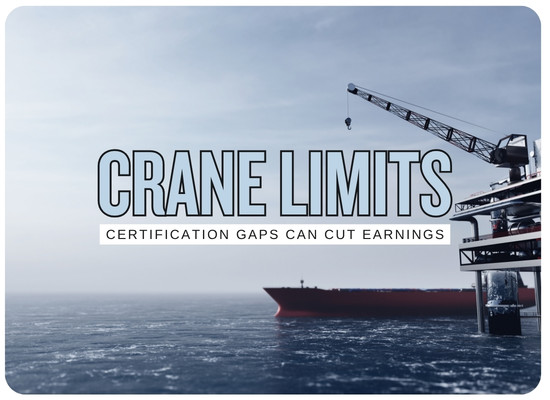
Marine crane certification is easy to treat as a compliance detail until a charterer asks for proof, a port requires a valid register, an offshore client rejects a lift plan, or a surveyor limits the crane’s safe working load. The lost earning power often appears quietly, before the crane ever fails mechanically.
The crane is part of the vessel’s earning profile
For many vessels, the crane is not just deck equipment. It is part of the ship’s commercial identity. A multipurpose vessel with reliable heavy-lift gear can chase project cargo. An offshore vessel with a correctly certified active-heave-compensated crane can compete for subsea work. A cargo ship with dependable deck cranes can serve ports with weak shore gear. A wind support vessel may need documented lifting capability before a client even reviews the rest of the tender.
The problem is that crane earning power depends on more than the rated capacity painted on the boom. Charterers, terminal operators, offshore clients, insurers, class surveyors, and cargo interests may want to see current certificates, load charts, test records, operator competence, inspection history, wire rope records, hook records, non-destructive examination reports, overload protection status, and confirmation that the crane is approved for the exact kind of lift being sold.
Owner takeaway: A crane with weak certification can reduce the vessel’s market before anyone says the word “defect.” The vessel may still trade, but the higher-value cargo, offshore job, or project scope may move to a competitor with cleaner lifting documentation.
9 certification problems that quietly reduce vessel earnings
Expired annual endorsements
An annual endorsement gap can make a crane commercially awkward even if the equipment looks healthy. Charterers and terminals may not want to wait while the owner arranges survey attendance, documentation review, or corrective action. In a tight fixture window, an incomplete endorsement can push the vessel out of consideration.
- Commercial damage Lost spot cargo, delayed port work, weaker charterer confidence, and last-minute service costs.
- Owner correction Maintain a rolling certificate calendar tied to fixture planning, not only technical department reminders.
- Deal test Can the broker send current crane certificates with the vessel description without waiting on the superintendent?
Five-year proof-load records that are unclear
Five-year load-test records carry commercial weight because they show whether the crane’s certified capacity has been proven under controlled conditions. A vague record, missing survey endorsement, unidentified test weights, unclear radius, or absent corrective-action closeout can create doubt during a cargo nomination or offshore tender.
- Commercial damage Reduced lifting confidence, rejected lift plans, client audit findings, and lower willingness to pay for crane capability.
- Owner correction Keep test certificates, surveyor endorsement, test load details, radius, boom configuration, and repair closeout together.
- Deal test Would a client’s lifting engineer approve the vessel from the certificate pack alone?
Load charts that do not match the job being sold
The crane’s headline SWL may not apply at the needed radius, sea state, outreach, boom angle, dynamic condition, personnel-lift condition, or subsea mode. Owners can overmarket a crane if the commercial description does not match the approved load chart. That creates fixture disputes and can make serious charterers walk away early.
- Commercial damage Overstated capability, failed tender screening, cargo rejection, and rate discounting after technical review.
- Owner correction Match the vessel description to approved load charts by radius, condition, crane mode, sea state, and lift type.
- Deal test Can the vessel perform the client’s actual lift at the required radius without relying on a best-case number?
Wire rope and hook documentation gaps
Wire ropes, hooks, blocks, sheaves, pins, bearings, swivels, and safety latches can become the weak link in a commercial crane file. If inspection, renewal, lubrication, non-destructive testing, or certificate history is thin, the crane’s rated capacity may matter less than the doubt around its lifting path.
- Commercial damage Failed pre-lift checks, cargo delay, emergency rope replacement, or reduced confidence from client auditors.
- Owner correction Track ropes and hooks by serial number, installation date, inspection history, defect status, and renewal plan.
- Deal test Can the owner prove every critical lifting component is inspected, in date, and tied to the crane certificate?
Uncertified pad eyes and loose lifting points
A vessel can have a certified crane but still lose work if deck pad eyes, lifting lugs, sea fastening points, spreader bars, slings, shackles, or portable lifting gear are not properly certified. Project cargo and offshore work often depend on the entire lifting system, not just the crane pedestal.
- Commercial damage Client refuses the lift plan, cargo has to be re-rigged, or the vessel needs last-minute third-party testing.
- Owner correction Build a register for fixed and loose lifting points, including SWL, test date, marking, inspection, and NDT status.
- Deal test Does the lift plan rely on any lifting point that cannot be verified immediately?
AHC and subsea crane capability not proven for the advertised scope
For offshore and subsea vessels, active heave compensation, subsea mode, man-riding restrictions, splash-zone limits, dynamic load allowances, wire length, and control-system condition can decide which jobs the vessel can bid. A vessel may have an impressive crane but still fail the tender if the certificates and load charts do not support the actual subsea work.
- Commercial damage Lost subsea project work, lower day-rate potential, and narrower client acceptance.
- Owner correction Keep AHC test evidence, subsea load charts, control-system maintenance, operator competence, and mode limitations in one tender-ready file.
- Deal test Can the crane perform the lift safely at depth, sea state, radius, and dynamic condition required by the client?
Repairs and modifications without clean class closeout
Crane repairs can create long-term commercial drag if the file does not show approved drawings, repair procedures, material certificates, welding records, NDT, hydraulic work, control-system checks, load testing, and class closeout. Buyers and charterers may discount the crane if the repair history is unclear.
- Commercial damage Reduced asset confidence, failed technical due diligence, and restricted crane use after survey review.
- Owner correction Treat crane repair records like a mini conversion file, with approvals, work packs, test evidence, and closeout certificates.
- Deal test Could a buyer or client auditor understand the repair without interviewing the former superintendent?
Operator and rigger competence not aligned with the work
Crane certification is not only hardware. Offshore clients, wind developers, subsea contractors, terminals, and project-cargo shippers may also look at operator training, rigger competence, lift-supervisor experience, toolbox-talk records, simulator training, and emergency procedures. A certified crane can still lose work if the crew competence file is weak.
- Commercial damage Client rejects the vessel team, imposes extra personnel, or reduces scope.
- Owner correction Match operator and rigger certificates to the vessel’s marketed lifting scope, including offshore, subsea, heavy-lift, or personnel-related work.
- Deal test Does the crew file support the same lift complexity as the crane certificate?
New SOLAS lifting appliance requirements not built into planning
New international lifting-appliance requirements make crane documentation more central to vessel compliance. Owners adding or replacing lifting appliances need to check certification, testing, marking, maintenance, survey scheme, cargo gear register, and safety construction certificate implications before the retrofit is treated as a simple equipment project.
- Commercial damage Retrofit delay, certificate problems, survey findings, and inability to market new crane capability on time.
- Owner correction Involve class, flag, crane maker, and lifting specialist before ordering or installing new equipment.
- Deal test Will the crane upgrade be fully certifiable and trade-ready before the vessel’s next commercial window?
The certificate pack that protects earning power
| Certificate or record | Commercial purpose | Problem if weak | Owner action |
|---|---|---|---|
| Register of lifting appliances and cargo gear | Shows the vessel’s lifting equipment is organized, traceable, and survey-ready. | Client cannot quickly verify the equipment in the lift plan. | Keep crane, pad eye, loose gear, and cargo gear records in one controlled file. |
| Annual thorough examination endorsement | Supports ongoing acceptance by class, ports, charterers, and client auditors. | Fixture can be delayed or rejected while survey attendance is arranged. | Track expiry against vessel employment and tender periods. |
| Five-year load-test certificate | Proves capacity under a formal test regime. | Heavy cargo or offshore client may reject the crane for the intended lift. | Record load, radius, boom setup, witness, findings, and closeout. |
| Approved load charts | Defines the real commercial capability at radius and operating condition. | Vessel is marketed above its approved working envelope. | Attach charts to cargo offers and offshore tenders where relevant. |
| Wire rope and hook records | Supports confidence in the full lifting path. | Lift is delayed by last-minute component questions. | Track serials, inspections, NDT, defects, renewal, and certificates. |
| Crane repair and modification file | Protects asset value after structural, hydraulic, electrical, or control work. | Buyer or charterer discounts the vessel due to uncertain crane history. | Keep drawings, approvals, materials, NDT, test records, and class closeout. |
| Operator and rigger competence records | Supports offshore, subsea, project cargo, and high-risk lift acceptance. | Client requires additional personnel or refuses scope. | Match crew training to advertised crane capability. |
Practical test: If a broker, charterer, or offshore client asks for the crane file today, the owner should be able to send a clean package in one email. If the file has to be rebuilt from class records, service reports, old attachments, and superintendent memory, the crane is already creating commercial friction.
Commercial jobs most exposed to crane paperwork gaps
| Vessel or work type | Certification sensitivity | Common earning restriction | Priority check |
|---|---|---|---|
| MPP and heavy-lift cargo | High because cargo value, lifting radius, and port limits can be unforgiving. | Vessel loses premium cargo to a better-documented competitor. | Load chart, crane pairing, wire records, hook blocks, lift plan support. |
| Offshore support vessels | Very high because client audits often review crane, operator, and lifting gear together. | Scope is reduced or client supplies additional lifting resources. | Crane certificate, AHC status, operator competence, offshore load charts. |
| Subsea construction support | Very high because dynamic conditions and subsea modes create tighter acceptance requirements. | Vessel cannot bid higher-value subsea lifts. | AHC records, subsea ratings, control-system status, wire length, dynamic load limits. |
| Wind support and project logistics | High because components, tooling, and port interfaces depend on approved lifting arrangements. | Client accepts the vessel only for lower-value support work. | Pad eyes, loose gear, deck layout, crane radius, operator competence. |
| Geared bulk and general cargo | Medium high because port independence is part of vessel value. | Charterer discounts the ship if deck cranes cannot be relied on. | Annual endorsement, wire rope, hook inspection, winch and brake condition. |
| Barges and floating cranes | High because the lifting appliance may be the core commercial asset. | Asset sits idle while certificates, tests, or repairs are completed. | Crane class status, proof-load test, stability, mooring, pad eyes, lifting plan. |
Crane earning power risk calculator
This tool helps owners estimate whether crane documentation gaps are likely to create commercial friction. It is a planning screen, not a substitute for class, flag, OEM, or lifting-engineer advice.
Crane commercial readiness screen
Adjust the assumptions to estimate how crane certification may affect marketability.
Planning note: Any structural defect, overdue load test, expired certificate, wire rope concern, or uncertain AHC limitation should be escalated to class, the OEM, and a competent lifting specialist before the vessel is marketed for the work.
Owner playbook for a lift-ready vessel
- ① Keep the crane file tender-ready. Annual certificates, five-year load-test records, load charts, component records, and class closeout should be easy to send.
- ② Market the approved capability, not the biggest number. The crane’s real commercial value depends on radius, sea state, mode, outreach, and lift type.
- ③ Treat pad eyes and loose gear as part of the revenue system. A certified crane can still lose the job if the supporting lifting points are not documented.
- ④ Rebuild repair records before S&P or tendering. Unclear repair history can reduce asset value even when the crane works.
- ⑤ Match operator competence to the lift being sold. Offshore, subsea, wind, personnel, and heavy-lift work all raise the competence bar.
- ⑥ Plan new crane retrofits around certification from day one. Design, installation, testing, cargo gear register, survey scheme, and safety certificate implications should be built into the schedule.
- ⑦ Run a commercial certificate audit before busy season. Crane issues are easier to fix before cargo is nominated, not after the charterer is waiting.
Certificate gate before quoting crane-dependent work
Before a vessel is offered for any job that depends on shipboard lifting capability, the owner should run a fast gate check.
- Scope match: The approved load chart covers the actual lift radius, weight, condition, and mode.
- Document match: Current certificates identify the correct crane, serial number, load test, and survey status.
- Component match: Wire ropes, hooks, blocks, slings, shackles, and pad eyes are traceable and in date.
- Personnel match: Crane operator, rigger, and lift supervisor competence fits the advertised work.
- Client match: The package satisfies the likely requirements of charterer, terminal, offshore client, class, and insurer.
The quiet valuation issue
Crane certification can also affect vessel value. A buyer of an MPP vessel, offshore support vessel, subsea unit, or project carrier is not only buying hull and machinery. They are buying commercial access. If the crane file is weak, the buyer may price in future load tests, repair risk, lost tenders, downtime, class comments, and the possibility that the advertised crane capability is not fully usable.
For lenders and insurers, crane documentation also matters because lifting incidents can produce large claims and operational delays. A clean file does not make every lift safe, but it shows that the owner understands the asset’s lifting system as a revenue-critical and risk-critical part of the vessel.