Maritime Investments Owners Are Reconsidering going into 2027 as Fuel Uncertainty Grows
🔔 Subscribe to ShipUniverse Weekly →
Owners are buying flexibility before they buy certainty
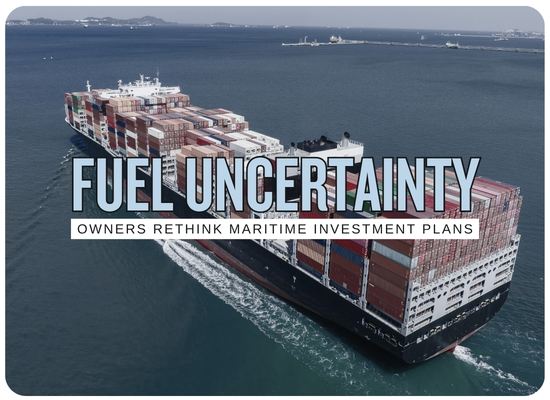
Fuel uncertainty is changing how owners rank capital projects. The safest investment is not always the newest fuel system. In 2026, many owners are reconsidering upgrades that protect optionality, reduce fuel burn, improve emissions data, and keep vessels commercially useful across several possible fuel futures.
The investment problem in 2026
The maritime fuel transition is no longer a simple line from today’s bunker fuel to one future replacement. Different owners are facing different answers by vessel type, route, cargo, charter structure, flag exposure, financing policy, port network, ship age, and customer base. LNG may fit some transition strategies. Methanol may fit certain liner, feeder, tanker, offshore, and project-cargo models. Ammonia may become important for deep-sea zero-carbon ambitions, but safety, availability, and infrastructure questions remain. Biofuels can help near-term compliance, but supply and certification matter. Ethanol is gaining attention as another liquid-fuel option. Electricity and shore power matter in port-heavy trades. Wind-assist can reduce fuel demand without choosing a molecule.
That creates a capital trap. A shipowner can spend heavily on a pathway that looks promising on paper but fails commercially if fuel is unavailable on the actual route, charterers will not pay for it, carbon rules shift, safety approvals take longer, or the vessel has too little remaining life to recover the investment. The smarter owner response is not to freeze all spending. It is to prioritize investments that stay valuable across several fuel outcomes.
Owner takeaway: The best 2026 fuel strategy may be a staged capital plan: reduce fuel demand first, improve data now, protect contract recovery, then commit to fuel-specific hardware only when the vessel’s route, charterer, and supply chain justify it.
9 maritime investments owners are reconsidering
Dual-fuel newbuilds without confirmed fuel corridors
Dual-fuel capability can protect future optionality, but it can also create expensive unused capability if the vessel trades where the fuel is not available, affordable, or accepted by charterers. Owners are looking harder at whether fuel-ready or fuel-capable designs actually match the ship’s first decade of employment.
- Capital concern Paying for capability that may sit idle while conventional fuel continues doing the work.
- Smarter screen Match fuel system, tank space, route, bunkering ports, charterer demand, and cargo-owner requirements before ordering.
- Owner test Can the vessel realistically use the alternate fuel for enough voyage days to justify the capex?
- Best fit Repeat-route vessels, liner services, green corridors, industrial cargo programs, and long-term charter-backed projects.
Fuel-ready notations that need real conversion economics
Fuel-ready designs can make a ship look future-proof, but buyers and financiers increasingly want to know what “ready” means. Some notations may preserve space and structural options. Others may still require major conversion work, tank installation, safety redesign, crew training, and yard time before the fuel can actually be used.
- Capital concern Marketing value may exceed practical conversion value if the remaining work is too large.
- Smarter screen Separate design readiness, structural readiness, tank readiness, piping readiness, safety readiness, and commercial readiness.
- Owner test If conversion were ordered today, what would it cost, how long would it take, and which revenue would pay for it?
- Best fit Younger vessels with long remaining life, stable routes, and strong buyer or charterer demand for future fuel optionality.
Efficiency retrofits that reduce fuel demand before fuel choice
Energy-saving devices, optimized propellers, ducts, fins, coatings, hull-performance monitoring, voyage optimization, trim tools, and wind-assist can all reduce fuel demand regardless of the final fuel pathway. These investments are getting more attention because they lower exposure to every fuel price, not only today’s bunker price.
- Capital concern Owners may underinvest in efficiency while waiting for a perfect future fuel answer.
- Smarter screen Rank projects by fuel saved, carbon exposure reduced, off-hire required, charter value, and proof quality.
- Owner test Does the upgrade still work if future fuel costs more than today’s fuel and charterers demand lower emissions?
- Best fit Vessels with enough remaining life, repeat operating profiles, and clean baseline performance data.
Fuel-storage and tank-space tradeoffs
Alternative fuels can require more space, different containment, additional safety zones, and more complex fuel handling. That can affect cargo capacity, stability, range, port compatibility, and earning profile. Owners are reviewing whether the fuel system protects future value or quietly reduces the vessel’s commercial flexibility.
- Capital concern Fuel tanks and safety systems can consume space that would otherwise earn freight.
- Smarter screen Compare lost cargo capacity, range, bunkering frequency, safety layout, and fuel flexibility against emissions benefit.
- Owner test Does the vessel remain commercially attractive after the fuel system changes cargo space or voyage range?
- Best fit High-value routes where charterers pay for lower emissions or long-term contracts justify the design compromise.
Bunker procurement systems built for multiple fuels
Fuel uncertainty is pushing owners to upgrade procurement and risk systems. A conventional bunker workflow may not be enough when the fleet needs to compare VLSFO, LNG, biofuel blends, methanol, ethanol, ammonia-ready assumptions, emissions factors, certificates, mass-balance claims, FuelEU pooling, and carbon cost exposure.
- Capital concern Buying the right fuel system but lacking the commercial process to source, certify, price, and document the fuel.
- Smarter screen Connect procurement, emissions accounting, certificates, risk management, charter billing, and voyage planning.
- Owner test Can the fuel desk compare two fuel options by delivered cost, emissions value, certificate quality, and charter recovery?
- Best fit Fleets with EU exposure, multiple charter types, mixed fuels, and growing sustainability reporting requirements.
Charter clauses that allocate fuel and carbon risk
Fuel uncertainty becomes a contract problem when the owner pays for the asset, the charterer controls employment, the fuel price moves, and carbon cost lands in a different part of the transaction. Owners are reconsidering charterparty language around fuel choice, speed, emissions, FuelEU compliance, EU ETS allocation, bunker certificates, pooling, and cost recovery.
- Capital concern Green investment underperforms because the owner cannot recover the value from the charterer.
- Smarter screen Align fuel clauses, speed clauses, emissions reporting, data sharing, allowance treatment, and bunker certificate rules.
- Owner test If the vessel uses a higher-cost lower-carbon fuel, who pays the premium and who receives the compliance benefit?
- Best fit Any vessel where fuel choice, emissions cost, or speed instructions can change the owner’s economics.
Digital fuel and emissions data foundations
Owners cannot manage fuel uncertainty with weak data. Fuel consumption, emissions, route, speed, cargo, bunker certificates, engine load, and charter allocation all need to connect. Without a trustworthy data foundation, owners may overpay for hardware, miss compliance value, or fail to prove savings to charterers and lenders.
- Capital concern Expensive fuel investments cannot be verified or monetized because the data chain is weak.
- Smarter screen Build a vessel-level data file before approving major fuel-specific investments.
- Owner test Can the fleet show fuel use, emissions, certificate status, cost allocation, and voyage exposure without manual reconstruction?
- Best fit Fleets preparing for FuelEU, EU ETS, CII, lender reporting, charterer emissions demands, or multi-fuel operations.
Secondhand vessels with limited fuel flexibility
Secondhand purchases are being re-priced through a fuel-uncertainty lens. A cheap older ship may look attractive if freight is strong, but buyers are asking harder questions about CII trajectory, carbon exposure, fuel consumption, retrofit space, charterer acceptance, and resale value if a new fuel pathway gains momentum.
- Capital concern Buying discount tonnage that becomes harder to charter, finance, insure, or resell.
- Smarter screen Add a fuel-flexibility score to S&P due diligence, alongside class, drydock, machinery, and earnings history.
- Owner test If fuel costs rise or charterers demand lower emissions, does the vessel still have a defensible trading niche?
- Best fit Older vessels with strong fuel efficiency, clean emissions data, low near-term capex, and a clear retirement or upgrade plan.
Shore power, batteries, and port-energy upgrades
For port-heavy vessels, the fuel transition is not only about deep-sea propulsion. Shore power, battery support, peak shaving, hybridization, and port-emissions readiness can reduce fuel use in port and improve access to stricter terminals. These investments are being reconsidered where the trading pattern makes them measurable.
- Capital concern Installing port-energy systems without enough compatible calls to recover the cost.
- Smarter screen Match shore-power readiness and battery value to actual port rotation, load profile, terminal rules, and electricity pricing.
- Owner test How many port calls per year can actually use the system, and who captures the benefit?
- Best fit Ferries, cruise vessels, container ships, Ro-Ro vessels, offshore units, and repeat-terminal operations.
Investment posture by fuel uncertainty
| Investment | Owner posture in 2026 | Reason for caution | Reason to proceed | Capital signal |
|---|---|---|---|---|
| Dual-fuel newbuild | More selective | Fuel corridors and charter recovery may be uncertain. | Strong if backed by route, cargo owner, charter, or infrastructure plan. | Selective |
| Fuel-ready notation | Scrutinized harder | Ready status may not equal affordable conversion. | Useful if the conversion path is documented and practical. | Review |
| Efficiency retrofit | Accelerating | Savings must be verified and off-hire controlled. | Reduces exposure to every fuel price scenario. | Strong |
| Fuel tank and storage redesign | Case-specific | Can reduce cargo space, range, and flexibility. | Strong when tied to long-term fuel use and contract support. | Model carefully |
| Bunker procurement software | Rising priority | Needs integration with emissions and charter accounting. | Helps compare fuels, certificates, and compliance value. | Strong |
| Fuel and carbon charter clauses | Urgent review | Value leaks if cost and compliance benefits are not allocated. | Protects owner economics when fuel choices change. | Urgent |
| Digital emissions data | Accelerating | Weak source data can undermine the system. | Supports regulation, finance, chartering, and fuel decisions. | Strong |
| Older secondhand tonnage | More discounted | Limited fuel flexibility can become a resale problem. | Still attractive if efficient, cheap, and backed by a clear exit plan. | Risk adjusted |
| Shore power and batteries | Segment-specific | Value depends on actual compatible port calls. | Strong for repeat-route and port-heavy vessels. | Route driven |
Practical test: Before approving fuel-related capex, owners should run three cases: fuel stays mostly conventional, lower-carbon fuel becomes available but expensive, and charterers require lower-carbon fuel on selected routes. The best investment survives more than one case.
Fuel pathway pressure by vessel segment
| Vessel segment | Likely owner focus | Fuel uncertainty pressure | Investment that stays useful |
|---|---|---|---|
| Container ships | Methanol, LNG, shore power, efficiency, data, and green-corridor planning. | High because customers and schedules can support fuel-specific strategies. | Fuel procurement systems, shore power, emissions data, and route-based fuel planning. |
| Bulk carriers | Efficiency, wind-assist, hull performance, voyage optimization, and fuel-ready screening. | High because tramp trading can weaken fuel availability assumptions. | Efficiency retrofits and fuel-flexibility due diligence. |
| Tankers | LNG, methanol-ready options, efficiency, vetting, cargo-owner expectations, and carbon clauses. | Medium high because cargo, route, and safety constraints shape fuel choices. | Charter clauses, emissions data, and propulsion efficiency. |
| Ro-Ro and ferries | Shore power, batteries, hybrid systems, methanol, and port-energy strategy. | High on repeat routes with port pressure and public visibility. | Shore power, batteries, and port-energy management. |
| Offshore support | Hybridization, batteries, shore charging, alternative fuels, DP efficiency, and client audit readiness. | High because clients may push emissions requirements into tenders. | Hybrid power, emissions data, and client-ready reporting. |
| MPP and project cargo | Efficiency, route flexibility, data, charter clauses, and selective fuel-ready options. | Medium because project routes and deck flexibility complicate fuel-specific investments. | Efficiency packages and performance proof. |
Owner capital screen for 2026
- 01. Route proof The investment fits the vessel’s real trading pattern, not a generic decarbonization roadmap.
- 02. Fuel access The fuel can be sourced at realistic ports, volumes, quality, and price.
- 03. Charter recovery The owner can recover fuel premium, carbon benefit, or efficiency value through contract language.
- 04. Data confidence The savings or compliance value can be measured and defended.
- 05. Remaining life The vessel has enough commercial years left to justify the capital.
- 06. Cargo impact Tanks, safety zones, equipment, or deck changes do not damage the vessel’s earning purpose.
- 07. Yard risk Installation scope, class review, crew training, spares, and off-hire are included in the payback.
- 08. Exit value The upgrade improves or at least protects secondhand value, financeability, and charter acceptance.
Invest first in no-regret fuel flexibility
A no-regret investment does not mean risk-free. It means the project remains useful across several fuel futures.
- Lower fuel demand: Hull performance, propeller optimization, voyage optimization, wind-assist, and energy-saving devices reduce exposure to every fuel price.
- Cleaner fuel decisions: Procurement, certificate tracking, emissions accounting, and route planning reduce confusion when multiple fuels are available.
- Stronger contract recovery: Charter clauses prevent green investment value from leaking away.
- Better asset optionality: Fuel-ready designs and secondhand purchases should be judged by practical conversion economics, not labels.
- Data before hardware: The owner should understand actual fuel burn, emissions, speed, route, and charter allocation before committing to high-capex fuel systems.
Fuel uncertainty investment calculator
This tool helps owners screen whether a maritime investment is likely to stay valuable under fuel uncertainty. It is not a full capital model, but it can help rank projects before deeper engineering or charter analysis.
Fuel uncertainty investment screen
Adjust the inputs to see whether the investment looks resilient under uncertain fuel pathways.
Planning note: This screen does not replace engineering review, class input, shipyard pricing, fuel-supply contracts, tax advice, or charterparty review. It is designed to help owners decide which projects deserve deeper analysis first.
Common capital mistakes in a fuel-uncertain market
| Mistake | Result | Better owner action | Priority |
|---|---|---|---|
| Buying fuel capability without supply confidence | The vessel continues burning conventional fuel while carrying expensive unused equipment. | Confirm route fuel access, price, quality, and charter demand before capex. | High |
| Ignoring fuel demand reduction | The owner waits for future fuels while avoidable fuel waste continues. | Fund efficiency projects that work across fuel pathways. | High |
| Assuming green premium without contract proof | Owner pays for the upgrade, but charterer captures the benefit. | Update charter clauses and commercial recovery logic before investing. | High |
| Overvaluing fuel-ready labels | The vessel looks future-proof but has expensive conversion work ahead. | Price the actual conversion path and downtime. | Medium high |
| Underbuilding the data foundation | Savings, emissions, and fuel premium cannot be verified. | Fix fuel, emissions, route, and certificate data before major fuel hardware decisions. | High |
| Buying older tonnage without fuel-flexibility review | Cheap asset becomes hard to charter, finance, or resell. | Add fuel uncertainty to secondhand due diligence and residual-value modeling. | Watch |
The owner mindset shift
Fuel uncertainty does not mean owners should stop investing. It means capital should be staged more carefully. The best projects either reduce fuel demand, improve proof, protect optionality, or create contract value that can survive several possible fuel pathways.
The biggest mistake in 2026 is treating the fuel transition as a single bet. For many owners, the better strategy is a portfolio: efficiency now, data now, contract protection now, fuel-specific commitments only when the trade, supply chain, vessel life, and charter economics are strong enough to carry the risk.
We welcome your feedback, suggestions, corrections, and ideas for enhancements. Please click here to get in touch.