China’s Electric Cargo Fleet Moves From Pilots to Scale
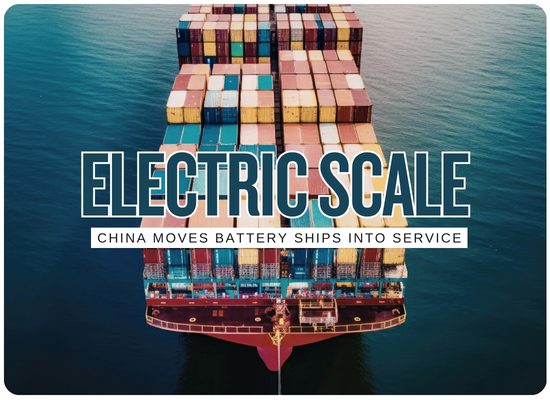
China’s electric ship rollout is moving beyond showcase vessels and into a larger commercial deployment phase, with recent market reporting showing the country’s electric cargo fleet expanding from four vessels in 2022 to 42 by 2025, while maximum vessel size has climbed from roughly 3,000 dwt to about 14,000 dwt and operating range has improved from the 150 to 400 km band toward as much as 500 km on some active vessels. The rollout is being reinforced by bigger containerized battery systems, inland and coastal routes that suit scheduled charging or battery swapping, and major battery suppliers moving from pilot projects into fleet-scale marine power packages. China’s first 10,000-tonne-class pure electric intelligent containership, Ningyuan Diankun, entered commercial service in April on the Ningbo-Zhoushan to Jiaxing route, with a 127.8-meter hull, 742-TEU capacity, and about 20,000 kWh of battery storage. CATL has also reported nearly 900 electric ships delivered and a broader ship-shore-cloud solution for zero-carbon waterborne transport, showing that China’s electric ship push is now combining vessels, batteries, ports, charging, swapping, digital systems, and inland waterway policy into one larger industrial rollout.
China’s electric ship market is moving into commercial deployment
The rollout is expanding from demonstration vessels into larger cargo ships, container feeders, battery-swapping models, and port-linked charging networks.
Electric cargo ships have multiplied quickly, with reported fleet growth from four vessels to 42 in only a few years.
The market is no longer limited to small harbor pilots, with active vessel sizes moving toward the 10,000-tonne and 14,000-dwt range.
Short-sea, inland river, coastal feeder, port shuttle, and fixed-route cargo services are the strongest near-term fit for battery-electric ships.
Charging speed, containerized battery swaps, shore power capacity, safety standards, and grid connection will decide how fast the model scales.
Battery systems, converters, thermal management, classification services, charging stations, software, and port electrical upgrades all move closer to procurement demand.
China electric ship rollout signal map
The table converts the latest electric-vessel expansion into practical signals for owners, ports, yards, suppliers, charterers, and financiers.
| Market signal | Current development | Commercial effect | Operator read | Next procurement focus | Signal level |
|---|---|---|---|---|---|
| Fleet scale | Electric cargo vessels have expanded quickly from a small base to a larger commercial fleet. | Electric shipping is moving beyond isolated demonstration projects. | Owners should treat battery-electric vessels as an active short-route option. | Screen fixed routes for payload, distance, energy cost, and charging access. | High |
| Vessel size | Maximum active vessel size has moved from small cargo ships toward much larger tonnage. | Larger vessels make the market relevant to cargo operators, not only ports and ferries. | Electric propulsion is gaining credibility in feeder, inland, and coastal cargo roles. | Compare battery layout, deadweight impact, and payload economics. | High |
| Operating range | Reported range is extending toward longer inland and coastal operating windows. | More routes become technically possible if charging points are reliable. | Range needs to be tested against load, speed, current, reserve, and port delays. | Model route energy with weather, waiting, auxiliary load, and battery degradation. | Watch |
| Containerized batteries | Standardized battery containers support charging and swapping models. | Battery handling can be integrated into existing port equipment, but safety requirements rise. | Swapping may reduce downtime where ports have enough power, cranes, and procedures. | Plan battery inventory, thermal controls, fire protection, and charging yard layout. | Strong |
| Port infrastructure | Charging and shore-side energy systems become central to vessel reliability. | Ports can compete on electric-vessel readiness, not only berth and crane capacity. | The port becomes part of the propulsion system. | Invest in grid upgrades, metering, berth power, cable handling, and safety zones. | High |
| Supplier ecosystem | Battery companies are offering broader ship-shore-cloud systems. | Procurement shifts from standalone equipment to integrated energy platforms. | Owners need clear responsibility across battery, charging, software, and maintenance. | Review warranties, service support, data access, class approval, and lifecycle cost. | Strong |
| Finance case | Higher capital cost can be balanced by lower fuel use and route-specific policy support. | Payback depends on utilization, power price, grants, carbon value, and maintenance savings. | The best candidates are high-frequency routes with stable cargo and repeatable energy demand. | Build a route-level ROI model before ordering or retrofitting vessels. | Watch |
| Deep-sea limits | Battery-electric ships remain strongest in inland, coastal, feeder, and fixed-route service. | Long-haul ocean replacement remains selective and technically harder. | Operators should avoid treating electric shipping as one universal answer. | Use batteries first where distance, schedule, and port access are controlled. | Medium |
Electric Route Readiness Calculator
A practical tool for estimating whether a cargo route is a strong candidate for battery-electric vessel deployment.
This route appears well suited for an electric vessel because distance, port energy access, and schedule predictability support repeatable operations.
We welcome your feedback, suggestions, corrections, and ideas for enhancements. Please click here to get in touch.