Hormuz VLCC Strike and Yanbu Projectile Attack Put Saudi Oil Export Routes Under Pressure
🔔 Subscribe to ShipUniverse Weekly →
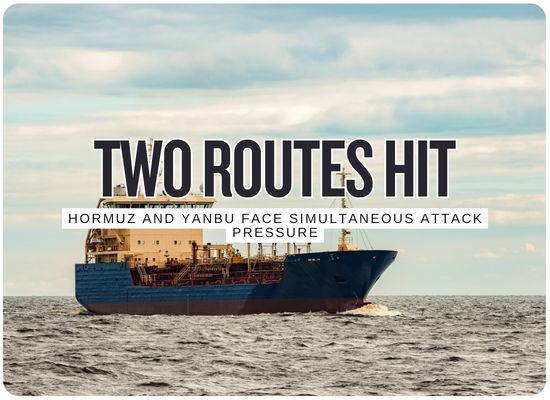
A Kuwait Oil Tanker Company VLCC was struck by an unknown projectile while transiting the Strait of Hormuz on Thursday, October 1, while a separate unidentified projectile landed inside Saudi Arabia’s Yanbu oil port on the Red Sea coast and temporarily interrupted tanker loading. UK Maritime Trade Operations said the Hormuz strike caused a fire but that the crew was safe; maritime security firm Vanguard Tech identified the vessel as the 317,250-dwt Kazimah III. At Yanbu, security reporting said a projectile caused a fire inside the port and briefly stopped loading involving a Liberian-flagged tanker before operations resumed. No public attribution for the Yanbu projectile had been confirmed by Saudi Aramco or Saudi port authorities at the time of reporting. The incidents put pressure on both sides of Saudi Arabia’s export strategy just days after Yanbu returned to service following the September 11 attack on the East-West Pipeline.
Two Corridors. Two Fires. One Day.
Saudi Arabia built export redundancy by combining Gulf loadings through Hormuz with East-West Pipeline flows to Yanbu. Fresh attacks now demonstrate that geographic diversification does not eliminate physical security exposure.
Kuwait Oil Tanker Company's Kazimah III was identified as the tanker struck by an unknown projectile while transiting Hormuz. UKMTO says the crew was safe; damage and environmental impact were still being assessed.
An unidentified projectile landed inside Yanbu port and caused a fire. Loading involving the reporting tanker was temporarily suspended and later resumed.
Attacks force the East-West Pipeline offline and halt crude exports from Yanbu.
Reduced-rate crude flow resumes toward the Red Sea coast.
KOTC VLCC is struck in Hormuz. Fire is extinguished and crew remain safe.
Mersin Prosperity, Sinbad and Al Ruwais are identified in another cluster of strikes.
A second KOTC VLCC in four days is struck while transiting Hormuz.
Projectile causes a fire and temporarily interrupts tanker loading on the Red Sea side.
Saudi Export Redundancy Stress Board
The two October 1 incidents did not close either export corridor, but they exposed the weakness in wartime rerouting: a route can avoid one chokepoint while remaining vulnerable to attacks on ships, terminals and pipeline infrastructure elsewhere.
| System | Latest Position | October 1 Event | Immediate Operational Effect | Why the Route Matters | Remaining Vulnerability |
|---|---|---|---|---|---|
| Strait of Hormuz | ACTIVE ATTACK ENVIRONMENT Kazimah III Hit | Unknown projectile struck a tanker identified by Vanguard Tech as Kazimah III, causing a fire. | Crew were reported safe. No closure of the strait was reported. | Kuwait, Qatar and most Iraqi export volumes lack a complete large-volume pipeline bypass. | Tankers remain exposed even with dark transits, escorts or reduced AIS visibility. |
| Yanbu Oil Port | LOADING RESUMED Fire Inside Port | An unidentified projectile landed within the port area and caused a fire. | Tanker loading was temporarily interrupted before operations resumed. | Yanbu allows Saudi crude to leave through the Red Sea without crossing Hormuz. | Avoiding Hormuz does not eliminate missile, drone or projectile exposure on the Red Sea coast. |
| East-West Pipeline | RECOVERING 2–2.65M b/d | The October 1 projectile was reported at the port, not as a confirmed new strike on Petroline itself. | No renewed pipeline shutdown had been publicly confirmed. | The approximately 1,200-km system carries eastern Saudi crude to the Red Sea. | It had only restarted after the September 11 attacks and remained below its previous operating rate. |
| Kuwait Oil Tanker Company | SECOND VLCC HIT 4 Days | Kazimah III follows the September 28 strike on KOTC VLCC Al Funtas. | Both incidents generated onboard fires, with crews reported safe. | Kuwait remains heavily dependent on Hormuz for seaborne crude exports. | Repeated strikes can affect voyage planning, security procedures and underwriting even without closure. |
| Regional Crude Network | VOLUME RECOVERED 16.5M b/d | The attacks arrive just as non-Iranian Gulf crude exports returned to roughly their pre-war average. | Neither October 1 incident immediately reversed the wider export recovery. | Roughly 40% of regional crude now uses Gulf of Oman or Red Sea outlets rather than Hormuz. | The system depends on multiple pipelines, ports, tankers and STS locations, creating multiple failure points. |
An incident affecting one corridor does not automatically stop all Saudi crude exports because Gulf and Red Sea outlets can operate in parallel.
Redirecting oil around Hormuz transfers risk toward pipelines, Red Sea terminals and another maritime theater rather than eliminating it.
October 1 put security pressure on the eastern and western sides of the diversification system during the same operating day.
Dual Export Corridor Disruption Analyzer
Model crude volume exposure when Saudi Gulf exports and Yanbu exports are disrupted separately or simultaneously.