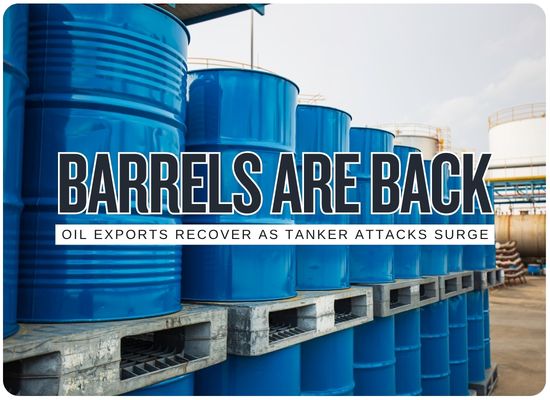
Middle East Oil Exports Exceed Pre-War Levels Even as Tanker Attacks Accelerate
🔔 Subscribe to ShipUniverse Weekly →
Middle East crude exports have moved above their pre-war average even as tanker attacks around the Strait of Hormuz accelerate. Provisional Kpler data put the region’s seven-day crude-export average at 18.3 million barrels per day on September 30, compared with roughly 18 million b/d during the 12 months before the war, with exports exceeding that benchmark on 14 days during September. Vortexa separately calculated a 14-day crude-and-condensate average of 18.6 million b/d, above its 10-year seasonal average. The recovery is being driven primarily by Saudi Arabia loading simultaneously from the Gulf and Red Sea and by renewed Iraqi tanker movements through Hormuz. But Marisks counted at least seven tanker incidents during the past week, including the October 4 projectile strike on the Liberian-flagged Lipsi, which damaged its engine room. The result is an unusual market: the barrels have returned, but moving them remains extraordinarily expensive and increasingly dangerous.
The Barrels Recovered. The Shipping System Did Not.
Middle East exporters have rebuilt crude supply to pre-war levels through a radically altered tanker network at the same moment attacks around Hormuz are accelerating.
The New Hormuz Equation
Exporters have solved much of the volume problem by creating a more complicated shipping system. The price is more tanker-days, more transfers, higher insurance exposure and a growing number of vessels operating inside an active attack environment.
| Signal | Latest Reading | Pre-War / Earlier Reference | What Changed | Shipping Consequence | Constraint Still in Place |
|---|---|---|---|---|---|
| Regional Crude Exports | ABOVE PRE-WAR 18.3M b/d | Approximately 18M b/d pre-war average. | Kpler's seven-day moving average exceeded the pre-war benchmark on September 30. | Tanker cargo availability has recovered sharply, supporting employment across VLCC and Aframax segments. | The export system remains dependent on rerouting, shuttle voyages, STS activity and elevated security procedures. |
| Vortexa Export Measure | PRE-CONFLICT LEVEL 18.6M b/d | Above the ten-year seasonal average. | Fourteen-day crude-and-condensate exports returned to pre-conflict levels. | Confirms the recovery is not limited to one short Kpler observation window. | Methodology and averaging window differ from Kpler and should not be directly combined. |
| Tanker Attack Frequency | ACCELERATING 7+ in One Week | Previous periods included longer intervals between successful strikes. | Marisks reported at least seven incidents during the latest week. | More vessels are now entering the same security environment because higher export flows require more tanker movements. | Attribution and individual targeting remain uncertain in several incidents. |
| Lipsi | ENGINE ROOM HIT Oct. 4 | Brand-new tanker delivered only weeks earlier. | Unknown projectile struck the Liberian-flagged vessel approximately 3.9 nm northeast of Jazirat Um Al Fayarin, Oman. | The engine-room damage demonstrates that strikes can impair propulsion rather than merely cause superficial deck damage. | Crew were reported safe and no casualties were reported. |
| MEG → Asia VLCC Earnings | RECORD RANGE >$1.2M/day | Approximately $30K/day in January. | Poten & Partners says recent VLCC rates exceeded $1.2M per day. | Owners are monetizing extreme scarcity, security exposure and inefficient tanker utilization. | A more efficient routing system could eventually reduce part of the extraordinary premium. |
| Shuttle Tanker Network | STRUCTURAL 63+ VLCCs | Before the war, almost no Gulf crude required offshore tanker changes. | Kpler says at least 63 VLCCs now work shuttle rotations; 35 form a core fleet. | Ships spend repeated cycles moving barrels between Gulf loading points and Gulf of Oman transfer locations instead of final buyers. | Transfer capacity at Fujairah and Sohar remains a physical bottleneck. |
| Freight Share of Delivered Barrel | LOGISTICS PREMIUM ~27% | Historically around 3%. | Freight has become a material component of delivered crude economics instead of a relatively minor cost. | High transportation costs can persist even when underlying crude supply improves. | Freight and insurance are unlikely to normalize until voyage patterns and vessel productivity normalize. |
| LNG Through Hormuz | RECOVERING September High | Highest monthly level since February. | More Qatar-linked LNG cargoes have begun appearing beyond Hormuz. | Gas-carrier traffic is gradually returning alongside crude tanker traffic. | Qatar lacks a meaningful LNG export bypass comparable with Saudi or UAE crude pipelines. |
Tanker Logistics Premium Analyzer
Compare normal and current freight economics for a VLCC cargo, then test how the rising logistics share changes the delivered value of a shipment.
We welcome your feedback, suggestions, corrections, and ideas for enhancements.
Please click here to get in touch