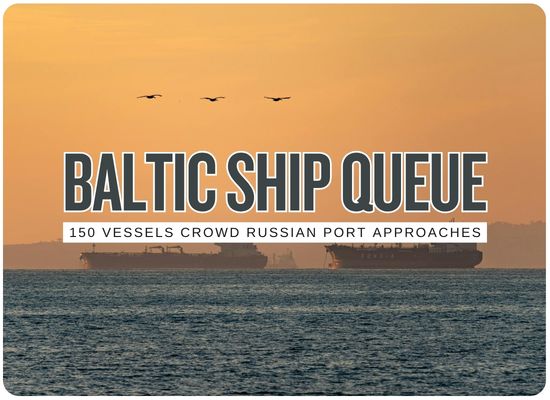
An unusually large concentration of ships has formed across the Gulf of Finland waiting for Russian Baltic ports, with Finnish newspaper Helsingin Sanomat counting as many as 150 Russia-bound vessels on September 30 using vessel-tracking data. The reported total comprised 65 tankers and 85 other cargo ships, with most associated with the Ust-Luga area and smaller groups bound for Primorsk and St. Petersburg. One visible line contained 46 ships and stretched more than 30 miles across the Gulf. Finland's Gulf of Finland Coast Guard confirmed that the number of vessels waiting for Russian ports is substantially above normal, although officials cautioned that the total changes quickly and such queues can dissipate. Separate congestion data show the pressure is highly concentrated: Ust-Luga recorded a 4.61-day median vessel wait for September 20–26, while St. Petersburg's median was only 0.31 day over the same period.
Gulf of Finland · September 30, 2026
A 150-Ship Queue Has Formed Around Russia's Baltic Gateways
The buildup stretches well beyond individual anchorages, with large clusters concentrated around Ust-Luga and a visible line extending more than 30 miles through the Gulf of Finland.
Helsingin Sanomat counted approximately 150 waiting ships on September 30. Finnish Coast Guard officials separately confirmed that the number waiting for Russian ports was substantially above normal.
65
Tankers
Roughly 43% of the reported queue, reflecting the continuing importance of Primorsk and Ust-Luga to Russian oil exports.
85
Other Cargo Ships
Bulk and general cargo traffic makes up the larger share of the reported waiting fleet.
Where the Pressure Is Concentrated
Baltic Sea
Incoming Russia-Bound Traffic
Ships enter the narrow Gulf of Finland corridor before separating toward major Russian terminals.
→
Main Congestion Zone
Ust-Luga / Laukaansuu
The largest visible concentrations were associated with this terminal complex, including oil, fertilizer, coal, bulk and newly redirected grain traffic.
→
Other Destinations
Primorsk + St. Petersburg
Additional waiting vessels were reported for both ports, although independent data show congestion is not equally severe at every Russian Baltic terminal.
Largest Reported Line>30 miles
A single formation of ships reportedly stretched more than 30 miles across the Gulf.
Ships in That Line46
Nearly one-third of the entire 150-vessel count appeared in one extended lineup.
Ust-Luga Median Wait4.61 days
Independent port-congestion data classified Ust-Luga as highly congested for September 20–26.
The 150 figure is a snapshot, not a fixed fleet count.
Finnish authorities say vessel numbers in the Gulf can change quickly, and not every vessel is necessarily anchored directly outside a terminal berth.
Black Sea Disruption → Baltic Congestion
The Queue Is Forming Inside a Much Larger Trade Rerouting
Russia is trying to place cargo into Baltic terminals faster than the existing transport chain was originally designed to absorb it.
How Export Pressure Moves North
01Black Sea Disruption
Port and vessel attacks reduce the reliability of Russia's dominant southern export corridor.
02Cargo Rerouted
Grain and other export flows are pushed toward Baltic and Arctic alternatives.
03Terminals Repurposed
Fertilizer, coal and general-cargo facilities begin handling commodities outside their traditional mix.
04Ships Accumulate
Marine arrivals outpace berth, terminal or landside processing capacity and vessel waiting time rises.
Supported by Current Evidence
What We Can Say
Approximately 150 Russia-bound vessels were counted waiting on September 30.
Finnish Coast Guard officials confirmed unusually heavy waiting traffic.
Russia is actively moving grain export activity toward Baltic terminals.
Ust-Luga's Ultramar terminal has been rapidly adapted to handle grain.
Ust-Luga recorded a 4.61-day median waiting time in late September.
Not Yet Established
What the Queue Does Not Prove
There is no public evidence that one terminal failure caused all 150 vessels to wait.
Sanctions or documentation delays have not been demonstrated as the primary cause.
The backlog does not mean every Russian Baltic terminal is operating at the same congestion level.
The vessel count can change rapidly as ships berth, depart or reposition.
Not every waiting tanker is necessarily laden with export cargo.
Same Region, Very Different Waiting Times
Ust-Luga
4.61 days
St. Petersburg
0.31 day
Navigation + Security Dimension
150 Waiting Ships Inside a Closely Monitored Waterway
The Gulf of Finland operates under the mandatory GOFREP reporting system jointly monitored by Finland, Estonia and Russia. Finnish reporting also identified some waiting vessels that appear on Ukrainian sanctions or vessel-risk lists. That increases monitoring and safety sensitivity, but it does not establish that sanctions screening caused the queue.
Ship Universe Queue Lock-Up Model
How Many Vessel-Days Can a 150-Ship Backlog Consume?
Convert a vessel queue and waiting-time assumption into ship-days, vessel-weeks and an illustrative operating-cost exposure.
vessels
days
US$ / day
User-adjustable scenario input, not an observed market rate for the waiting fleet.
ships / day
Assumes no additional vessels join the queue.
Vessel-Days Delayed
692
Queue size multiplied by the entered waiting-time assumption.
Equivalent Vessel-Weeks
98.8
Aggregate delay divided by seven days.
Illustrative Delay Cost
$17.29M
Vessel-days multiplied by the entered daily vessel-cost assumption.
No-New-Arrival Clearance
7.5 days
Theoretical time needed to process the queue at the entered daily clearance rate.
Reported Queue Composition
Tankers
65 · 43%
Other Cargo Ships
85 · 57%
Capacity Effect
Ship-Days Matter
Congestion does not destroy physical fleet capacity. It temporarily consumes it. A vessel waiting four or five days is a vessel that cannot complete another voyage during those same days, tightening effective supply even when the global fleet itself has not changed.
Illustrative scenario:
the 150-vessel count covers ships associated with several Russian destinations and the 4.61-day figure is Ust-Luga's late-September median waiting time. Applying that wait to every ship is a stress-test calculation, not a measured total delay. Daily vessel cost and clearance rate are adjustable assumptions.