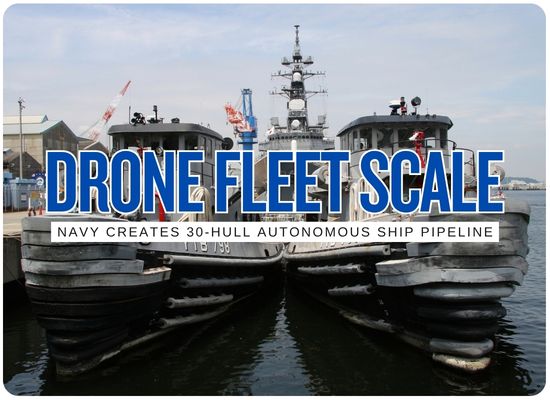
The U.S. Navy has ordered 30 Medium Unmanned Surface Vessels from three competing builders, awarding production Other Transaction Authority agreements to HII, Galliano Marine Services and Saronic Technologies for 10 vessels each following Phase I autonomy trials. The Navy lists an average procurement cost of about $40 million per MUSV, implying approximately $1.2 billion across the 30-hull procurement, although individual award values have not been disclosed. Production is beginning immediately in Louisiana, with the first vessels scheduled for delivery before the end of fiscal 2027. The award follows at-sea testing that required candidate vessels to operate for roughly 26 hours and more than 360 nautical miles with only a single command-and-control input during the endurance demonstration.
Medium Unmanned Surface Vessel · Production Phase
30 Hulls Changes the Scale of the Experiment
Instead of selecting one prototype and refining it for years, the Navy is putting three competing autonomous vessel families into parallel production.
Production Buy30Medium unmanned vessels
Ten hulls from each of three production awardees.
Average Procurement Cost$40MPer vessel
Navy-reported average. Individual vendor award totals were not disclosed.
Implied 30-Hull Scale~$1.2BAt the stated average
Mathematical fleet-wide implication rather than a separately announced Navy contract ceiling.
Three Builders · Three Production Lines
HIIROMULUS10 Hulls
HII is using a distributed Gulf Coast production network involving Breaux Brothers, Halimar Shipyard and fabrication partners.
GALLIANODesign Undisclosed10 Hulls
Galliano Marine Services, associated with Edison Chouest Offshore, won production after Phase I testing. Its selected design has not been publicly identified.
SARONICMARAUDER10 Hulls
The 180-foot autonomous vessel will be built from Saronic's expanding Franklin, Louisiana manufacturing base.
01
March 2026Marketplace Opens
Navy launches a faster acquisition model built around production-ready commercial technology.
02
May 2026Seven Designs Advance
Seven vendors move into the first round of at-sea evaluation.
03
Summer 2026Autonomy Tested
Candidates demonstrate perception, COLREG navigation and extended autonomous operation.
04
FY2027First Production Deliveries
Initial MUSVs are scheduled to reach the Navy before the fiscal year ends.
The Strategic Shift
Prototype Autonomy → Repeatable Fleet Production
Thirty vessels create enough physical inventory for the Navy to develop deployment cycles, maintenance practices, payload integration, operator training and manned-unmanned tactics at a scale that isolated demonstrators cannot provide.
Modular Payload Architecture
The MUSV Is Designed Around the Mission Deck
Instead of permanently fixing one sensor or weapon configuration to the hull, the Navy is pursuing vessels that can accept new mission payloads as technology and fleet requirements change.
One Hull · Multiple Potential Roles
Containerized mission space allows sensors, communications equipment, unmanned vehicles and other payloads to be changed without designing an entirely new ship class.
01ISR
Sensors and communications for persistent maritime surveillance and reconnaissance.
02Mine Warfare
Support for mine-countermeasure payloads and associated unmanned systems.
03Counter-UAS
HII identifies counter-unmanned-air-system missions among potential ROMULUS roles.
04Strike
Weapon integration is possible within the modular architecture, although Navy loadouts have not been publicly assigned.
05Drone Carrier
Launch and recovery of UUVs, UAVs and smaller unmanned systems extends the vessel beyond its own sensor horizon.
What Is Public About the Three Production Families
HII ROMULUS
10-vessel award
Production Activity
Five ROMULUS 151 hulls already reported under construction before the Navy award.
Autonomy
HII Odyssey Autonomous Control Solutions.
Phase I Demonstration
HII reports a 420-nm autonomous mission lasting 28 hours during Navy-monitored testing.
Mission Approach
Open architecture for sensors, weapons, AI algorithms and unmanned-system integration.
Galliano Marine Services
10-vessel award
Builder
Galliano Marine Services, associated with Edison Chouest Offshore.
Production Location
Houma, Louisiana.
Selected Design
Not publicly identified in the Navy award material reviewed.
Phase I
Successfully completed the Navy's at-sea testing requirements.
Saronic Marauder
10-vessel award
Length
180 ft
Published Range
5,400 nm at 25 MT base load.
Published Max Payload
150 metric tons.
Payload Arrangement
Up to four 40-ft ISO containers, eight 20-ft containers or alternative modular configurations.
Phase I Range Requirement2,500 nm
Required program range benchmark.
Speed Requirement25 knots
Required while meeting the Phase I vessel specification.
Payload Requirement25 MT
Carried in at least two 40-foot container positions.
Autonomy Test~26 hr
More than 360 nm with only one allowed C2 input.
Mission examples above should not be read as confirmed loadouts for all 30 production vessels. ISR, counter-UAS, mine countermeasures, strike and launch/recovery are published HII ROMULUS mission concepts. The Navy has emphasized modular integration rather than announcing fixed mission assignments for each hull.
Ship Universe MUSV Procurement Model
What Does a 30-Hull Autonomous Production Run Cost?
Model the procurement scale using the Navy's reported average vessel cost and test how a larger follow-on production tranche would change total program value.
vessels
$M / vessel
$40 million default is the Navy's reported average for the initial 30-vessel buy.
builders
Modeled Procurement$2.00B
Hull count multiplied by entered average procurement cost.
Average Hulls per Builder16.7
Simple equal-share scenario across the entered number of builders.
Current 30-Hull Baseline$1.20B
Implied value using 30 vessels at the stated $40 million average.
Increment vs. Current Buy+$0.80B
Difference between the modeled fleet and today's 30-hull procurement.
Current Production Distribution
HII
10
Galliano
10
Saronic
10
Phase II Is Already Open
10+ Days Unmanned
The next marketplace phase seeks vessels no longer than 90 meters with at least 10 days of unmanned operation and capacity for at least two 20-foot containerized payloads. That keeps the supplier base open even after the first 30 production awards.
Procurement scenario only:
the Navy has announced 30 production vessels at an average procurement cost of approximately $40 million each. The $1.2 billion figure is the mathematical implication of that average, not a separately disclosed aggregate contract value. Fleet sizes above 30 are hypothetical and do not represent announced Navy purchases.
Feedback Welcome
We welcome your feedback, suggestions, corrections, and ideas for enhancements.