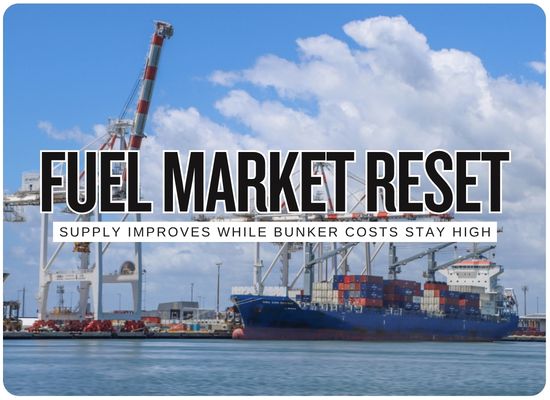
Global marine-fuel availability has improved substantially from the severe squeeze seen in March and April, but shipping enters the fourth quarter with fuel costs still elevated and unusually large differences between grades and bunkering hubs. On September 30, VLSFO was assessed at about $854/mt in Singapore, $681/mt in Rotterdam and $944.50/mt in Fujairah, while marine gasoil stood at $1,278.50, $1,400 and $1,675.50/mt respectively. Fujairah is receiving more fuel oil again, but its inventories remain roughly half pre-conflict levels and VLSFO is still described as tight. The outlook became more complicated on October 1 when China suspended most October refined-fuel exports to rebuild domestic inventories, while Brent crude climbed back to about $100/bbl.
Marine Fuel Market · October 1, 2026
Supply Has Recovered Faster Than Prices
The immediate global bunker shortage has eased, but the market that replaced it
is fragmented. Residual fuel supply is improving, marine gasoil remains extremely
expensive, and Middle East bunkering still carries a substantial regional premium.
Q4 Starting Position
High Price · Better Supply
Physical bunker availability is significantly better than during the spring
shock, but crude, refinery outages and middle-distillate scarcity are preventing
a return to pre-war fuel economics.
Brent · Oct. 1~$100/bbl
Crude rose about 2% after China suspended most October fuel-product exports.
20-Port VLSFO Average$860.50/mt
Major-port bunker prices remain substantially above normal pre-conflict levels.
20-Port MGO Average$1,522/mt
Middle distillates remain the most stressed mainstream marine-fuel segment.
20-Port HSFO Average$726.50/mt
Residual HSFO availability has recovered more strongly than VLSFO and MGO.
September 30 Bunker Snapshot
Singapore
World's largest bunker hub
VLSFO$854
MGO$1,278.50
HSFO$729
Rotterdam
Northwest Europe
VLSFO$681
MGO$1,400
HSFO$605
Fujairah
Middle East bunker hub
VLSFO$944.50
MGO$1,675.50
HSFO$656
Singapore MGO Premium+$424.50/mt
MGO premium over VLSFO, reflecting continuing distillate tightness.
Rotterdam MGO Premium+$719/mt
One of the clearest signs that Europe's diesel market remains heavily stressed.
Fujairah Scrubber Spread$288.50/mt
VLSFO minus HSFO, creating unusually strong economics for scrubber-equipped vessels.
Q4 risk has shifted:
the question is no longer simply whether ships can find bunker fuel.
The immediate risk is whether refinery outages, crude disruption and tighter diesel
exports keep specific marine grades, especially MGO and VLSFO blending components,
expensive even while headline fuel-oil availability improves.
Q4 Fuel Outlook · Conventional + Alternative Fuels
The Market Is Separating by Fuel Type
Residual fuels, middle distillates and alternative fuels are no longer moving
as one market. Refinery economics, regional supply and compliance costs are
increasingly determining which fuel has the strongest economics on a particular voyage.
VLSFO
HIGH / WATCH
Availability has improved globally, but low-sulphur blending components remain
exposed to Middle East supply disruptions. Fujairah remains notably more expensive
than Rotterdam.
Q4 Outlook
Easing is possible, but crude above $100 and regional supply risk argue against
a rapid return to pre-war prices.
MGO / LSMGO
HIGH
Diesel and middle-distillate markets remain exceptionally tight because of refinery
outages, lost Russian supply, Middle East disruption and strong competition from
road, aviation and industrial demand.
Q4 Outlook
Most exposed mainstream marine grade. China's October export suspension adds
another near-term supply constraint.
HSFO
IMPROVING
Supply has recovered faster than VLSFO in several hubs. Fujairah specifically
is now described as well supplied with HSFO.
Q4 Outlook
Wide VLSFO-HSFO spreads continue to strengthen scrubber economics,
particularly in the Middle East.
LNG
MIXED / BUILDING
Gas prices remain volatile because Qatari exports are impaired, but recent
Hormuz transits and softer European gas pricing have improved bunker economics.
Rotterdam LNG-MGOe stood at $1,193/mt on September 30 versus $1,400 for MGO.
Q4 Outlook
Increasingly competitive against distillate fuel for suitable engines,
but methane slip and compliance treatment remain important.
Biofuels
GROWING
B30 and B100 volumes are expanding, particularly in Rotterdam. FuelEU Maritime,
EU ETS and Dutch renewable-fuel incentives can materially alter the economics
compared with the raw delivered price.
Q4 Outlook
Strongest near-term low-carbon bridge for existing engines, but feedstock
pricing and compliance-credit values remain volatile.
Methanol
SELECTIVE
Bunkering infrastructure continues to grow, but 2026 newbuilding momentum has
shifted away from methanol toward LNG. Grey methanol remains commercially available,
while renewable methanol remains substantially more constrained.
Q4 Outlook
Strategic fuel rather than broad near-term bunker substitute. Green-methanol
supply and pricing remain the key constraints.
Ammonia
EARLY STAGE
Commercial vessel numbers remain small and bunkering infrastructure is still
in the demonstration and early deployment phase.
Q4 Outlook
Important long-term fuel pathway, but not yet a meaningful substitute for
conventional bunker demand in 2026.
August Alternative-Fuel Orders
52 Ships
DNV recorded the strongest month since October 2024.
LNG accounted for 46 of the 52 new orders.
LNG Capable942 + 705
942 vessels operating and another 705 on order in DNV's database.
Methanol / Ethanol159 + 293
Operating fleet plus current newbuilding pipeline.
Ammonia Capable5 + 41
Still a much smaller commercial fleet and orderbook.
Regulatory uncertainty remains part of the fuel outlook:
adoption of the IMO Net-Zero Framework was postponed in 2025. IMO's current
schedule calls for MEPC 85 from November 30 to December 3 and a possible resumed
extraordinary session on December 4, 2026. Until the final framework is adopted,
the long-term global price signal for low-GHG marine fuels remains unsettled.
Ship Universe Bunker Cost Tool
Bunker Port & Fuel Cost Analyzer
Compare September 30 bunker prices across Singapore, Rotterdam and Fujairah,
then calculate the fuel-cost difference across a voyage.
Primary Voyage Fuel Cost$768.6Kprice × burn × voyage days
Comparison Voyage Cost$1.15Madjusted by entered consumption factor
Voyage Cost Difference$382Kcomparison minus primary
Fuel Required900 mtprimary-fuel consumption over entered voyage
Voyage Cost Comparison
Use the consumption factor to account for different energy efficiency,
engine configuration or fuel consumption assumptions.
VLSFO
$768.6K
MGO
$1.15M
Entered Scenario
VLSFO Lower
Under the current assumptions, the primary fuel produces the lower modeled voyage fuel bill.
Cost screening only:
this tool compares published bunker price indications and user-entered fuel
consumption. It does not include scrubber capital costs, EU ETS, FuelEU Maritime,
methane slip, pilot fuel, biofuel certification, lubricants, port fees, availability,
emissions pricing or contractual bunker adjustments.
Feedback Welcome
We welcome your feedback, suggestions, corrections, and ideas for enhancements.