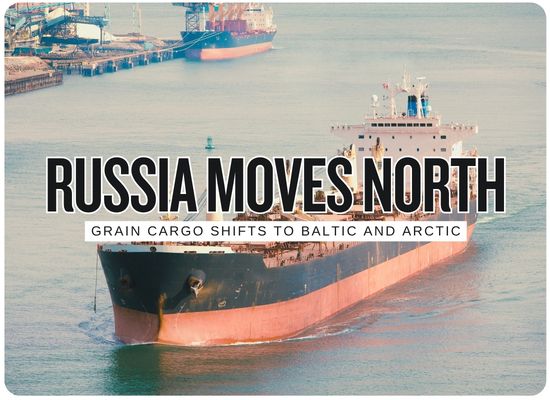
Black Sea Attacks Push Russian Grain North to Baltic and Arctic Ports
🔔 Subscribe to ShipUniverse Weekly →
Russian grain exporters are rapidly shifting cargo away from their traditional southern gateways after a series of Ukrainian drone attacks damaged terminals and grain-carrying vessels around Novorossiysk, Tuapse and the Sea of Azov. In the 2025-26 export season, Russia shipped 46.3 million tonnes of grain through Black Sea and Azov ports, nearly 90% of its seaborne grain exports. That dependence is now being reduced through Ust-Luga, Vysotsk and newly converted terminals in St. Petersburg, while the Arctic port of Murmansk is preparing to begin grain exports in October. Ust-Luga's Ultramar terminal, previously focused on fertilizer, received rail applications for about 260,000 tonnes of grain in September, while Russian Railways has approved the first 40,000-tonne grain movement from Stavropol to Murmansk. The shift is substantial, but northern capacity remains far smaller than the southern system it is being asked to replace.
Russia's Export Map Is Moving North
A grain system built around deepwater Black Sea terminals is being reconfigured around longer rail movements, Baltic bulk terminals and, for the first time, a meaningful Arctic export option.
Black Sea & Azov
46.3M t grain exported last seasonNearly 90% of Russia's seaborne grain exports moved through the southern system. Repeated attacks on terminals and grain vessels have reduced loadings and made shipowners increasingly reluctant to call.
Baltic Ports
260K t Ultramar rail requests in SeptemberUst-Luga, Vysotsk and St. Petersburg are taking cargo that previously moved south. Fertilizer and general-cargo terminals are being modified to accept grain without waiting for purpose-built new terminals.
Murmansk
40K t first approved rail shipmentThe year-round ice-free port plans to begin grain exports in October. Its ability to handle Panamax-class vessels gives exporters a large-ship outlet far from the Black Sea conflict zone.
The Grain Cargo Is Entering Ports Built for Other Commodities
Russia's immediate answer is not a new generation of grain terminals. It is adapting existing fertilizer, coal and general-cargo infrastructure while shifting rail capacity toward the northwest and Arctic.
| Port / Terminal | Previous Role | Current Grain Signal | Ship / Cargo Capability | Commercial Advantage | Main Limitation |
|---|---|---|---|---|---|
| Novorossiysk DISRUPTED | Russia's dominant deepwater grain export gateway. | NKHP and NZT were damaged in the August 12 attack and suspended operations. Other terminals continued only at reduced pace. | Large deepwater bulkers and established high-volume grain handling. | Short rail distance from major southern producing regions and established grain storage, inspection and loading infrastructure. | Attack risk, terminal damage, vessel availability and rapidly rising insurance and freight costs. |
| Ust-Luga · Ultramar CONVERTED | Large fertilizer terminal. Ultramar exported about 16 million tonnes of fertilizer last year. | Began handling grain in August. September rail applications reached roughly 260,000 tonnes, including grain destined for Egypt and Saudi Arabia. | Large modern bulk-handling complex with significant unused terminal capacity. | Existing conveyors, berths and rail infrastructure allow grain exports to start without building a completely new facility. | Grain must travel much farther by rail from southern production regions, increasing inland cost and rail-network pressure. |
| Vysotsk GRAIN ACTIVE | Baltic deepwater bulk port with existing dedicated grain infrastructure. | Russian Grain Union data put first-ten-days-of-September grain shipments at about 95,000 tonnes. | Deepwater terminal suitable for larger dry-bulk vessels. | Unlike the newly converted terminals, Vysotsk already has a grain-export operating chain. | Baltic capacity remains too small to absorb volumes normally shipped through the south. |
| St. Petersburg NEW GRAIN CARGO | Modul and BSMZ previously handled other cargoes rather than bulk grain exports. | Both terminals are now accepting grain. Modul is reported capable of handling up to 70,000 tonnes per month in containers. | Containerized and multipurpose cargo handling. | Rapid capacity addition without waiting for purpose-built grain elevators and shiploaders. | Containerized grain is generally more expensive than conventional bulk export logistics. |
| Murmansk ARCTIC ENTRY | Coal, ore and metals export port with total port capacity of up to 24 million tonnes annually. | Grain exports are expected to start in October. The first 40,000-tonne rail delivery from Stavropol has been approved. | Can accommodate Panamax-class ships and is ice-free year round. | Provides access to the Atlantic through northern waters and moves grain away from the Black Sea security zone. | The producing region-to-port rail haul is extremely long and there is not yet an established large-scale grain terminal system comparable with Novorossiysk. |
Black Sea Replacement Capacity Analyzer
Test how much northern export capacity would be required if part of Russia's 46.3-million-tonne Black Sea and Azov grain flow had to be permanently rerouted.
We welcome your feedback, suggestions, corrections, and ideas for enhancements.
Please click here to get in touch